




In today’s decreasingly complex enterprise networking geography, choosing the right access or distribution switch is consummate for reliability, scalability, security and future- proofing. In this detailed comparison, we examine two major players, the Cisco Catalyst 9300 series (frequently appertained to simply as “C9300”) and the HPE Aruba 2930F series, assessing their performance, features, strengths and limitations in 2025. Our blog at Jazz Cyber Shield is devoted to delivering in-depth reviews of enterprise IT and cybersecurity structure, so you can make informed procurement and deployment opinions.
Why this comparison matters
In enterprise networks, access/distribution switches are no longer just “connect devices”. They must handle high consistency of wired endpoints (PCs, VoIP phones, Wi-Fi access points, IoT) give PoE, support multigigabit and 10/ 25/ 40Gb uplinks, mound elegantly and offer strong security, robotization and cloud-operation features. Keywords like enterprise switch performance, stackable access switch, PoE, multigigabit switch, network robotization and secure wired structure are largely searched in 2025.
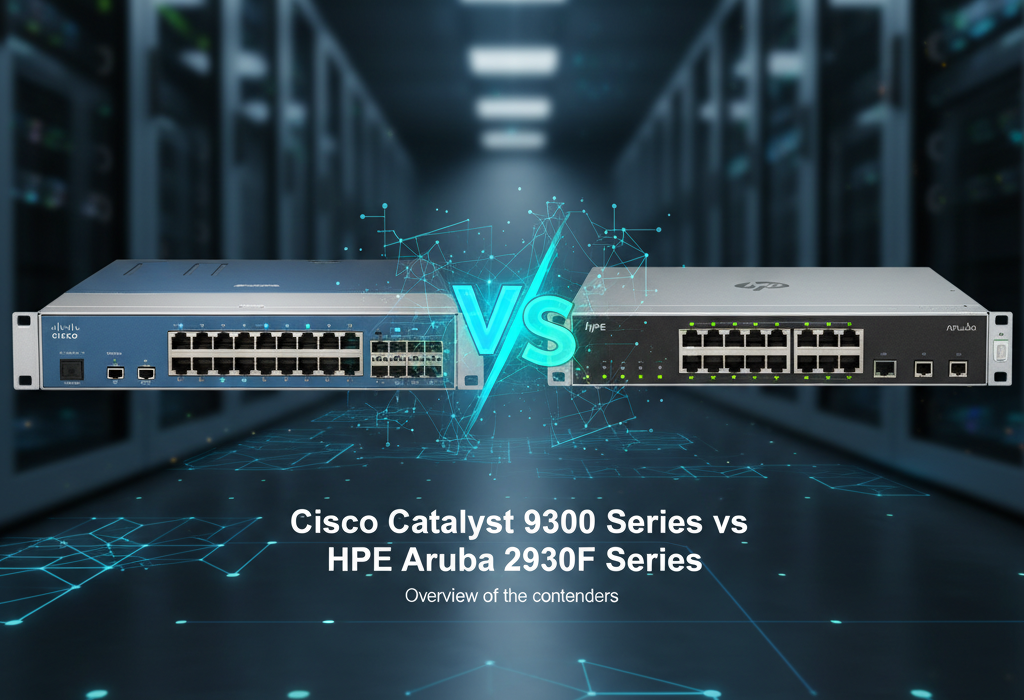
Overview of the contenders
Cisco Catalyst 9300 Series
The Catalyst 9300 series is Cisco’s flagship fixed-access, stackable enterprise switch platform. According to the Cisco data distance, it’s “erected tore-image connection, support security and review experience” for the hybrid workplace.
Key highlights
- Up to 1Tbps mounding bandwidth using Stack Wise-1T on certain models.
- Flexible uplink options 1 G, multigigabit (2.5/ 5G), 10G, 25G and 100G/40G modules.
- High PoE/ UPoE support (including 90W per port models) for high-power devices.
- Rich software features open APIs (NETCONF/ RESTCONF/ gNMI), advanced security (IPsec 100G tackle on C9300X models) and integration with Cisco DNA and Meraki ecosystems.
- Broad enterprise ecosystem, strong support and large install base.
HPE Aruba 2930F Series
The Aruba 2930F series is deposited as a high-value L3 access switch with mound-capability and ultramodern features, suitable for mobile-first digital workplaces. From the Aruba datasheet “Designed for guests creating smart digital workplaces that are optimized for mobile users.”
Key highlights
- Subcaste 3-point set (static routing, RIP, OSPF, IPv6) without fresh software licensing.
- Uplinks of 1GbE or 10GbE erected-in; PoE support up to 740 W (for certain models)
- Mounding support via VSF (Virtual Switching Framework) for up to 8 members.
- Emphasis on ease of deployment (Zero-Touch Provisioning), cloud-based operation (Aruba Central) and integration with Aruba Clear Pass and Air Wave.
- Strong value proposition in price- performance.
Performance comparison
Now let’s compare them head-to-head on crucial parameters that count for enterprise deployments.
1. Switching stacking capacity
- The Catalyst 9300 supports stacking bandwidth up to 1Tbps (on C9300X models with Stack Wise-1T) and over to eight switches in a mound.
- The Aruba 2930F supports mounding (via VSF) with up to 8 members as well.
- While both support 8-member heaps, Cisco offers significantly advanced stacking bandwidth and uplink inflexibility — profitable for high- viscosity, high-outturn enterprise networks.
2. Uplink and multigigabit ports
- Catalyst 9300 Supports 1G, 2.5/ 5G multigigabit, 10G, 25G, 40G, 100G uplinks depending on model.
- Aruba 2930F Offers erected- in 1GbE or 10GbE uplinks on numerous models; multigigabit support is more limited.
- Verdict Cisco leads in uplink inflexibility and coming-generation speeds (25G/ 100G) which makes it more unborn-evidence for high bandwidth scripts.
3. PoE/ UPoE and power budget
- Cisco 9300 Offers 90W UPOE on 48- ports models, allowing high-power devices (e.g., Wi-Fi 6/ 6E access points, cameras) to be powered.
- Aruba 2930F Models support up to 740W PoE budget in 48- ports variants.
- Verdict Both support strong PoE budgets; Cisco’s UPoE with 90W per harborage may offer an edge for extreme edge use-cases (IoT, smart- structures). For standard enterprise access PoE, Aruba holds over well.
4. Feature set: Layer 3, security, management
- Cisco 9300 expansive point set including open APIs, advanced telemetry (flows up to 64k/ 128k), integration with Cisco DNA and Meraki.
- Aruba 2930F Solid L3 support (OSPF, RIP, IPv6), ACLs, VSF mounding and cloud-operation via Aruba Central. Still, some users note CLI limitations.
- Verdict Cisco has the richer enterprise point set for larger, complex networks taking advanced robotization and security. Aruba offers sufficient features for numerous enterprise access deployments at a lower cost.
5. Total cost of ownership (TCO) and value
- Aruba 2930F is generally more affordable than the Cisco 9300 in numerous deployments. Numerous sources note that Aruba delivers good performance at a lower cost.
- Cisco’s decoration comes with decoration features, ecosystem, support and brand, which may justify the cost in demanding surroundings.
- Verdict if budget is constrained and needs moderate; Aruba is a strong value. However, mounding viscosity, uplinks and long-term investment, if you need highest performance.
Real- world feedback
From stoner forums, one mastermind in r/ networking comparing Catalyst 9300 vs Aruba 2930F wrote
“I’ve looked at the Cisco Catalyst 9300, the HPE Aruba 2930F The Aruba switches feel to be a better deal.”
This reflects a common view for many access- subcaste deployments, Aruba offers “good enough” performance and mounding at a more attractive cost.
Deployment scenarios & recommendation
Use- case large enterprise lot or high- viscosity terrain
Still, need high uplink speeds (25G/ 40G/ 100G), expect to scale and require rich robotization/ telemetry/ security — also Cisco Catalyst 9300 is the better choice, if you have numerous multigigabit devices (Wi-Fi 6/ 6E access points).
Use-case Standard enterprise access subcaste or branch office
Still, stacking up to 8 units, PoE (or moderate high-power PoE), if you need solid Subcaste 3 access switches.
Use- case Mid-sized enterprise with moderate growth
Depending on budget, you may conclude for Aruba now and plan for Cisco latterly, or mix infrastructures depending on edge vs core access.
Why choose Jazz Cyber Shield for your network insights
At Jazz Cyber Shield, we specialize in enterprise networking and cybersecurity– offering detailed performance reviews, deployment tips and buying guidance. Whether you’re looking at switching structure, secure lot access or wired/ wireless convergence, our papers deliver practicable perceptivity. We keep pace with 2025 networking trends like climate- apprehensive power budgets, multigigabit access, Wi-Fi 6E and Wi-Fi 7 readiness and robotization/ AI in network operations so you can trust our reviews when making strategic IT opinions.
Final verdict
Both the Cisco Catalyst 9300 and HPE Aruba 2930F are strong enterprise switch families. However, throughput, uplink performance, if your terrain demands maximum scale. However, access to subcaste demands is moderate, and value is a key driver — Aruba offers compelling performance, if your budget is tighter. In 2025, balancing performance, cost and future- readiness means assessing your network needs. Use this review to guide your switch selection and long-term strategy.

