



Quantum computing is progressing much quicker than anticipated, and now the cybersecurity experts have come up with a rather serious question: Is it that modern encryption has become a thing of the past in the world of quantum computers? Presently, the encryption still secures the confidentiality and integrity of the online banking, cloud storage, chat apps, blockchain networks, and even the government systems. On the contrary, the menace of quantum computing could possibly uncloak the existing encryption standards in the near future. Hence, the necessity to discuss quantum computing security risks, encryption safety, and post-quantum cryptography comes up. In this article, we will discuss the impact of quantum computing on encryption, the reasons for the current methods to fail, and how the world is ready for quantum-safe security.
What Is Quantum Computing and Why It Changes Everything
The essence of quantum computing lies in qubits as the basic units of information instead of classical bits and this very difference is what makes quantum machines enormously powerful. The ability to execute several calculations at the same time distinguishes quantum computers from the traditional ones. As a result, complex mathematical problems can be solved much faster. Among the problems that quantum power will be able to solve, there are the ones that currently Protect the encryption algorithms like RSA and ECC. The thing is, the quantum power ascension could result in the weakening of such protective mechanisms.
Moreover, quantum computing takes advantage of superposition, entanglement, and quantum parallelism, which collectively produce exponential speed in processing. Hence, the encryption methods which were thought to be unbreakable might turn out not to be so in the near future. Quantum computing, therefore, is a dawn of a new era in cybersecurity and encryption technology.
The Working of Modern Day Encryption
The encryption of today makes use of the cryptographic algorithms that are based on the complex mathematical theories to keep the data safe. The popular method of encryption that is currently used the most consists of the RSA, AES, and ECC. These are the algorithms that darkness the data transmission over the internet, through the virtual private networks, in the emails, in the digital wallets, and in the enterprise networks. No classical computer available today can manage to break these systems in the span of a few realistic hours.
On the other hand, quantum computing is a game-changer. A quantum attack could potentially succeed within minutes or hours while a classical attack would take millions of years. Thus, modern encryption is still secure at the moment but maybe not so in the very near future. Hence, the experts in the field of cybersecurity are of the opinion that the new kinds of machines have to be first matured before the current encryption is phased out.
The Threat from Quantum Computers is Maximum to Public-Key Encryption
One of the major areas affected by this threat is public-key encryption. The RSA and ECC algorithms are based on the factorization of large integers or solving discrete logarithms. These are difficult tasks for conventional computers. However, quantum computers with Shor’s algorithm can solve these problems at a much faster rate. Very soon, the RSA and ECC would suffer fates of being relegated to the past if the large scale of quantum computers comes into existence.
Symmetric Encryption is More Robust but Not Invulnerable
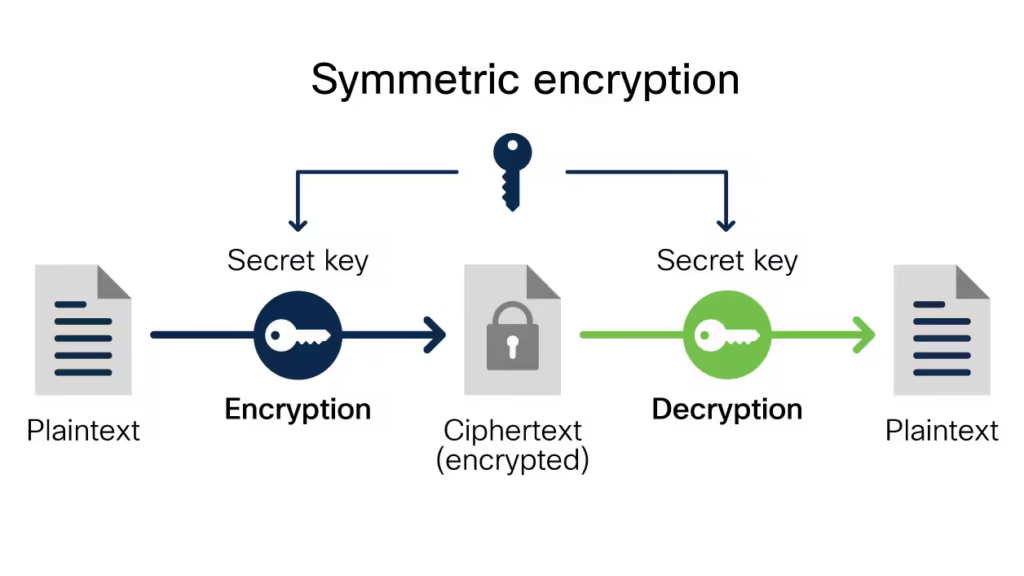
Take AES-256 for instance, symmetric encryption is able to survive quantum attacks. However, it is not totally invulnerable. Quantum computer employing Grover’s algorithm can, therefore, reduce the strength of a cipher to half. For that reason, in a quantum world, AES-256 could be seen as having the same security level as that of AES-128.
Nevertheless, AES-256 continues to claim an outstanding level of security for the time being. Notwithstanding, the security analysts advise larger key sizes, better key management, and even quantum-resistant innovations as the way forward. Thereby, symmetric encryption will outlive public-key encryption, yet it still demands a future makeover.
The “Harvest Now, Decrypt Later” Cybersecurity Threat
The harvest now, decrypt later quantum computing threat is one of the most devastating ones. Cybercriminals can take today’s encrypted data and store it for later decryption when the time comes, i.e., when quantum computers become so strong that they can break the encryption used.
The mentioned threat poses the highest risk to the most confidential data like medical records, financial details, state secrets, and patents. Consequently, the protection of such data not just for the present but also for the future is a necessity. In this way, the demand for quantum-resistant encryption has been acknowledged by all sectors, especially the low-security ones.
Post-Quantum Cryptography: The Future of Encryption
By the invention of post-quantum cryptography (PQC), the researchers managed to secure quantum attacks. The new algorithms cannot be broken by either classical or quantum computers. They are based on mathematical issues that quantum computers will not crack easily.
Lattice-based cryptography, hash-based signatures, and code-based encryption are among the quantum-resistant algorithms that are already recognized by the main standardization bodies. These new standards are intended to gradually suppress RSA and ECC.
Hybrid Encryption and Quantum-Safe Migration
It is a lengthy process to change to post-quantum encryption. Hence, hybrid encryption models are recommended by many experts as the best solution. These systems combine classical encryption with quantum-safe algorithms. This method enables backward compatibility along with security improvement.
Besides, some companies are considering quantum key distribution (QKD) for super-secure communication. Although QKD is still costly, it has been identified as a potential candidate for infrastructure and government sectors. Consequently, hybrid and layered security approaches will govern the encryption’s future.
Why Businesses Must Prepare for Quantum Threats Now
The companies have no choice but to act quickly. The threats of quantum computing are present in the aspects of finance, healthcare, cloud services, blockchain, and even the security of nations. The organizations that fail to migrate to quantum-safe practices will have to bear the costs of massive data loss and even face regulatory penalties.
On top of that, the compliance standards may soon require businesses to be equipped with post-quantum security. First movers will be able to build trust with customers, become more robust, and eventually get a competitive advantage. The “it’s too early” approach to quantum-resistant encryption is therefore a mere misconception.
What Individuals Can Do to Stay Secure
Quantum risks can be reduced even by individuals who take certain measures. The users are advised to go for the services that utilize strong encryption standards, long key lengths, and forward secrecy. Moreover, the users are empowered to make better security choices by being aware of quantum-safe technology.
Quantum computers might not be every day, but just the awareness today can save one from the damage tomorrow. As a result, the adaptation of individuals and businesses will have to happen at the same time.
Conclusion – Is Modern Encryption Still Safe?
Modern encryption is now safe but not for eternity. Quantum computers will eventually overpower the conventional cryptography. Amongst the different types of cryptography, public-key cryptography which is predominantly used will be the first to fall. But still, there are post-quantum cryptography, hybrid security models, and early migration strategies that very clearly lead us forward.
The future of encryption lies in the hands of the users. If the organizations take early actions and make wise upgrades, encryption will still be robust in the quantum era.
Frequently Asked Questions (FAQ)
1. Are quantum computers really going to destroy the encryption used nowadays?
Futurology has it that quantum computers will not only be able to do that but also use Shor’s algorithm for RSA and ECC as well. Nonetheless, encryption currently in use is still unbreakable.
In what time frame the quantum computing can significantly impress into the realm of cybersecurity cases?
Time experts while making the predictions claim that we will be facing serious threats in the next 10-15 years, nonetheless, data that has been stolen today might be decrypted tomorrow.
3. Should companies wait before making encryption changes?
Certainly not. Quantum-safe encryption technologies adopted early can meanwhile minimize the threat of long-term security and compliance shortcomings.

