



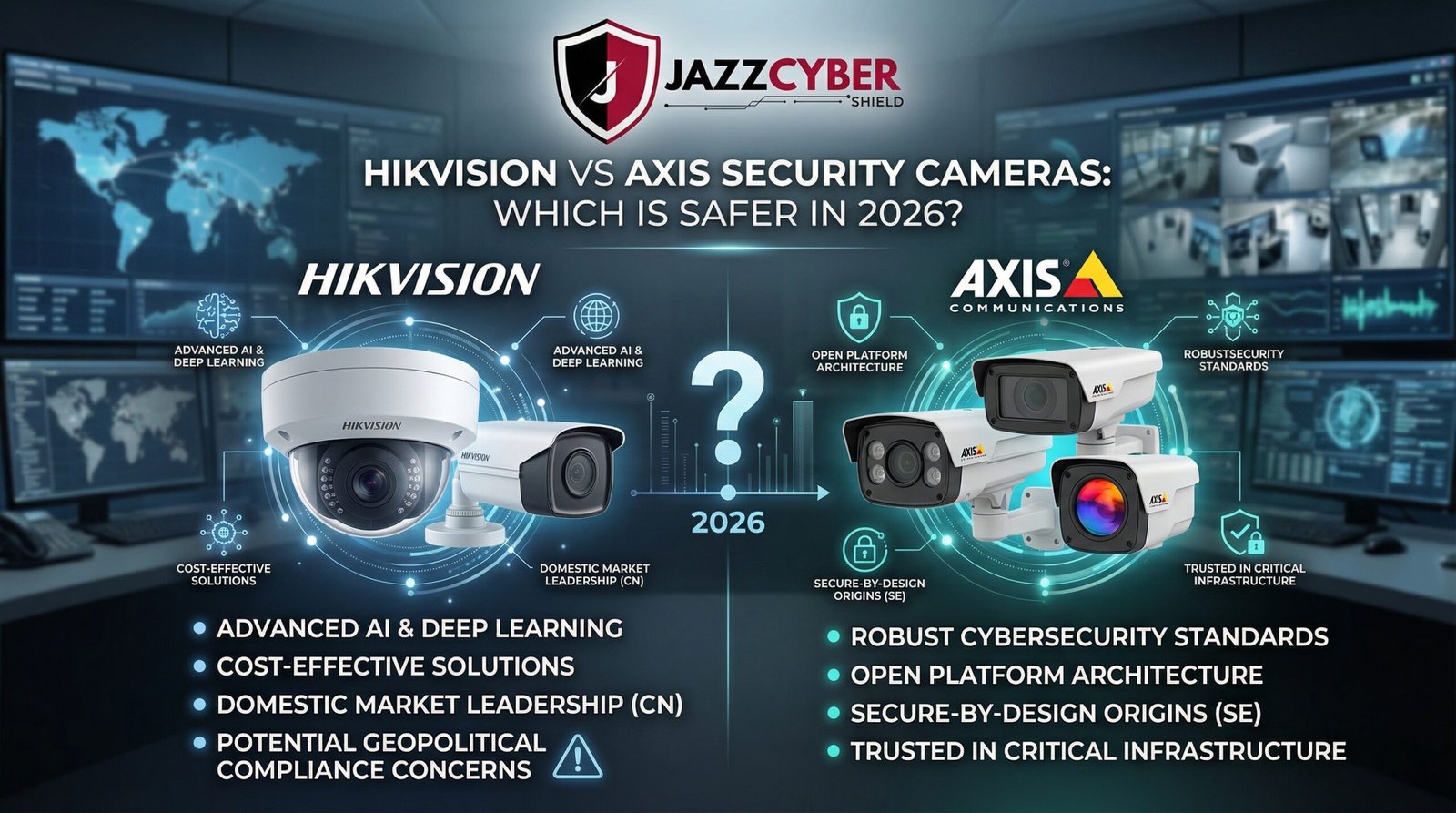
If you’re deciding between Hikvision vs Axis security cameras in 2026, you’re not just comparing resolution specs or night vision ranges — you’re making a decision that directly impacts your physical security, your data privacy, and potentially your compliance with government regulations.
Both brands dominate the global IP camera market, but they couldn’t be more different when it comes to cybersecurity posture, firmware transparency, and enterprise trustworthiness. In this in-depth comparison, we break down everything you need to know before buying.
🔴 Recent Topic: Hikvision Under Fire Again in 2026
To begin with, in early 2026, the ongoing U.S. federal scrutiny of Chinese-manufactured surveillance technology has intensified. Specifically, the FCC’s Covered List continues to restrict federal procurement of Hikvision products, citing national security risks tied to Chinese government data-sharing laws. As a result, several state governments and enterprise IT departments have moved to ban Hikvision hardware entirely. Furthermore, many organizations are now actively phasing out existing Hikvision infrastructure to align with new federal compliance standards.
Meanwhile, Axis Communications — headquartered in Lund, Sweden — has been actively expanding its cybersecurity certifications and partnerships with U.S.-based security integrators, positioning itself as the trusted alternative.
This context makes the Hikvision vs Axis security cameras debate more important than ever in 2026.
What Is Hikvision?
Hikvision is a Chinese state-owned enterprise (SOE) and the world’s largest video surveillance manufacturer by revenue. Founded in 2001, it holds approximately 24% of the global video surveillance market. Its cameras are known for being affordable, feature-rich, and widely available — but they carry significant baggage in terms of geopolitical risk and cybersecurity vulnerabilities.
If you still want to explore Hikvision products, you can browse Hikvision Security Cameras at Jazz Cyber Shield.
What Is Axis Communications?
Axis Communications, founded in Sweden in 1984, pioneered the world’s first network camera in 1996 and has since set the standard for IP-based video surveillance. Axis is now a subsidiary of Canon and is widely regarded as the gold standard for enterprise-grade, cybersecure surveillance. Their cameras are used by governments, hospitals, data centers, airports, and Fortune 500 companies worldwide.
You can explore the full range of Axis Communications Security Cameras at Jazz Cyber Shield, including the popular AXIS M3065-V 2MP Compact Dome Camera — an excellent entry-level enterprise camera.
Hikvision vs Axis Security Cameras: Head-to-Head Comparison
1. Cybersecurity & Firmware Integrity
This is the most critical differentiator in 2026.
To begin with, Axis Communications operates with a Security Development Lifecycle (SDL) framework, meaning security is baked into every stage of product design. In addition, their firmware is built on a hardened Linux kernel and is regularly audited by third parties. Furthermore, they follow responsible disclosure practices to ensure maximum transparency. Ultimately, Axis provides signed firmware updates with SHA-256 hashing to prevent tampering.
Hikvision, on the other hand, has a documented history of critical CVEs (Common Vulnerabilities and Exposures). In 2021, the U.S. CISA issued an advisory (CVE-2021-36260) warning of a critical 9.8/10 severity command injection vulnerability in Hikvision cameras that allowed unauthenticated remote code execution. While Hikvision released a patch, millions of cameras remained unpatched globally. In 2026, similar concerns persist around the transparency of their firmware source code and the risk posed by Chinese government compelled data access laws.
Winner: Axis Communications — by a significant margin.
If you’re concerned about how hackers target IP cameras generally, read our detailed guide: How Hackers Break Into Security Cameras (And How to Protect Yours).
2. Image Quality & Video Analytics
Axis cameras offer industry-leading image quality with their proprietary ARTPEC chip series. The ARTPEC-8 processor (used in current-gen Axis cameras) enables deep learning-based AI analytics natively on the camera, including license plate recognition, people counting, and behavior detection — all processed on-device without sending raw video to the cloud.
Hikvision also offers impressive image quality at a lower price point. Their DarkFighter and ColorVu technologies provide excellent low-light performance. Hikvision cameras also support AI analytics, but the brand often ties enterprise-grade deep learning features to its NVR ecosystem or Hik-Connect cloud platform. This connection raises additional data sovereignty concerns.
Winner: Axis for enterprise analytics. Hikvision wins on value for basic surveillance.
3. Network Security Architecture
Axis cameras support IEEE 802.1X port-based network access control, TLS 1.3 encryption, HTTPS enforcement, and SRTP for encrypted video streams. Their AXIS OS (formerly known as AXIS Camera Firmware) receives regular security patches and has a published vulnerability disclosure program.
Hikvision cameras support HTTPS and some level of encryption, but their default configurations have historically shipped with weak settings. Many Hikvision deployments still operate over unencrypted RTSP streams, especially in budget-conscious installations.
For businesses building a secure infrastructure, securing your cameras is only part of the equation. You also need a properly segmented network — read How to Set Up a Completely Secure Home Network From Scratch (2026 Guide) to understand how VLANs and firewalls protect your camera networks. You can also pair your camera system with enterprise-grade Firewalls from Jazz Cyber Shield for a complete network defense posture.
Winner: Axis Communications
4. Regulatory & Compliance Standing
Axis Communications cameras are NDAA (National Defense Authorization Act) compliant and are approved for use in U.S. federal government facilities. They hold certifications including UL, CE, FCC, and are compliant with GDPR and various data protection frameworks globally.
Hikvision is explicitly named in Section 889 of the 2019 NDAA, which prohibits U.S. federal agencies from purchasing Hikvision equipment. They remain on the FCC’s Covered List and are subject to ongoing export restrictions. For private enterprises, there’s no current blanket ban, but insurance providers and compliance auditors are increasingly flagging Hikvision deployments as risk factors.
Winner: Axis Communications — especially for regulated industries (healthcare, finance, government, education).
5. Ease of Integration & Ecosystem
Axis cameras are designed around open standards. They support ONVIF Profile S, G, T, and M, making them compatible with virtually every major VMS (Video Management System) including Milestone, Genetec, Hanwha Wisenet Wave, and more. Axis also has a rich ACAP (Axis Camera Application Platform) ecosystem for third-party analytics apps.
Hikvision’s ecosystem is functional but more proprietary. Their cameras work best within the Hikvision/Hik-Connect ecosystem, and while ONVIF compatibility exists, third-party VMS integration can be inconsistent across firmware versions.
Winner: Axis for enterprise integration. Hikvision for cost-effective closed-loop deployments.
6. Price & Total Cost of Ownership
This is where Hikvision genuinely wins. A comparable Hikvision IP dome camera typically costs 40–60% less than an Axis equivalent. For large-scale deployments with hundreds of cameras, this difference is significant.
However, the total cost of ownership (TCO) tells a different story. In addition, Axis cameras typically offer longer support lifecycles, more consistent firmware update schedules, and a lower risk of sudden regulatory obsolescence. Consequently, organizations that invested heavily in Hikvision and faced government mandates to “rip and replace” learned this lesson the hard way.
Winner: Hikvision on upfront cost. Axis on TCO.
7. Support & Warranty
Beyond the hardware, Axis Communications provides a standard 3-year warranty on most camera models. Moreover, the company facilitates global technical support through an extensive partner network to ensure minimal downtime. In light of this, their partner program (Axis Application Partner Program) remains highly regarded by IT departments seeking long-term reliability.
Hikvision offers competitive warranties but support quality varies by region and reseller.
Winner: Axis Communications for enterprise support structure.
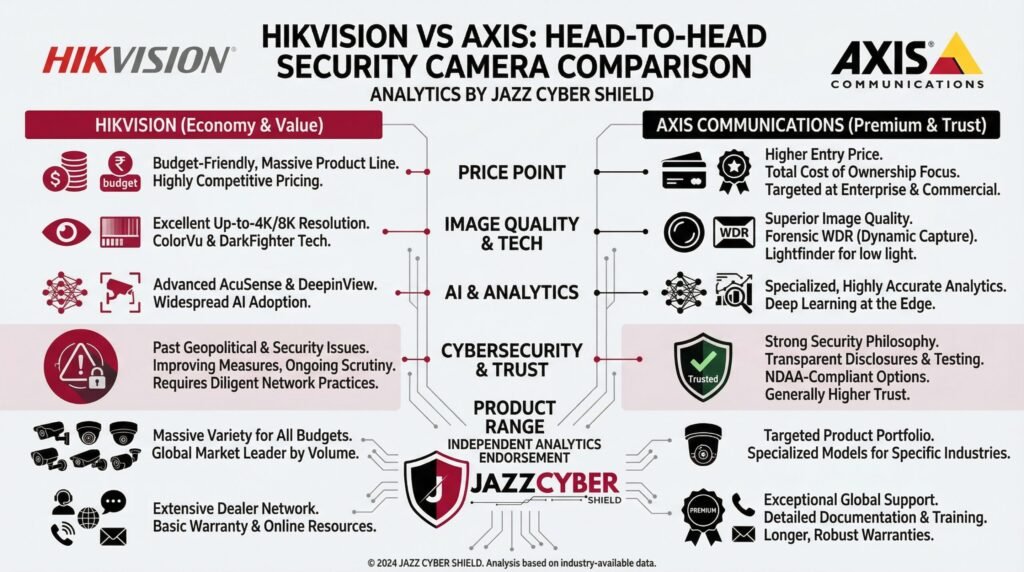
Quick Comparison Table
| Feature | Hikvision | Axis Communications |
|---|---|---|
| Cybersecurity Track Record | Poor (Multiple CVEs) | Excellent (SDL framework) |
| Firmware Transparency | Low | High |
| NDAA Compliance | ❌ No | ✅ Yes |
| AI Analytics | Good | Excellent (ARTPEC-8) |
| Encryption Support | Basic | Advanced (TLS 1.3, SRTP) |
| ONVIF Integration | Moderate | Excellent |
| Price | Low | Premium |
| Total Cost of Ownership | Higher risk | Lower long-term risk |
| Government Use | Banned (U.S. Federal) | Approved |
| Recommended For | Budget deployments | Enterprise & regulated sectors |
Which Should You Choose in 2026?
Choose Axis Communications if:
- You operate in a regulated industry (healthcare, education, government, finance)
- Cybersecurity and data sovereignty are non-negotiable
- You need long-term firmware support and compliance assurance
- You’re integrating with a professional VMS platform
- You’re a U.S. government contractor or receive federal funding
Choose Hikvision if:
- You operate in a private, non-regulated environment
- Budget is the primary constraint
- Your deployment is completely isolated from external networks
- You have experienced IT staff who can harden configurations and monitor for CVEs
⚠️ Jazz Cyber Shield Recommendation: For any enterprise, SMB, or government-adjacent deployment in 2026, we strongly recommend Axis Communications security cameras. The cybersecurity risk profile of Hikvision has only grown more complex, and the regulatory tide is moving firmly against Chinese-manufactured surveillance hardware in North America and Europe.
How to Secure Whichever Camera System You Choose
Regardless of which brand you select, proper network security is essential. Our recent guide on security camera hacking and how to stop it walks through the exact attack vectors hackers use and how to mitigate them. Key steps include:
- Change all default credentials immediately after installation
- Isolate cameras on a dedicated VLAN (learn more: What Is a VLAN and Why Every Home Network Needs One in 2026)
- Enable HTTPS and disable unencrypted RTSP
- Keep firmware updated on a scheduled basis
- Deploy a hardware firewall between your camera network and your corporate LAN
- Use network switches with 802.1X support to enforce port-level access control
Frequently Asked Questions
Q1: Is Hikvision banned in the United States in 2026? Hikvision is not banned for private use in the U.S. However, it is prohibited for U.S. federal government agencies under Section 889 of the NDAA and remains on the FCC’s Covered List. Private enterprises, contractors with federal ties, and publicly funded institutions should avoid Hikvision due to compliance and insurance risk.
Q2: Are Axis cameras worth the higher price? Yes, for enterprise and regulated environments. Axis cameras deliver superior cybersecurity architecture, longer firmware support lifecycles, and NDAA compliance. The premium price is justified when you factor in risk mitigation, regulatory compliance, and long-term operational costs.
Q3: Can Hikvision cameras be made secure? You can harden Hikvision cameras through specific configurations: change default passwords, disable UPnP and cloud connectivity, enable HTTPS, and isolate them on a VLAN. However, these configurations cannot fully mitigate the underlying risks from undisclosed firmware vulnerabilities and Chinese government data access obligations.
Q4: Do Axis cameras work with third-party VMS platforms? Yes. Axis cameras support ONVIF Profile S, G, T, and M, making them compatible with virtually all major VMS platforms including Milestone XProtect, Genetec Security Center, Hanwha Wisenet WAVE, and many others.
Q5: What Axis cameras does Jazz Cyber Shield sell? Jazz Cyber Shield carries a curated range of Axis Communications cameras including the AXIS M3065-V 2MP Compact Dome Camera and more. Browse the full Axis security camera collection for current pricing and availability.
Q6: How often should I update security camera firmware? Best practice is to check for firmware updates at least quarterly. Critical security patches should be applied immediately upon release. Read our guide on how hackers exploit unpatched security cameras to understand why timely patching matters.
Published by Jazz Cyber Shield | Your Cyber Defense Partner — Hardware, Firewalls & Security Solutions 🌐 Store: jazzcybershield.com | 📰 Blog: blog.jazzcybershield.com

