



Nowadays, it is a must for every company to think of cyber safety as the primary and first concern. As a result, organizations have to secure their IT setup against the ever-increasing number of cyber threats. Besides that, the selection of firewall solution is crucial in the entire security process. In this article, we will discuss hardware firewall vs. cloud firewall, concentrating on cost comparison, security features, and business use cases. Jazz Cyber Shield is the place where organizations acquire modern, trustworthy, and scalable network security solutions.
What Is a Hardware Firewall?
A hardware firewall is a physical security device that guards a network from outside threats. It is positioned between your internal network and the internet. Consequently, it screens the incoming and outgoing traffic before data gets to your systems. On top of that, it denies the entry of unauthorized users and also lessens the chance of attacks.
Furthermore, hardware firewalls supply security at the perimeter, making them perfect for organizations which have on-premise firewall. They also prohibit the individual computers’ overloading of processing. On the contrary, they need a physical set-up, routine updates, and technical support. Thus, to effectively run such security devices, organizations frequently require expert IT personnel.
What Is a Cloud Firewall?
The cloud firewall, also referred to as Firewall as a Service (FWaaS), is a complete cloud-based technology. Instead of a tangible item, it regulates traffic through the infrastructure of the cloud. Thus, enterprises enjoy adaptability plus a remote security feature. Moreover, the cloud-based firewall not only secures cloud applications but also shields remote personnel as well as hybrid networks.
Moreover, cloud firewalls apply updates automatically and instantly expand. Thus, companies’ defenses are continuously the same as the new threats’ without their manual effort. Hence, it would be accurate to say that cloud firewalls are a perfect security solution for contemporary businesses that have adopted cloud platforms or have a remote work model.
Differences in Deployment Between Hardware and Cloud Firewalls
To start with, hardware firewalls need to be physically deployed. This entails the setup of the device, the laying of cables, the provision of power, and the allocation of space. Consequently, deployment is a time-consuming and a well-planned process. In addition, upgrades generally involve replacing the entire hardware.
In contrast, cloud firewalls are deployed in no time. You can turn them on in a few minutes. Besides, there is no need for any physical hardware at all. Thus, companies get their time back and the whole process is less complicated. Additionally, cloud firewalls can connect multiple locations without the need for additional hardware.
Cost Comparison: Hardware Firewall vs Cloud Firewall
Cost is a very significant factor in the selection of a firewall. Hardware firewalls are capital intensive and need a lot of investment upfront. Such costs include that of the device, licensing fees, maintenance contracts, and IT personnel. Plus, upgrades will make long-term expenses even higher. Therefore, high total ownership costs are the result.
On the contrary, cloud firewalls are priced according to a subscription model. A business will pay either monthly or yearly depending on how much they use it. Therefore, the initial costs remain low. Moreover, cloud firewalls lower the cost of running because the provider takes care of updates and maintenance.
So far, hardware firewalls are still the right option for budget-limited buyers residing in stable, long-term deployments. On the contrary, the cloud firewalls are suitable for those businesses that want flexibility and are looking for a predictable price.
Security Features and Threat Protection
A very key point in the discussion of firewall solutions is security. Hardware firewalls do not allow the network to be reached by unfiltered or suspicious traffic. They offer very good security at the outer boundary of the network and control the entry of any connections to the internal systems. Also, they can support high volumes of traffic without causing any performance issues.
Thus, cloud firewalls are revealing the ultimate level of server security. Included are real-time detection of threats, DDoS prevention, intrusion detection, and monitoring based on artificial intelligence, among others. What’s more, cloud firewalls are constantly updated, so they can stop cyber threats that are just appearing much quicker.
Thus, to sum up, cloud firewalls are the future in terms of security because they are always smart and ready to adapt. In contrast, hardware firewalls are still the ones that provide dependable minimum protection for insecure environments.
Scalability and Business Growth
The ability to scale is the main factor that differentiates hardware firewalls from cloud firewalls. Hardware firewalls take a far longer time to scale. When there is a hike in traffic, companies have to buy and set up new devices. Therefore, the cost of scaling is both time-consuming and expensive.
On the contrary, cloud firewalls can scale up or down without hesitation. They adapt to the traffic demand automatically and without any manual intervention. Therefore, the process of expansion for the growing businesses is still that of moving through the non-existent barriers. Besides that, cloud firewalls have the capacity to provide global access and facilitate remote working.
This is the reason why cloud firewalls are the best bet for start-ups, SaaS companies, and enterprises that have fluctuating workloads.
Management and Maintenance Comparison
The cost of owning a hardware firewall includes regular updates, monitoring, and troubleshooting. Hefty IT manpower is required to maintain hardware firewalls due to the manual installation of patches, the long process of waiting for hardware repairs to be done before getting back online, and Downtime caused by hardware failure, thus, the burden on maintenance is heavy.
Cloud firewalls, on the other hand, are much easier to manage. The providers are responsible for the updates, the security patches, and the infrastructure. The admins, however, just oversee the rules through the single dashboard that is centralized. Hence, the company’s operational efficiency gets a big boost.
This management simplicity turns cloud firewalls into appealing options for the companies that have limited IT support only.
Best scenarios for every firewall type
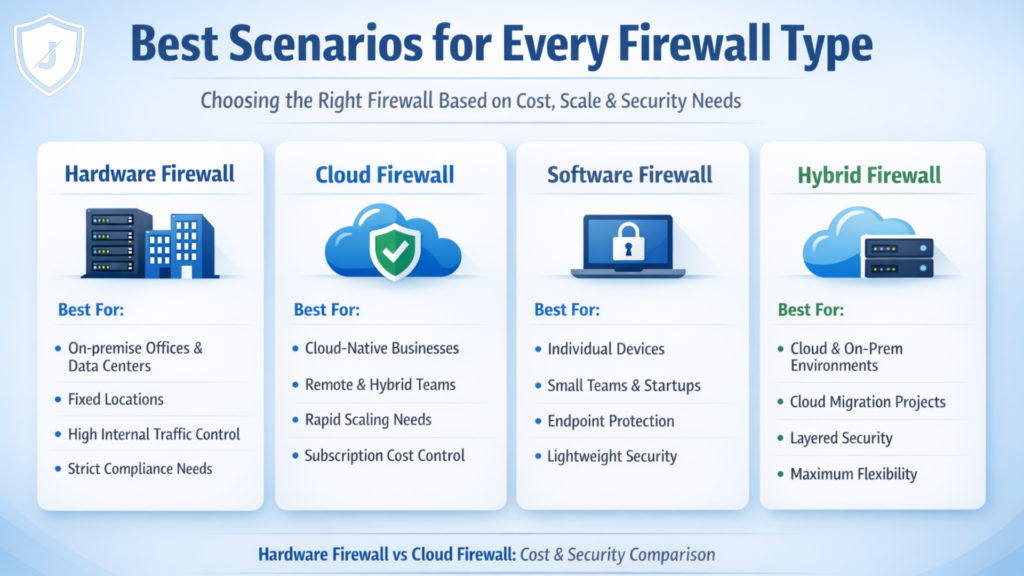
Hardware firewalls are the most suitable for:
- Internal office locations
- Stable network settings
- Industries that are compliance-driven
- Areas of high internal traffic
Cloud firewalls are the most suitable for:
A lot of companies go for a combination of both methods. Such a layered approach ensures maximum security and gives more leverage.
Firewall Trends in 2025 and Beyond
The trends in cybersecurity point towards a great cloud-based security. Companies now focus on zero-trust security, AI threat detection, and cloud-native firewalls. And, hence, there is an increase in the adoption of cloud firewalls.
At the same time, hardware firewalls still hold their ground. The modern devices have now become a part of the cloud-based services. This hybrid future promises to deliver the same reliability and performance. Thus, the road ahead is for flexible and smart firewall solutions.
Conclusion: Choose the Right Firewall With Jazz Cyber Shield
To sum up, the hardware firewall vs cloud firewall price and security analysis indicates that both options are strong in protection. Hardware firewalls ensure security at the perimeter reliably while cloud firewalls offer other advantages namely, scalability, advanced security, and cost efficiency.
At Jazz Cyber Shield, we assist companies in selecting a firewall security solution that fits their requirements. Our offerings include hardware firewall protection, cloud firewall services, or a combination of the two. We provide reliable cybersecurity solutions that safeguard your business not only now but also in the future.

