



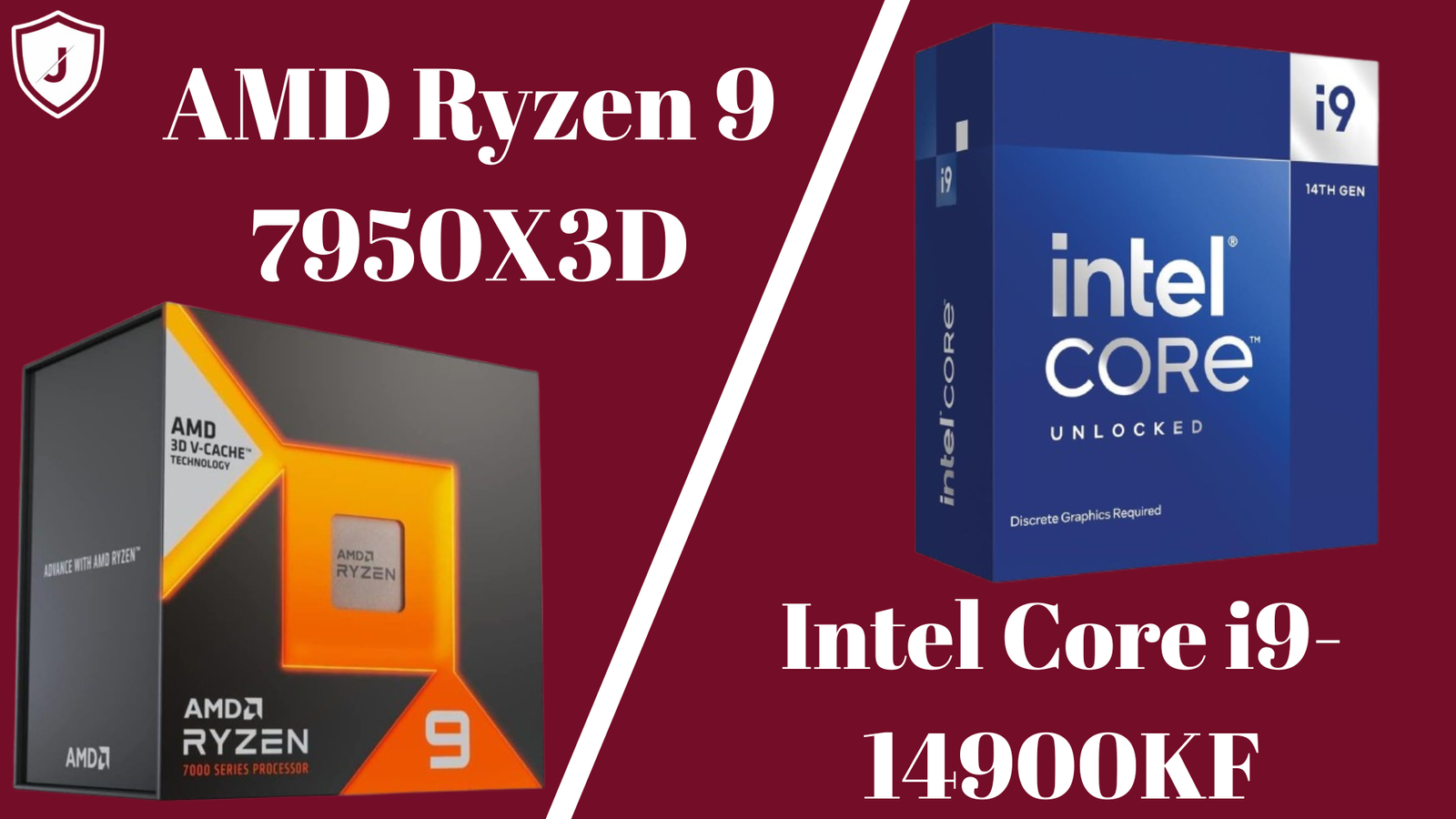
In 2025, the battle for the desktop CPU throne is fiercer than ever. Two titans stand out in the performance arena the AMD Ryzen 9 7950X3D and the Intel Core i9‑14900KF. In this comprehensive comparison, we dive into specs, real-world gaming & productivity performance, power/ thermal behaviors, upgrade paths and eventually decide which chip deserves the “performance crown” in 2025?
At Jazz Cyber Shield, our charge is to bring you unprejudiced, in- depth reviews using the latest benchmarks, ensuring you make informed hardware decisions whether you’re gaming, content-creating or erecting a powerhouse workstation.
Technical Specifications Overview
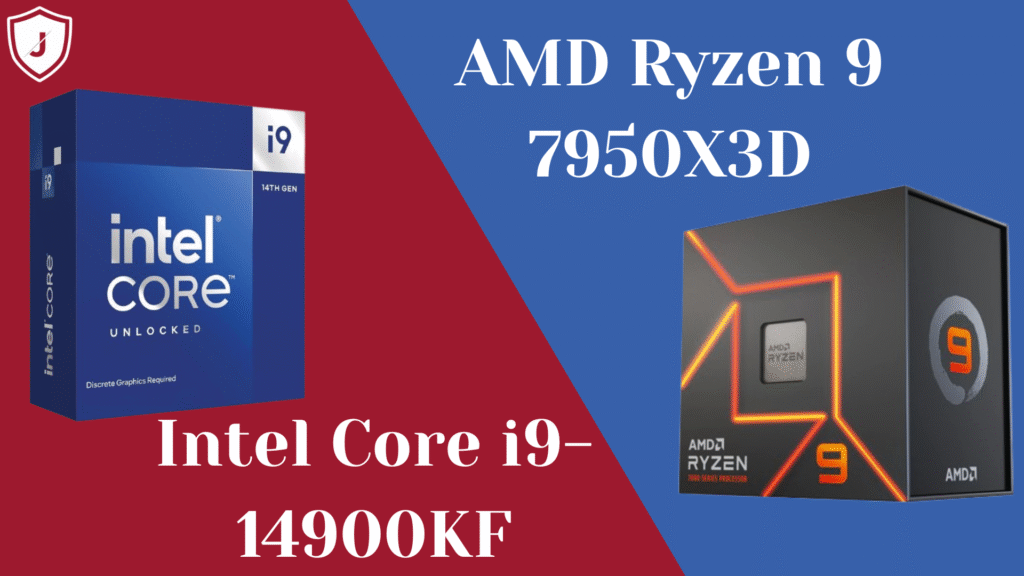
AMD Ryzen 9 7950X3D
- 16 cores/ 32 threads.
- Erected on the Zen 4 “Raphael” armature with 3D V-Cache stacked design.
- Massive 128 MB of L3 3D V- Cache.
- TDP around 120 W (base), with practical cargo/power somewhat higher.
- AM5 socket, DDR5 support, PCIe5 support.
Intel Core i9- 14900KF
- 24 cores/ 32 threads (8 Performance cores +16 effectiveness cores) in a hybrid architecture.
- Erected on Intel’s Raptor Lake-S Refresh architecture.
- No integrated graphics (KF variant).
- Much higher power consumption PL2 figures and heat under full load are significantly advanced.
- LGA 1700 socket (though nearing end of typical upgrade path).
Real- World Performance: Gaming & Productivity
Gaming Performance
For gamers looking for maximum frames per second, cache size, latency and core architecture matter. The 7950X3D’s large 3D V- Cache gives it a real advantage in cache-sensitive gaming workloads (especially at 1080p/ 1440p with strong GPUs).
On the flip side, the 14900KF boasts higher boost clocks and more cores threads, which helps in multi-core heavy games and unborn-proofing. But its power draw and heat also contribute to potential throttling or noisy cooling.
One Reddit stoner summarizes
Still, it’s a complete whine to cool and uses wattage like risible, “If I’m using the PC to game indeed though the 14900k is better for gaming by like 1-2 vs a 7950x3d. Not worth the trade-off.”
Productivity & Multitasking
For videotape editing, 3D modelling, rendering or heavy multitasking, raw multi-core throughput matters. Here, the 14900KF’s 24 cores give it an edge in many marks. According to CPU-Monkey comparison
- Single-core Intel leads (~100 vs ~87 for AMD in some datasets)
- Multi-core Intel slightly ahead of average scores.
Still, effectiveness, cooling and thermal headroom come into real practical enterprises for long sessions.
Power Efficiency & Thermal Considerations
From the data
- Ryzen 9 7950X3D shows lower power consumption and better thermal behaviour.
- Core i9- 14900KF draws significantly more power, especially under PL2 or all-core boost conditions and demands higher-end cooling and power delivery.
In practical terms if you make a compact PC, care about operating costs, or want a quieter/ lower heat ferocious setup, AMD holds a meaningful advantage.
Platform & Upgrade Path
- AMD’s AM5 socket is future-friendly with many anticipated Ryzen next-gen compatibility with AM5, meaning upgrades without changing motherboard in some cases. (Community sentiment “AMD because of the upgrade path.”)
- Intel’s LGA 1700 (for 14th word) is presumably near the end of its mainstream upgrade cycle, which may reduce long-term value.
- Motherboard/ VRM quality matters especially when dealing with high-power CPUs. As one advice post states: “Keep in mind both are mainly important, high power draw CPUs so you really want a board with a veritably good VRM configuration. You do not want to skimp on the motherboard or the power force.”
Value & Recommendation in 2025
From a value- perspective
- Still, especially at high refresh- rates and you want effective, cooler, if your focus is gaming.
- Still, multi-tasking, happy creation and want raw multi-core power and are okay with advanced power/ thermal cost — consider Core i9- 14900KF, if you’re doing heavy productivity workloads.
- For hybrid use (gaming creation) the 7950X3D is compelling due to efficiency+ gaming-cache advantage.
- Still, the “performance crown” is not absolute for one — each win part.
Our Verdict Who Wins the Performance Crown in 2025?
At Jazz Cyber Shield we conclude Ryzen 9 7950X3D takes the edge for almost users in 2025 for these reasons
- Exceptional gaming performance thanks to 3D V- Cache.
- Better effectiveness and cooling headroom = > lower fuss with big coolers noise/ power bills.
- Strong upgrade path with AM5.
- Balanced performance across gaming + productivity.
That said, for ultra-heavy productivity workloads where every multi-core cycle counts and cooling/ power budget is not a constraint — the 14900KF remains a formidable contender and could be your pick.
Why Jazz Cyber Shield?
At Jazz Cyber Shield, we believe in delivering expert- level CPU reviews, tailored for both enthusiasts and professionals. Our mission: to cut through marketing hype, bring you benchmarks, platform attendants, upgrade advice and clear take-aways. Stay tuned for further deep-dives and let us be your guard in the ever-evolving cyber-hardware battleground.
Final Thoughts & Buying Tips
- Check motherboard VRM quality and cooling results specs only tell part of the story.
- Suppose long term Platform + socket life matters for upgrade value.
- For ultra-compact or silent shapes effectiveness may count further than marginal fps earnings.
- Prioritize your use-case gaming vs creation vs mixed use.
- Watch for deals Pricing oscillations in 2025 may shift value balances.

