



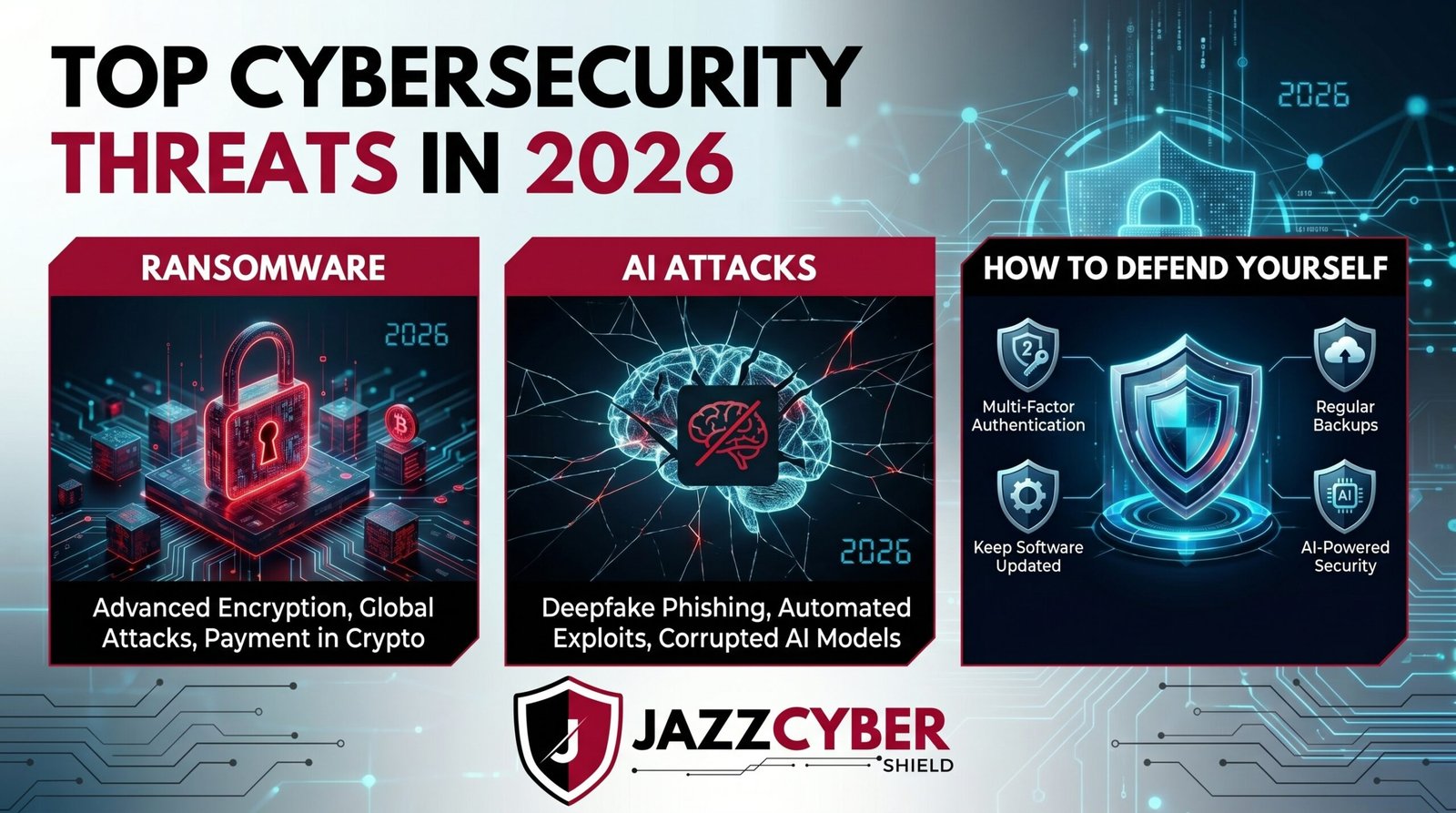
Cybersecurity threats 2026 have transformed the digital landscape into a real-time battlefield. AI-powered ransomware, deepfake social engineering, zero-day exploits, and nation-state operations have converged into an unprecedented risk environment. Global cybercrime now costs $10.5 trillion annually. This guide breaks down every major threat — and the defenses that actually work.
Cybersecurity Threats 2026: The Current Landscape 01
Cybersecurity threats 2026 are defined by one brutal truth: attackers move faster than defenders. The convergence of artificial intelligence, geopolitical tensions, and increasingly connected infrastructure has created a perfect storm for both cybercriminals and nation-state actors. Every organization — from a small business to a government agency — is now a potential target.
Mandiant’s M-Trends 2026 report reveals that the mean time to exploit vulnerabilities has dropped to –7 days — meaning exploitation is routinely occurring before a patch is even released. Traditional patch-management cycles are no longer a sufficient defense.
The World Economic Forum’s Global Cybersecurity Outlook 2026 found that 87% of respondents identified AI-related vulnerabilities as the fastest-growing cyber risk of the past year. Meanwhile, ransomware, supply chain attacks, and phishing have all materially worsened — what was once forecast is now daily reality.
For a structured breakdown of how threats are categorized, see our Cybersecurity hub and the JazzCyberShield Threat Intelligence center.
Cybersecurity Threats 2026 — Volume Index (Community Discourse)
Ransomware & Extortion: Still the #1 Threat 02
Ransomware is the most financially disruptive category of cybercrime in 2026. It has evolved far beyond simple file encryption. Modern ransomware combines data theft, partner-network attacks, DDoS campaigns, and compliance violation reports — a model called triple extortion. The average recovery cost has reached $2.73 million, with healthcare breaches averaging $7.42 million.
Ransomware-as-a-Service (RaaS)
The RaaS ecosystem operates like a franchise: developers build and maintain the malware, affiliates deploy it and split the ransoms. This industrialization means even low-skill attackers can launch devastating campaigns. In 2026, 80% of ransomware attacks now incorporate AI tools to accelerate reconnaissance, personalize payloads, and evade detection.
Prior compromise — where attackers already have a foothold in a network — has become the top initial infection vector in ransomware operations (30%), doubling from 2024 levels, according to Mandiant’s M-Trends 2026 report.
AI-powered ransomware has cut the median dwell time inside a compromised network from 9 days down to 5 days. Your incident response window is shrinking, not growing. Organizations must invest in behavioral detection and 24/7 monitoring — not just perimeter defenses.
Implement immutable, air-gapped backups. Deploy EDR with behavioral analysis. Enforce least-privilege access across all systems. Conduct regular ransomware tabletop exercises. Also see our guide on best firewalls for small businesses in 2026 to strengthen your first line of defense.
Among all cybersecurity threats 2026 has produced, ransomware remains the most financially damaging. The US Cyber Incident Reporting for Critical Infrastructure Act (CIRCIA) now requires organizations to report ransomware payments to the government — making transparency a legal obligation. Learn more in our cybersecurity compliance guides.
AI Security: The Double-Edged Sword of 2026 03
Among all cybersecurity threats 2026 defenders face, AI stands out as the single most transformative force. AI is simultaneously the most powerful weapon attackers have ever had — and the most effective defensive tool defenders have ever deployed. The organizations that master both sides will thrive. Those that ignore either will suffer the consequences.
How Cybercriminals Are Using AI in 2026
Attackers now scan networks at 36,000 probes per second using automated AI tools. In 2025, 41% of zero-day vulnerabilities were discovered by attackers using AI-assisted reverse engineering before defenders had identified them. Credential theft driven by AI jumped 160% in 2025. Malware families like PROMPTFLUX and PROMPTSTEAL actively query large language models during execution to evade detection signatures.
82.6% of phishing emails now contain AI-generated content — perfectly written, personalized, and undetectable by grammar checks alone.
How Defenders Are Leveraging AI
Organizations using AI-driven security platforms cut breach response time by 80 days and save an average of $1.9 million per incident. The rise of “Agentic SOCs” — where AI agents handle tier-one analyst work, including alert correlation, incident summaries, and threat intelligence drafting — is transforming security operations at scale.
Prompt injection attacks manipulate AI systems to bypass security controls and follow hidden attacker commands. As enterprise AI adoption accelerates, every chatbot, AI assistant, and automated analysis tool becomes a new potential attack surface. Read our related article: Your Network Has 22 Seconds: How Agentic AI Is Rewriting Cyberattacks.
The most dangerous AI risk in 2026 is not an external AI attack — it’s internal AI governance failure: AI systems deployed without proper security controls, auditability, or access restrictions. Building AI governance layers that continuously test systems against misuse is now a foundational security requirement.
Zero-Day Vulnerabilities: Exploitation Before the Patch 04
A zero-day vulnerability is a software flaw that is unknown to the vendor — or for which no patch yet exists. In 2026, the mean time to exploit has dropped to an estimated –7 days, meaning attackers are regularly exploiting flaws before vendors even know they exist. Mandiant’s M-Trends 2026 documents this alarming acceleration.
Nation-State Actors & Zero-Day Stockpiles
China-nexus threat clusters like UNC6201 and UNC5807 deliberately target edge devices — VPNs, routers, and firewalls — that typically lack standard EDR telemetry. These devices are exploited with zero-day vulnerabilities, providing persistent, stealthy access that can persist for months before discovery.
Understanding CVEs (Common Vulnerabilities and Exposures) is no longer just for IT teams — it’s a business-critical discipline. Organizations must implement risk-based vulnerability prioritization that accounts for active exploitation data, not just CVSS scores.
Microsoft’s Patch Tuesday releases remain a key calendar event for every security team — but in 2026, monthly patching cycles are dangerously insufficient. Implement continuous vulnerability scanning, subscribe to threat intelligence feeds, and adopt a risk-based patching cadence. See our Free Network Security Tools guide for scanning solutions.
Phishing, Vishing & Social Engineering 05
Phishing has fundamentally transformed in 2026. Traditional email phishing has declined as a primary attack vector — dropping to just 6% of intrusions as automated controls improved. In its place, adversaries have pivoted to highly interactive, voice-based social engineering (vishing) and AI-generated spear-phishing.
AI-Perfected Phishing & Voice Cloning
AI-driven voice cloning creates hyperrealistic impersonations of executives or IT staff, making attacks nearly impossible to detect by ear. Groups like UNC3944 specifically target IT help desks to bypass multi-factor authentication and gain access to SaaS environments — a technique documented extensively in Mandiant’s “Vishing for Access” research.
75% of breaches now use compromised legitimate credentials. Attackers log in — they don’t break in. Identity has become the new perimeter.
- Deploy AI-powered email security with behavioral analysis beyond basic spam filters
- Implement phishing-resistant MFA — passkeys and hardware security keys, not SMS codes
- Train employees with realistic social engineering simulations quarterly
- Establish voice verification protocols (code words) for high-risk financial requests
- Monitor OAuth tokens and session cookies for anomalous access patterns
For more on protecting your network from social engineering, read our article on AI-Powered Firewall Security in 2026.
Data Breaches: The $4.88M Average 06
The average cost of a data breach globally is now $4.88 million, with 287 days required to identify and fully contain the incident. Healthcare breaches are the most expensive at $7.42 million average. Manufacturing downtime from breaches costs $125,000 per hour.
| Industry | Avg. Breach Cost | Days to Contain | Top Attack Vector |
|---|---|---|---|
| Healthcare | $7.42M | 329 | Phishing / Credential Theft |
| Financial Services | $6.08M | 233 | Insider Threat / Malware |
| Technology | $5.20M | 266 | Zero-Day / Supply Chain |
| Manufacturing | $4.73M | 252 | OT / Ransomware |
| Retail | $3.28M | 197 | Web App / POS |
| Education | $3.10M | 210 | Phishing / Ransomware |
According to IBM’s Cost of a Data Breach Report, proactive AI-driven security delivers an estimated 400% ROI through faster detection, reduced analyst burnout, eliminated credential theft, and decreased regulatory penalties. For OT and industrial security, see our cybersecurity articles covering critical infrastructure protection.
Nation-State & APT Threats 07
Geopolitics is the defining factor in cybersecurity risk for 2026. Nation-state actors operate with state resources, legal immunity, and long-term strategic objectives that make them categorically more dangerous than criminal groups. Advanced Persistent Threats (APTs) focus on stealth, persistence, and intelligence gathering over rapid financial gain.
China, Iran & North Korea: Active Threat Actors
China-nexus operations continue to surpass other nations in volume, prioritizing stealthy targeting of edge devices and zero-day exploitation. Iranian actors remain resilient and semi-deniable, deliberately blurring lines between espionage, disruption, and hacktivism. North Korea continues financial operations — including cryptocurrency theft — alongside IT worker infiltration programs embedded inside Western technology companies.
Understanding threat actor TTPs (Tactics, Techniques and Procedures) is prerequisite to effective defense. Browse our related articles on Zero Trust Network Access for US Businesses and AI-Driven Intrusion Prevention for defensive countermeasures.
Supply Chain Attacks: One Vendor, Thousands of Victims 08
Supply chain attacks have become one of the most effective and high-impact tactics in the modern threat landscape. 29% of breaches now involve third-party compromises — a single vendor breach can simultaneously affect thousands of downstream customers. The Shai-Hulud 2.0 attack in early 2026 demonstrated how poisoning trusted developer packages can silently infect thousands of projects, bypassing every perimeter defense entirely.
Why Perimeter Security Fails Against Supply Chain Attacks
Organizations typically have strong controls over their own systems but minimal visibility into their vendor ecosystem. Attackers exploit this blind spot by compromising trusted software libraries, hardware components, or managed service providers. Security maturity in 2026 is measured not only by how well you protect your own assets, but by how deeply you understand your entire vendor ecosystem — including shadow IT.
- Implement a formal Vendor Risk Management (VRM) program with annual assessments
- Require Software Bills of Materials (SBOMs) from all software vendors
- Apply Zero Trust principles to all third-party and contractor connections
- Monitor third-party access using Privileged Access Management (PAM) tools
- Include supply chain compromise scenarios in all incident response exercises
Deepfakes & Identity Fraud 09
Deepfake technology has matured from a curiosity into an operational attack weapon. AI-generated voice and video impersonations are now routinely used in CEO fraud, financial wire-transfer scams, and large-scale disinformation campaigns. Real-time AI voice cloning has resulted in multi-million dollar unauthorized wire transfers at numerous organizations globally.
Traditional identity verification — voice recognition, video calls, email confirmation — is no longer reliable against AI-generated impersonation. Organizations must implement out-of-band verification protocols and establish code-word procedures for any high-risk financial authorization.
Deepfakes are also powering Dark Web synthetic identity marketplaces — where AI-generated documents enable large-scale account takeovers. Pair identity controls with robust VPN and privacy hygiene to reduce the attack surface available to identity thieves.
📚 Related Reading
The Modern Defense Stack Against Cybersecurity Threats 2026 10
Effective defense against cybersecurity threats 2026 is not a single product — it is a layered architecture of people, processes, and technology working in concert. In 2026, the minimum viable security stack spans detection, response, identity, endpoint, cloud, and governance.
SIEM, XDR & the Agentic SOC
SIEM (Security Information and Event Management) provides centralized log collection and threat correlation. XDR (Extended Detection and Response) unifies signals across endpoint, network, email, and cloud into a single detection and response platform. In 2026, these tools are increasingly AI-powered — handling tier-one analyst tasks, correlating thousands of alerts per second, and even executing automated containment actions.
MFA, IAM & Passwordless Authentication
Multi-Factor Authentication (MFA) remains one of the highest-ROI security controls available. In 2026, the critical shift is toward phishing-resistant MFA — passkeys and hardware security keys that cannot be bypassed by voice phishing or session hijacking. IAM platforms now treat AI agents as distinct digital actors with their own managed identities and access policies.
Endpoint Protection & Cloud Security Posture
Behavioral endpoint detection — not signature-based antivirus — is the minimum viable protection against modern threats including Living off the Land (LotL) attacks that abuse legitimate Windows tools like PowerShell. Cloud Security Posture Management (CSPM) ensures cloud workloads are continuously assessed for misconfigurations and policy violations.
For product comparisons and buying guides, explore our Best Firewalls for Small Businesses, Next-Generation Firewall Complete Guide, and Free Network Security Tools guides. Or shop enterprise-grade security hardware at JazzCyberShield Shop.
Zero Trust Architecture: Never Trust, Always Verify 11
Zero Trust is the most important architectural shift in enterprise security today. The principle is elegantly simple: never automatically trust any user or device — inside or outside the network perimeter. Every access request is verified continuously using identity, device health, location, and behavioral signals.
Gartner predicts organizations adopting Continuous Exposure Management will be 3x less likely to experience a breach by 2026. IBM X-Force continues to identify credential abuse as the leading attack vector — and Zero Trust directly neutralizes this by eliminating implicit trust after initial authentication.
- Identity: Verify every user with adaptive MFA and continuous risk scoring
- Device: Validate device health and compliance posture before granting access
- Network: Micro-segment networks to prevent lateral movement after breach
- Application: Enforce least-privilege access to every application individually
- Data: Classify, encrypt, and continuously monitor all sensitive data flows
Read our deep-dive article: Zero Trust Network Access in 2026: The AI-Powered Defense Every US Business Needs Now.
Quantum Computing & Post-Quantum Cryptography 12
Quantum computing represents a long-term existential threat to current encryption standards. While cryptographically relevant quantum computers are not yet operational, nation-state actors are already conducting “harvest now, decrypt later” operations — collecting encrypted data today to decrypt it once quantum capabilities reach sufficient scale.
NIST Post-Quantum Cryptography: Act Now
NIST finalized its first post-quantum cryptographic standards in 2024, including CRYSTALS-Kyber for key encapsulation and CRYSTALS-Dilithium for digital signatures. Organizations should begin crypto-agility planning immediately: inventory all cryptographic assets, identify systems relying on RSA or ECC encryption, and build migration roadmaps to quantum-resistant algorithms. The window to act is narrowing — especially for regulated industries and organizations handling long-lived sensitive data.Governance: GDPR, CISA, NIS2 & the Compliance Revolution 13
Cybersecurity regulation is entering its strictest enforcement era. The EU’s NIS2 Directive and Cyber Resilience Act (CRA) mandate security controls for products with digital elements, with reporting obligations starting September 11, 2026. The US CIRCIA requires rapid reporting of cyber incidents and ransomware payments. GDPR enforcement actions continue to set record fines.
Key Compliance Frameworks for 2026
GDPR governs personal data processing across the EU, with extraterritorial reach. CISA sets baseline security standards for US critical infrastructure operators. DORA governs digital operational resilience for EU financial entities. PCI DSS v4.0 applies to all organizations handling payment card data globally. Organizations that treat compliance as a genuine security improvement — not a checkbox exercise — consistently demonstrate stronger real-world security posture.
For compliance-specific hardware and solutions, visit the JazzCyberShield shop for Cisco, Fortinet, and Aruba security products. Also read: Why 60% of Small Businesses Close Within 6 Months of a Cyberattack.
The Infosec Community: CTF, OSINT & Bug Bounties 14
The cybersecurity community remains one of the most collaborative and knowledge-driven professional communities in technology. Three disciplines define active participation and continuous skill development in 2026: CTF competitions, OSINT research, and bug bounty programs.
Bug Bounties, CTFs & OSINT in 2026
Bug bounty programs paid out record amounts in 2025, with top researchers earning over $1 million annually from platforms like HackerOne and Bugcrowd. CTF (Capture the Flag) competitions provide hands-on training across reverse engineering, web exploitation, forensics, and cryptography — the most practical path to real offensive security skills.
OSINT (Open Source Intelligence) has become a mainstream discipline used by threat intelligence analysts, red teams, and journalists alike to map attack surfaces and track threat actors across the open and dark web.
Penetration testing — offensive security testing that simulates real attacks — is now a standard enterprise practice. Organizations that conduct regular red team engagements are measurably more resilient to breach. Explore JazzCyberShield’s security services for managed pentesting and red team options.
🛡 Is Your Organization Protected Against Cybersecurity Threats 2026?
JazzCyberShield provides enterprise-grade security hardware, threat intelligence resources, and expert guidance — from Cisco and Fortinet firewalls to Aruba networking and beyond.
Get a Free Security Assessment Shop Security Hardware
