



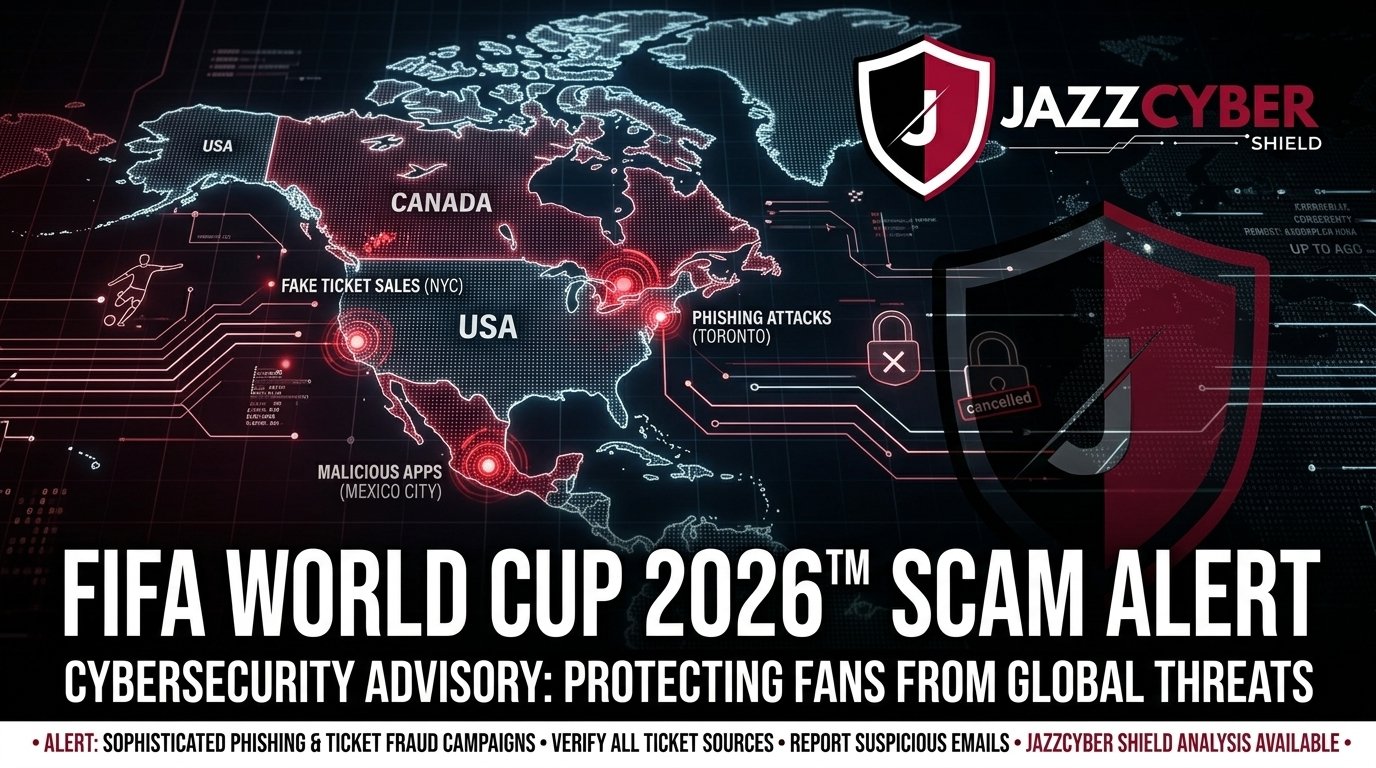
The 2026 FIFA World Cup kicks off on June 11 — and cybercriminals have been preparing longer than most football teams. The FBI, Fortinet, Group-IB, Bitdefender, and Check Point Research all published warnings this week describing a fraud infrastructure that is already live, fully operational, and growing fast.
This is not a handful of opportunistic phishing pages. Researchers across multiple firms have confirmed that what is unfolding is a coordinated criminal ecosystem targeting fans, corporate sponsors, ticketing platforms, and anyone connected to the tournament.
Here is exactly what is happening, who is behind it, and what you need to do right now.
Table of Contents
What Is the Scale of the FIFA World Cup 2026 Cyber Threat?
The numbers are staggering.
According to Intel 471, the 2026 FIFA World Cup is now described as “the largest and most complex cyberattack surface in sporting history.” Since January 2026 alone, over 19,000 domains containing references to “FIFA” or “World Cup” have been registered — the vast majority created for fraud.
Check Point Research documented that in April 2026 alone, nearly 9,741 new FIFA-themed domains were registered — over five times the peak seen during the Qatar 2022 World Cup. By early May, the ratio of suspicious domains had worsened to 1 in every 41 newly registered FIFA domains being confirmed malicious.
Fortinet’s FortiGuard Labs tracked over 13,000 FIFA-themed domains between January and May 2026, with approximately 8.8% already classified as malicious or suspicious. Group-IB identified more than 4,300 fraudulent domains specifically mimicking FIFA’s official web presence, and uncovered six parallel fraud schemes run by at least four independent threat actor groups.
The FBI formally confirmed the threat with a Public Service Announcement, warning: “Cyber threat actors are conducting spoofing attacks against the FIFA website in advance of the 2026 FIFA World Cup.”
How Are Cybercriminals Exploiting the World Cup?
1. Fake Ticketing Sites
The most visible attack vector is fake ticket platforms. With over 150 million ticket requests received for only 6 million available seats, demand is extreme. Cybercriminals are exploiting exactly this anxiety.
Fake ticketing pages are engineered to look authentic. Group-IB identified a Chinese-speaking threat group it calls GHOST STADIUM, which is running hundreds of phishing sites using the same kit. These pages replicate FIFA’s single sign-on login interface, including a genuine client ID copied from the real site, and load images directly from FIFA’s own servers to pass visual inspection.
Over 300 of the 4,300+ identified domains are already actively deploying phishing infrastructure, with an additional 3,800 registered and parked — ready for activation as the tournament progresses.
2. Fake Merchandise Stores
Fortinet found a coordinated network of counterfeit FIFA merchandise stores offering jerseys, souvenirs, and official World Cup products at discounts of up to 80%. One domain — fifaofficialstore[.]shop — was registered in March 2026, designed to steal payment card data from buyers who complete checkout.
Bitdefender researchers identified more than 55 football-themed scam advertising campaigns running across Facebook and Instagram, promoting fake Panini sticker collections, counterfeit kits, and direct phishing pages.
3. Banking Malware in Pirate Streaming Apps
Fans unable to buy tickets are turning to streaming — and cybercriminals anticipated this. Fake streaming platforms are collecting subscription fees and simultaneously installing banking malware on the victim’s device. Malware families including Vidar, LummaC2, and RedLine have been documented in FIFA-themed lure campaigns, with FortiGuard Labs detecting over 4,600 FIFA-associated URLs inside stealer log telemetry.
4. Credential Harvesting via Fake Job Ads
Fortinet documented a sophisticated credential theft campaign targeting both fans and potential employees. Fake FIFA-related job advertisements and sponsor recruitment posts directed applicants to calendar invites, which redirected to counterfeit Google login pages. Several domains across this campaign shared the same Google Analytics tracking ID — confirming coordinated infrastructure behind what appeared to be separate sites.
Over 260 FIFA employee credentials and more than 270,000 general user credentials have already been found in stealer logs associated with these campaigns.
5. QR Code and Public Wi-Fi Fraud
A Kaspersky survey conducted across Mexico City, Monterrey, and Guadalajara found that 10% to 12% of public Wi-Fi networks in those cities are completely open and password-free, with WPS pairing still active on nearly half of surveyed networks. This creates a direct attack surface for man-in-the-middle attacks targeting fans at host venues.
QR code fraud is also identified as a fast-growing variant. Fake shuttle pass QR codes, parking permit codes, and fan transport codes that fail on scanning are already appearing in pre-tournament listing scams.
Who Is Behind the FIFA World Cup 2026 Cyberattacks?
Multiple distinct threat actor groups are active. Group-IB’s primary discovery is GHOST STADIUM — a Chinese-speaking, financially motivated operation running hundreds of phishing sites from a centralized kit. The group is distinguished by loading authentic FIFA server assets directly into fake pages to defeat basic visual security checks.
Fortinet’s investigation found that multiple impersonation domains across different scam types shared the same Google Analytics tracking ID — indicating a single coordinated campaign operator running what appears to be separate scam brands. Recorded Future identified a distinct network of 33 World Cup-themed purchase scam domains tied to an active carder operation. Stolen payment credentials are being used to buy real tickets for immediate resale — turning fraud into a revenue arbitrage model.
In April 2026, a separate threat actor claimed to have breached the Fédération Royale Marocaine de Football, publishing sample records including names, passport numbers, dates of birth, and FIFA IDs. A second actor claimed to have leaked a dataset from the Asian Football Confederation containing thousands of passport records and registration forms.
The Role of AI in Making These Scams Harder to Detect
This is where the 2026 threat environment is categorically different from previous tournaments.
Anne Cutler, Cybersecurity Evangelist at Keeper Security, noted: phishing emails in 2026 are grammatically perfect, contextually accurate, and personalized in seconds using AI tools. The traditional advice of spotting typos or awkward phrasing is now obsolete.
Pyry Åvist, Co-founder and CTO at Hoxhunt, confirmed that explosive growth in AI-assisted phishing began in late 2025. Attackers can now generate convincing messages in multiple languages, tailor them to specific individuals, and produce thousands of variations of the same lure simultaneously — a scale that outpaces manual detection and most rule-based filtering.
Fake pages are also now being built to a professional standard. Cybercriminals are using legitimate cloud infrastructure, including Render-hosted APIs, to process stolen credentials — making traffic analysis harder and giving malicious infrastructure a clean reputation score.
What Should Individuals and Businesses Do Right Now?
For Fans
Only use FIFA’s official website (fifa.com) for ticket verification, merchandise purchases, and login. Any domain with even a minor spelling variation — fifa2026[.]com, fifastore[.]shop, or any combination with host city names — should be treated as suspicious.
Do not click links in unsolicited emails, SMS messages, or social media posts about World Cup tickets. If a deal looks too good to be true, it is. The 80% discount stores are all fraudulent.
Avoid open public Wi-Fi at host city venues. If you must connect, use a VPN. Check the network name carefully before connecting — evil twin networks mimicking hotel or stadium Wi-Fi are a known attack vector.
Use a payment method that supports chargeback for any World Cup-related purchases. Never use wire transfer or cryptocurrency for ticket purchases.
For Businesses and Organizations
Organizations with any connection to the tournament — sponsors, travel providers, hospitality platforms, ticketing resellers — face elevated risk of brand impersonation. Monitor for lookalike domains using tools that alert on newly registered domains containing your brand terms.
Corporate accounts should enforce multi-factor authentication on all email and identity systems. The FIFA job ad phishing campaign demonstrated that attackers can move from a fake LinkedIn post to a compromised Google account in a single session. Having enterprise firewall solutions deployed at the perimeter is no longer optional for organizations operating near high-value events.
Review user awareness training to address AI-generated phishing. Employees need to understand that a grammatically perfect email from a recognized sender is no longer evidence of legitimacy.
Monitoring and Detection Priorities
Security teams should add FIFA-related threat intelligence to their monitoring stack immediately. Key indicators include newly registered domains matching your brand terms combined with “FIFA,” “2026,” or host city names; Vidar, LummaC2, and RedLine malware families (all confirmed active in this campaign); and any credential dumps referencing FIFA-associated services appearing on dark web forums.
Why This Matters Beyond Football
The FIFA World Cup 2026 cyber threat environment is a preview of what AI-assisted fraud at scale looks like. The same infrastructure, the same malware families, and the same social engineering techniques will be repurposed after the tournament ends.
The combination of massive public attention, a scarcity-driven purchase environment, global travel, and multi-platform social media exposure creates ideal conditions for cybercriminals — and those conditions are increasingly replicable for any major event.
Security researchers, the FBI, and firms including Fortinet, Group-IB, Check Point, Bitdefender, and Kaspersky are all tracking this in real time. The consensus is consistent: the infrastructure is built, the threat is live, and the window between now and July 19 (the final) is the highest-risk period.
Stay vigilant, verify everything directly, and make sure your organization’s network security posture is audited before the tournament begins. If you need help reviewing phishing protection tools or upgrading your perimeter defenses ahead of major events, the Jazz Cyber Shield store carries enterprise-grade solutions built for exactly this kind of elevated threat window.
Final Thoughts
The 2026 FIFA World Cup is the most phished sporting event in history — by a measurable margin. Over 19,000 fraudulent domains, six parallel fraud schemes, banking malware in streaming apps, AI-generated phishing emails, and an active FBI warning all confirm that this is a coordinated, scaled threat with a hard deadline: the tournament ends July 19.
Fans and businesses both need to act now, not after the first breach notice arrives in their inbox.

