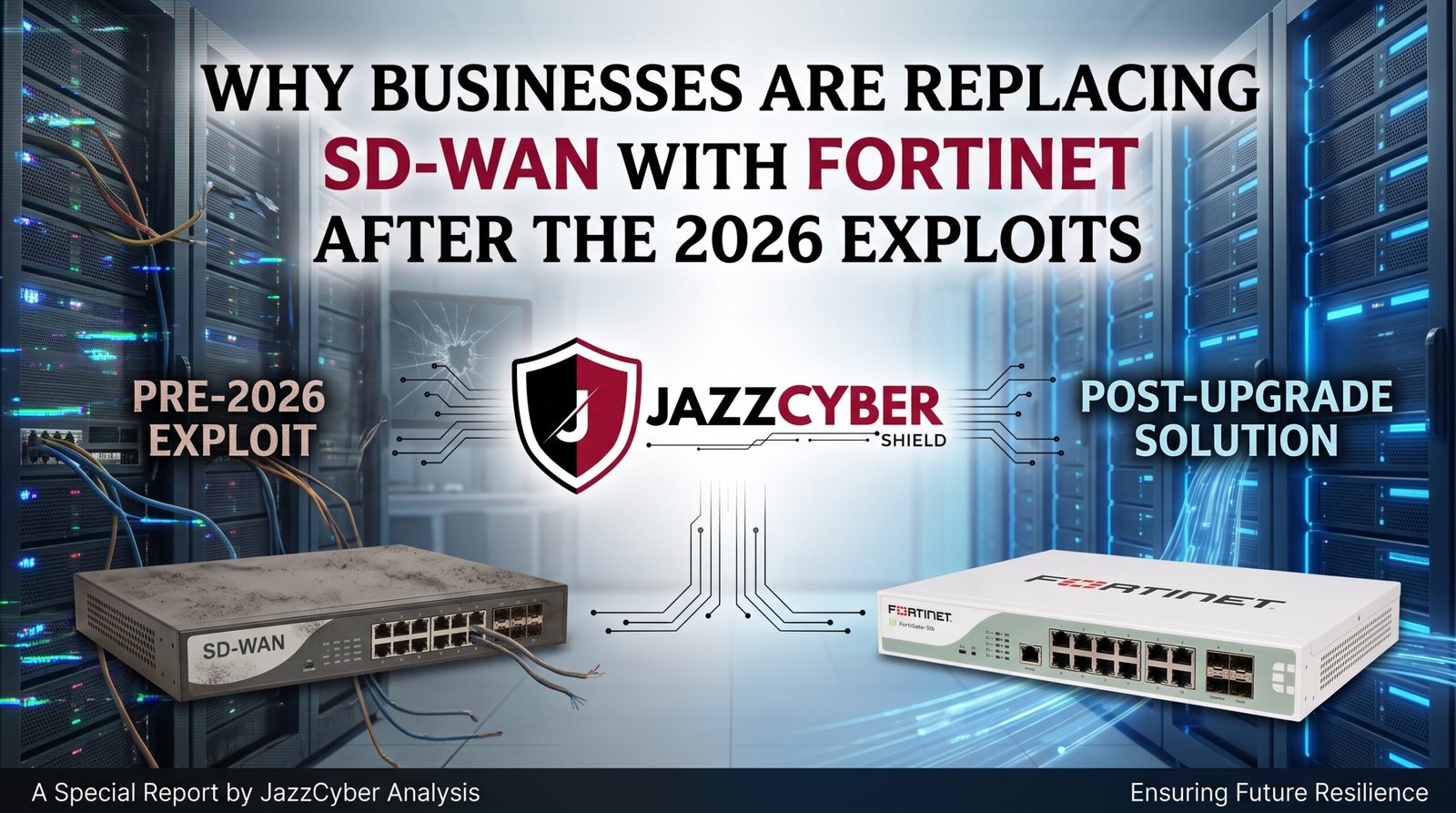
Your SD-WAN Is a Network — Fortinet’s Is a Security Platform
The shift from generic SD-WAN with Fortinet isn’t just a hardware upgrade — it’s a fundamental rethink of what wide-area networking should actually do in a threat environment that’s outgrown the assumptions most SD-WAN platforms were built on.
A regional insurance company in Ohio had deployed a standalone SD-WAN solution across 14 branch offices three years earlier. It was fast. It was flexible. It delivered exactly the application performance and cloud connectivity their operations team wanted.
Then 2025 happened. Their SD-WAN vendor disclosed two critical vulnerabilities — both actively exploited — affecting the management plane of their deployed hardware. Emergency patches. Emergency audits. Three weeks of elevated risk while their team worked through remediation across every location simultaneously.
Their CISO’s conclusion: “We bought a fast network with a slow security response. We needed a secure network with fast traffic.” Six months later, they were migrating to Fortinet Secure SD-WAN.
That story is playing out across thousands of organizations right now. This guide explains why, and exactly what the Fortinet approach delivers differently.
Table of Contents
The State of SD-WAN Security in 2026
SD-WAN adoption exploded through the early 2020s as organizations moved away from expensive MPLS circuits toward internet-based wide-area connectivity with intelligent traffic routing. The value proposition was real: lower costs, better cloud performance, centralized management.
What the SD-WAN market underinvested in was security. Traditional SD-WAN was designed to move traffic intelligently across wide-area networks. Security was treated as a separate layer — a bolt-on provided by third-party firewalls or cloud-based security services sitting alongside the SD-WAN fabric.
That architectural assumption has proven costly. SD-WAN management planes and edge devices have become high-value targets because they sit at the perimeter of branch office networks with privileged access to everything behind them — and many lack the same security investment that dedicated firewall hardware receives.
⚠️ ALERT: CISA has issued multiple advisories specifically addressing vulnerabilities in WAN edge devices and SD-WAN solutions, noting that network perimeter appliances have become a primary target category for nation-state and ransomware actors due to their privileged network position and historically slower patch adoption rates compared to core enterprise security tools. Read CISA’s network infrastructure security advisories (opens in new tab)
The response from security-forward organizations has been a shift toward Secure SD-WAN — where wide-area networking and security enforcement are unified in the same platform, the same management console, and the same threat intelligence pipeline. Fortinet is the market leader in this converged approach.
Why Traditional SD-WAN and Security Don’t Mix
To understand why the shift toward SD-WAN with Fortinet is accelerating, you need to understand the architectural limitation of traditional SD-WAN.
The Bolt-On Security Problem
Traditional SD-WAN architectures route traffic across the wide-area network but leave security enforcement to separate tools — branch office firewalls from different vendors, cloud-based security services, or centralized inspection at headquarters. This creates:
- Management fragmentation: separate consoles for SD-WAN and security
- Policy inconsistency: security policies defined in one system don’t automatically apply in another
- Blind spots: traffic that bypasses the central security stack goes uninspected
- Slow response: threat intelligence from the security layer doesn’t automatically inform routing decisions in the SD-WAN layer
TRADITIONAL SD-WAN ARCHITECTURE (Security Fragmented)
━━━━━━━━━━━━━━━━━━━━━━━━━━━━━━━━━━━━━━━━━━━━━━━━━━━━
Branch Office:
[SD-WAN Edge Device] → Routes traffic
        +
[Separate Firewall]  → Inspects traffic
        +
[Cloud Security]     → Filters some traffic
Three separate consoles. Three separate policies.
Traffic routed before security decisions are made.
━━━━━━━━━━━━━━━━━━━━━━━━━━━━━━━━━━━━━━━━━━━━━━━━━━━━

SD-WAN WITH FORTINET ARCHITECTURE (Unified)
━━━━━━━━━━━━━━━━━━━━━━━━━━━━━━━━━━━━━━━━━━━━━━━━━━━━
Branch Office:
[FortiGate: SD-WAN + NGFW + IPS + DNS + DPI]
        │
One device. One console. Security informs routing.
Traffic is inspected as it's routed, not after.
━━━━━━━━━━━━━━━━━━━━━━━━━━━━━━━━━━━━━━━━━━━━━━━━━━━━
The Vulnerability Exposure Pattern
When SD-WAN edge devices contain critical vulnerabilities, the remediation challenge is compounded by the number of distributed locations involved. A critical vulnerability in your branch office SD-WAN hardware means patching dozens or hundreds of edge devices across every location simultaneously — a logistical challenge that creates extended windows of exposure that attackers specifically exploit.
🔴 WARNING: Verizon’s Data Breach Investigations Report consistently identifies network perimeter devices — including WAN edge hardware — as a primary initial access vector for breaches. The combination of privileged network position, distributed deployment, and historically slower patch adoption makes SD-WAN edge devices an attractive and productive target for attackers conducting mass exploitation. Read the Verizon DBIR (opens in new tab)
SD-WAN With Fortinet: How the Secure SD-WAN Model Works {#fortigate-model}
Fortinet’s approach to SD-WAN fundamentally differs from traditional SD-WAN by building SD-WAN functionality directly into FortiGate next-generation firewalls rather than deploying SD-WAN as a separate platform.
One Platform, Both Functions
A FortiGate deployed at a branch office simultaneously serves as:
- A full next-generation firewall with deep packet inspection
- An intrusion prevention system
- An SSL inspection engine
- A DNS filtering service
- An SD-WAN edge device managing link selection and quality of service
- A Zero Trust Network Access enforcement point
All of these functions run on the same hardware, managed from the same FortiManager or FortiCloud console, informed by the same FortiGuard threat intelligence feed.
Security-Aware Routing
In the FortiGate SD-WAN model, routing decisions are aware of security context. Traffic to known malicious destinations can be blocked before a routing decision is made rather than routed and then blocked by a separate downstream tool. Application traffic can be steered based on both performance metrics and security policy simultaneously.
Centralized Policy Management
Security policies defined at headquarters apply consistently to every branch FortiGate through FortiManager’s centralized configuration management. A new threat intelligence update, a new application policy, or a new security rule deploys across every branch simultaneously — not branch by branch through separate management consoles.
If your business is evaluating the SD-WAN with Fortinet migration, browse our Fortinet collection for the specific FortiGate models sized for branch office deployments — from the compact FortiGate 40F for small branches through mid-range appliances for larger regional offices.
What Fortinet Secure SD-WAN Actually Delivers
Beyond the architectural argument, SD-WAN with Fortinet delivers specific operational capabilities that organizations migrating from traditional SD-WAN consistently cite as the primary reasons for the switch.
Application-Aware Path Selection
FortiGate’s SD-WAN engine continuously measures the performance of every available WAN link — internet circuits, MPLS, LTE backup — and steers specific application traffic to the best-performing link based on latency, jitter, and packet loss measurements. This happens for over 5,000 application signatures that FortiGate identifies through deep packet inspection, not just port-based traffic categorization.
Automatic Failover With Security Context
When a primary WAN link fails, FortiGate automatically fails over to the secondary link while maintaining the same security policies on the new path. Traditional SD-WAN failover sometimes creates brief windows where traffic bypasses security inspection during the transition — FortiGate maintains full inspection throughout.
Integrated SASE Capability
Fortinet’s Secure SD-WAN integrates with FortiSASE for organizations moving toward a Secure Access Service Edge architecture — connecting branch offices and remote users to cloud-delivered security services through the same FortiGate edge platform that manages SD-WAN traffic, without deploying additional hardware or agents.
Single-Pane-of-Glass Management
FortiManager provides unified management across all branch FortiGate deployments — SD-WAN policies, security policies, firmware updates, and threat response from a single console. Organizations running 50 branch offices manage all SD-WAN and security configuration from one interface rather than separate SD-WAN and firewall management platforms.
SD-WAN vs Fortinet Secure SD-WAN: Side-by-Side
| Capability | Traditional SD-WAN | SD-WAN With Fortinet |
|---|---|---|
| WAN link management | ✅ Yes | ✅ Yes |
| Application-aware routing | ✅ Yes | ✅ Yes — security-aware too |
| Deep packet inspection | ❌ Separate tool | ✅ Built-in |
| Intrusion prevention | ❌ Separate tool | ✅ Built-in |
| DNS filtering | ❌ Separate tool | ✅ Built-in |
| SSL inspection | ❌ Separate tool | ✅ Built-in |
| Threat intelligence integration | ❌ No | ✅ FortiGuard (live) |
| Security-informed routing | ❌ No | ✅ Yes |
| Single management console | ❌ Typically not | ✅ FortiManager |
| Zero Trust enforcement | ❌ No | ✅ Built-in |
| SASE integration | ❌ Separate solution | ✅ FortiSASE native |
The table reveals the core issue with traditional SD-WAN in a security context: the capabilities that matter most for protecting branch offices from modern threats all require separate tools, separate vendors, and separate management in a traditional SD-WAN architecture. SD-WAN with Fortinet unifies all of them.
⚠️ ALERT: IBM Security’s X-Force threat intelligence team has documented that branch office WAN edge devices are increasingly targeted as a lateral movement path — attackers who gain initial access through a branch office SD-WAN device use that foothold to reach the corporate headquarters network through the WAN fabric itself. Unified security inspection across the entire SD-WAN path is the architectural response to this documented attack pattern. Read IBM’s threat intelligence research (opens in new tab)
Real Migration Scenarios: Who’s Making the Switch and Why
The SD-WAN with Fortinet migration is happening across specific business types for specific, consistent reasons.
Multi-Location Retail Businesses
Retail chains with dozens to hundreds of locations face the exact logistical challenge that makes traditional SD-WAN vulnerability management so painful: dozens of separate devices to patch simultaneously. SD-WAN with Fortinet’s FortiManager-based centralized update management deploys firmware and security patches across every location from a single action.
Healthcare Networks With Compliance Requirements
Healthcare organizations running HIPAA-regulated environments need consistent security policy enforcement across every site where patient data is accessed or transmitted. Traditional SD-WAN’s separate security layer creates the policy consistency gaps that compliance auditors flag. FortiGate’s unified platform enforces the same policies everywhere.
Financial Services With Branch Banking
Banks and credit unions with branch locations need WAN connectivity and security that meets both operational and regulatory requirements. The combination of SD-WAN performance with built-in IPS, DPI, and threat intelligence aligns with financial services security requirements without the complexity of separate vendors for networking and security.
MSP-Managed Business Networks
Managed service providers running SD-WAN for multiple clients increasingly prefer Fortinet’s unified platform because managing one system per client (rather than SD-WAN plus firewall plus security service per client) dramatically reduces management overhead and improves consistency across the MSP’s client base.
For businesses that also need to upgrade their switching infrastructure alongside an SD-WAN with Fortinet migration, our network switches collection includes compatible switching options that integrate with FortiGate for unified wired and wireless management.
The Security Fabric Advantage
The single most compelling long-term argument for SD-WAN with Fortinet isn’t any individual feature — it’s the Security Fabric ecosystem that FortiGate participates in.
Shared Threat Intelligence Across the Entire Network
When FortiGate at one branch location detects a threat, that intelligence propagates through the FortiGuard threat feed and can inform the response at every other FortiGate deployment — branch offices, headquarters, remote access gateways. A threat detected at your Seattle branch can update defenses at your Atlanta branch within minutes.
Integrated SD-WAN, Switching, and Wireless
Fortinet’s Security Fabric extends beyond just the WAN edge. FortiSwitch and FortiAP integrate with FortiGate so that the same security policies, the same visibility, and the same management console cover the WAN layer, the LAN switching layer, and the wireless access layer simultaneously. An organization that builds on FortiGate SD-WAN gets a unified security platform across the entire network infrastructure rather than point solutions at each layer.
Zero Trust Extension Across the WAN
FortiGate’s Secure SD-WAN natively extends Zero Trust Network Access principles across the WAN — devices connecting through branch FortiGate devices are subject to the same identity and posture checks as remote users connecting through FortiClient VPN. The security model follows the user and device regardless of which network path they use.
How to Evaluate Your Options: Step-by-Step
Whether you’re evaluating SD-WAN with Fortinet for the first time or planning a migration from a traditional SD-WAN platform, here’s the practical evaluation framework:
- Audit your current SD-WAN security posture — Identify every security function (firewall, IPS, DNS filtering, SSL inspection) in your current branch architecture and which separate tools provide them.
- Map your management complexity — Count how many separate consoles your team uses to manage WAN connectivity and security across all locations. More than one is the problem SD-WAN with Fortinet solves.
- Review your patch management history — How quickly has your organization historically applied critical patches to branch office WAN edge hardware? If the answer is “weeks to months,” consolidated patch management through FortiManager addresses a specific documented risk.
- Assess your compliance requirements — Identify which security controls must be documented and consistently applied across every branch location for your compliance framework. Verify whether your current SD-WAN architecture provides consistent policy enforcement across all sites.
- Calculate total cost of ownership — Compare the cost of your current SD-WAN hardware plus the separate security tools it requires against the unified FortiGate approach. The consolidation math often surprises organizations.
- Evaluate your growth trajectory — If you’re adding branch locations, each new site in a FortiGate SD-WAN deployment is provisioned through FortiManager with consistent policies from day one. Each new site in a traditional SD-WAN architecture requires configuring a separate SD-WAN device and a separate security stack.
- Test application performance metrics — FortiGate SD-WAN’s application-aware path selection is most compelling when your branch users are heavily dependent on specific cloud applications. Identify which applications matter most and evaluate whether performance-based routing would improve their experience.
- Engage a Fortinet partner or reseller — SD-WAN migration planning benefits significantly from vendor expertise, particularly for multi-site deployments where migration sequencing matters.
Quick Reference Checklist
Use this to structure your SD-WAN with Fortinet evaluation.
SD-WAN WITH FORTINET — EVALUATION CHECKLIST
━━━━━━━━━━━━━━━━━━━━━━━━━━━━━━━━━━━━━━━━━━━━━━━

CURRENT STATE ASSESSMENT
[ ] Current SD-WAN vendor and firmware version documented
[ ] Security tools running alongside SD-WAN identified
[ ] Number of management consoles in use counted
[ ] Patch management timeline for WAN edge devices reviewed
[ ] Recent vulnerability disclosures for current platform checked
[ ] Compliance requirements across all sites documented

FORTINET EVALUATION
[ ] FortiGate model range reviewed for branch sizing
[ ] FortiManager centralized management demoed
[ ] FortiGuard threat intelligence feeds reviewed
[ ] FortiSASE cloud security integration evaluated
[ ] Security Fabric ecosystem scope understood
[ ] Total cost of ownership calculated vs current stack

MIGRATION PLANNING
[ ] Site inventory and migration sequence planned
[ ] Professional installation for initial sites budgeted
[ ] FortiManager deployment planned (on-prem or cloud)
[ ] Network segmentation strategy confirmed
[ ] Staff or MSP FortiGate training identified

ONGOING MANAGEMENT
[ ] Firmware update SLA defined (72hrs for critical CVEs)
[ ] Centralized logging and monitoring confirmed
[ ] Incident response plan updated for new platform
[ ] Annual security assessment scheduled

━━━━━━━━━━━━━━━━━━━━━━━━━━━━━━━━━━━━━━━━━━━━━━━
Frequently Asked Questions
Q: Is Fortinet Secure SD-WAN actually SD-WAN or just a firewall with SD-WAN features?
A: It’s both, and that’s precisely the point. Fortinet builds full SD-WAN functionality — application-aware path selection, dynamic link monitoring, QoS, automatic failover — directly into FortiGate hardware that simultaneously functions as a next-generation firewall. This isn’t a firewall with superficial SD-WAN features bolted on; Fortinet is consistently ranked by independent analysts including Gartner as a leader in the SD-WAN market specifically, not just the firewall market.
Q: What does migration from a traditional SD-WAN to Fortinet actually involve?
A: The migration scope depends on your current architecture but typically involves: deploying FortiGate hardware at each branch location, configuring SD-WAN policies and security policies in FortiManager, migrating WAN circuit configurations, and decommissioning existing SD-WAN and separate security hardware. Professional services or an experienced MSP significantly reduces risk in multi-site migrations. Many organizations migrate in phases, starting with highest-priority branches first.
Q: Does SD-WAN with Fortinet require replacing all my existing network switches?
A: No. FortiGate integrates with third-party switching infrastructure in any standard network. The Security Fabric integration (where FortiSwitch is managed through FortiManager alongside FortiGate) is an optional enhancement rather than a requirement. You can deploy FortiGate Secure SD-WAN while retaining your existing switches.
Q: How does Fortinet SD-WAN handle multiple internet circuits and failover?
A: FortiGate continuously monitors all configured WAN links — measuring latency, jitter, and packet loss on each circuit — and automatically steers traffic to the best-performing path based on per-application performance thresholds you define. Failover happens in seconds when a primary link degrades below your defined thresholds, with full security inspection maintained throughout the failover transition.
Q: Is SD-WAN with Fortinet cost-effective for small businesses with only 2-3 locations?
A: The economics improve significantly at 5+ locations, but even 2-3 location businesses benefit from consolidated management and a unified security platform. The comparison that matters is FortiGate’s all-in-one cost versus the combined cost of a traditional SD-WAN device plus a separate firewall plus separate security subscriptions at each location. Many small multi-site businesses find the consolidated approach costs less in total and significantly less in ongoing management time.
Conclusion
The shift from traditional SD-WAN to SD-WAN with Fortinet isn’t driven by marketing — it’s driven by a documented pattern of WAN edge vulnerabilities exploited faster than distributed organizations can patch them, combined with the operational complexity of managing separate networking and security stacks across dozens of locations. Both problems have the same root cause: treating wide-area networking and security as separate disciplines served by separate tools.
Fortinet’s answer — SD-WAN capability built into the same FortiGate hardware that enforces security, managed from the same console, informed by the same threat intelligence — removes the architectural separation that creates both the management complexity and the security gaps. The Ohio insurance company’s CISO got it right: they needed a secure network with fast traffic, not a fast network with separate security.
If your organization is evaluating whether SD-WAN with Fortinet is the right direction, browse our Fortinet collection for the specific FortiGate models that fit your branch size and throughput requirements — and start with a conversation about what your current SD-WAN architecture is leaving unprotected.
Related Reading
- SonicWall vs Fortinet FortiGate: Which Firewall Fits Your Budget in 2026?
- Fortinet FortiAP vs Standard Router: Is It Worth the Upgrade?
- Why Small Businesses Close After a Cyberattack
- VLAN for Home Network 2026: Complete Setup Guide
- Router Settings You Must Change Right Now