



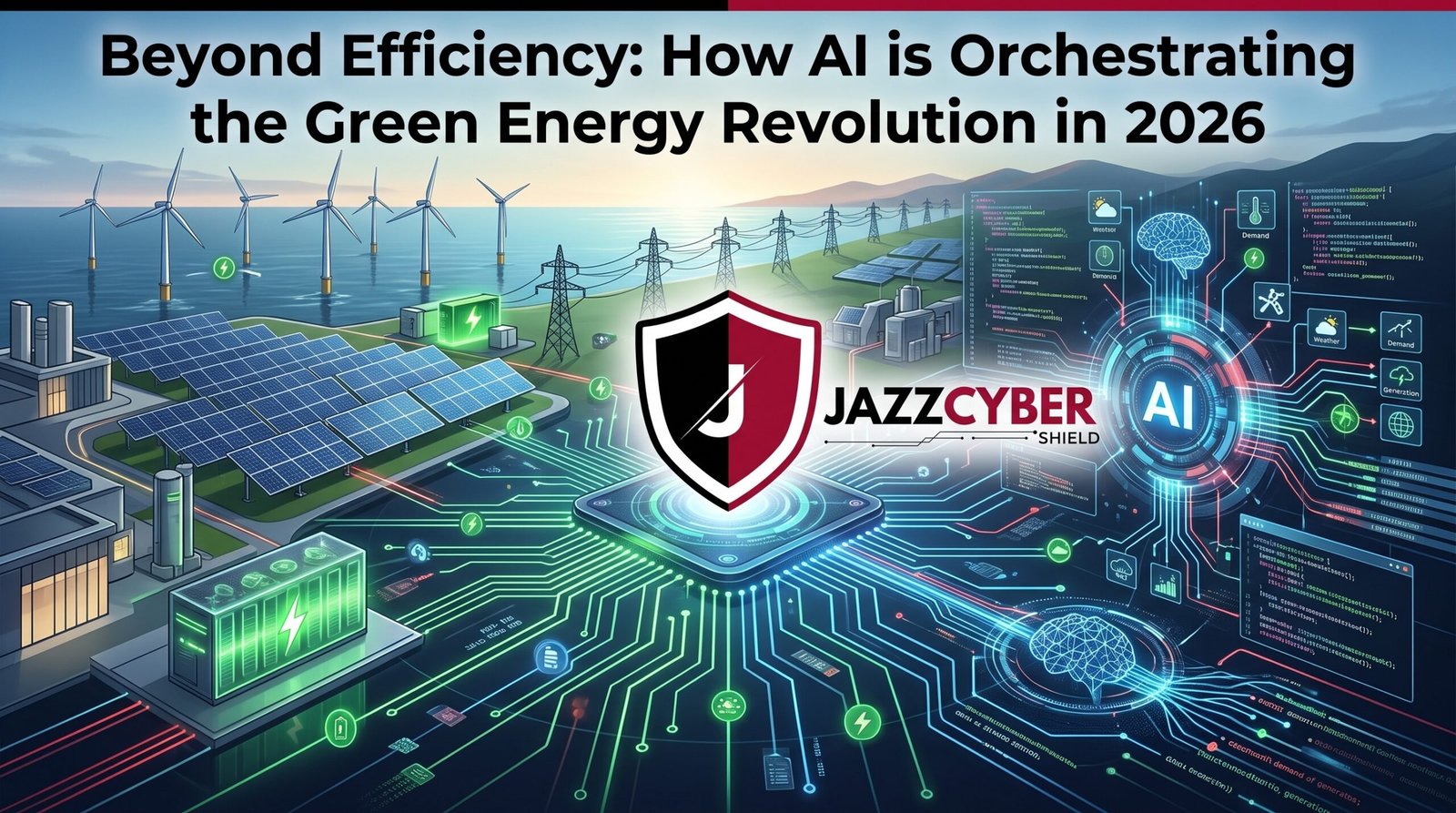
The AI Green Energy Revolution is no longer a Silicon Valley pitch deck — it is the operating system of the modern American power grid. In 2026, US tech giants like Google, Microsoft, Amazon, NVIDIA, and Meta have collectively poured tens of billions of dollars into artificial intelligence systems that manage smart grids, forecast hurricanes with superhuman accuracy, and predict wildfire spread in real time. What started as efficiency tweaks has become a full-scale orchestration of how the United States generates, distributes, and defends its energy future.
This story is bigger than data centers chasing clean power. It is the convergence of three forces that will define the next decade: AI for Climate Change, Smart Grid Management at national scale, and Tech Sustainability as a non-negotiable boardroom priority. Here’s how the AI Green Energy Revolution is reshaping 2026 — and what it means for every business that depends on a stable, secure, and increasingly intelligent network.
The Energy Crisis Behind the AI Boom
To understand the AI Green Energy Revolution, you have to start with a paradox: the same artificial intelligence systems driving climate solutions are also the largest new source of electricity demand in the United States. Training a single frontier AI model can consume as much electricity as 100 American households use in a year. Hyperscale data centers from Microsoft, Google, Amazon, and Meta are now competing directly with cities for grid capacity.
The response from Big Tech has been remarkable. Since 2022, Google has added 340 energy specialists to its workforce, while Microsoft has hired more than 570 energy professionals. All three of the major US hyperscalers — Amazon, Google, and Microsoft — now hold Federal Energy Regulatory Commission approval to trade electricity directly. In effect, the line between technology companies and energy companies has dissolved. Tech Sustainability is no longer a CSR slide; it is a survival strategy.
That convergence is why the AI Green Energy Revolution matters to every IT leader, business owner, and network operator. The same edge devices that secure your network — firewalls, switches, access points — sit downstream of grids being rebuilt by AI in real time. If you want to understand the full digital threat landscape, our guide on the top cybersecurity threats in 2026 provides the broader context.
How AI is Powering Smart Grid Management Across the US
Smart Grid Management used to mean a SCADA dashboard and a few dozen sensors. In 2026, it means machine learning systems ingesting real-time data from millions of distributed assets — rooftop solar panels, EV chargers, battery storage units, smart thermostats, and industrial loads — and rebalancing the grid every few seconds.
US utilities are now deploying fully automated AI control platforms that detect and isolate faults before customers even notice an outage. The biggest leap of the past two years has been AI’s ability to self-correct and learn on the job, transforming Smart Grid Management from a reactive discipline into a predictive one. The Virtual Power Plant concept — where thousands of distributed energy assets are aggregated and managed as a single coordinated resource — has moved out of pilot programs and into full production deployments across regional transmission organizations.
The results are tangible. AI-driven demand forecasting now reduces peak-load strain, integrates intermittent solar and wind generation more reliably, and optimizes energy flow with precision impossible for human operators. This is the operational backbone of the AI Green Energy Revolution, and it depends on something every IT professional understands: rock-solid network infrastructure. Utilities running these AI systems rely on enterprise-grade network switches and hardened access points to move telemetry from substations to control rooms without a single dropped packet.
Google’s Tapestry: Inside the AI Driving the National Grid
The most ambitious chapter of the AI Green Energy Revolution so far is Google’s Tapestry initiative — a moonshot from Alphabet’s X division that has now partnered directly with PJM Interconnection, the largest grid operator in the United States. PJM coordinates electricity for 65 million Americans across 13 states and the District of Columbia. Tapestry’s AI is being woven into PJM’s interconnection process, helping the operator approve new energy capacity faster and with greater confidence.
Starting in early 2026, PJM is launching a new cycle-based interconnection process where Tapestry’s AI models will play a foundational role. According to Page Crahan, General Manager of Tapestry, this partnership will allow PJM to make faster decisions, opening up more energy capacity for connection in shorter time frames. Amanda Peterson Corio, Head of Data Center Energy at Google, has framed the initiative as one of the most important responses to the AI era’s energy demands.
This isn’t just a technology story. It is a political and economic one. The PJM-Google partnership represents the first time a private AI company has been embedded so deeply into US grid operations. If it succeeds, it becomes the template for grid modernization across the country. If it stumbles, it could trigger regulatory backlash that reshapes how Big Tech and utilities collaborate. Either way, the AI Green Energy Revolution runs through this partnership.
Microsoft, Amazon, and Meta — AI Investments Reshaping Tech Sustainability
Google is not alone. Microsoft, Amazon, and Meta have each launched massive AI-driven sustainability programs of their own. Microsoft’s Aurora foundation model, with over a billion parameters, can be specialized for tasks ranging from air quality prediction to tropical cyclone tracking — often with greater precision and lower cost than traditional physics-based methods. Microsoft Research’s collaboration with Cambridge and the Alan Turing Institute on the Aardvark Weather model has produced an AI forecasting system that runs on a single desktop computer while matching the accuracy of national weather services.
Amazon’s AWS now powers some of the largest cloud-native smart grid platforms in the country, providing the elastic compute backbone for utilities running AI workloads. Meta has invested billions in nuclear power partnerships specifically to feed its AI infrastructure with carbon-neutral electricity. Together, these companies have made Tech Sustainability one of the most heavily funded engineering disciplines in the world.
For business leaders, the takeaway is straightforward: the cloud platforms you already use — AWS, Azure, Google Cloud — are themselves becoming nodes in the AI Green Energy Revolution. The data your business produces today is helping train the AI systems that will manage tomorrow’s grid. As enterprise data continues to grow, the demand for high-capacity, energy-efficient enterprise storage solutions is rising in lockstep.
AI for Climate Change — Predicting Wildfires Before They Spread
Smart grids are only one half of the AI Green Energy Revolution. The other half — arguably more dramatic — is AI for Climate Change applied to extreme weather prediction. Wildfires, in particular, have become a defining test case.
In April 2026, USC researchers published a breakthrough wildfire prediction model in the journal Remote Sensing. The system fuses high-resolution data from VIIRS polar-orbiting satellites with the GOES geostationary satellite to estimate fire ignition times with unprecedented precision, then runs physics-informed simulations to forecast a wildfire’s path, intensity, and growth rate in real time. For emergency responders, this is the difference between evacuating the right neighborhoods two hours early and finding out where the fire is going by watching it burn.
NVIDIA’s platforms now power similar disaster-response workflows by analyzing satellite and drone footage during hurricanes, wildfires, and floods. The ability to process visual data in real time helps responders prioritize evacuations and pinpoint infrastructure damage. AI for Climate Change is no longer an academic exercise — it is operational technology saving lives. To understand how AI is being applied across both defense and offense in 2026, our breakdown of how AI is being used to hack you in 2026 shows the full picture.
AI Hurricane Forecasting — How Google DeepMind Outperformed NOAA
Perhaps the most stunning proof point of the AI Green Energy Revolution came during the 2025 Atlantic hurricane season. Google DeepMind’s AI hurricane model accurately predicted both the path and the Category 5 intensity of Hurricane Melissa — the strongest storm ever to hit Jamaica — when traditional physics-based models disagreed wildly. James Franklin, a former branch chief at the National Hurricane Center, called Google DeepMind the best forecast guidance of the entire season.
Earlier in 2025, the same AI system outperformed the official US National Hurricane Center forecast on Hurricane Erin for the first 72 hours. This is the forecast window that triggers evacuations and disaster declarations, making the accuracy improvement a matter of public safety, not academic curiosity.
NOAA responded in February 2026 by deploying its own AI forecasting suite, AIGFS, built on a fine-tuned version of Google’s GraphCast model. AIGFS produces a complete 16-day forecast in approximately 40 minutes using just 0.3 percent of the computing resources required by NOAA’s traditional Global Forecast System. AI for Climate Change has officially gone operational at the federal level, marking one of the most consequential agency technology deployments of the decade.
NVIDIA Earth-2 and the Hardware Behind the Revolution
None of this would be possible without specialized compute. NVIDIA’s Earth-2 platform — built on the same accelerated computing infrastructure powering ChatGPT and Copilot — is now the de facto hardware backbone for AI weather and climate digital twins. Its FourCastNet model emulates atmospheric dynamics at a tiny fraction of traditional cost, while CorrDiff, NVIDIA’s generative downscaling model, turns coarse global forecasts into kilometre-scale guidance up to 1,000 times faster and 3,000 times more energy-efficient than conventional methods.
For NVIDIA’s Earth Day 2026 announcement, the company detailed five distinct environmental AI applications: rainforest deforestation monitoring, recycling plant automation, hurricane damage assessment, wildfire response, and biodiversity tracking. Each runs on the same GPU architecture that powers data center AI workloads — meaning the AI Green Energy Revolution and the broader AI compute boom are running on identical silicon.
That dual-purpose compute is reshaping how businesses think about AI hardware procurement. Whether you are building a private inference cluster or a small-business workstation for AI-assisted productivity, the underlying processors matter more than ever. Browse current high-performance options at our authorized AMD processor store for compute decisions that align with both performance and power efficiency goals.
What the AI Green Energy Revolution Means for Your Business in 2026
The AI Green Energy Revolution isn’t just a story about hyperscalers and federal agencies. Three concrete shifts now affect every business operating in the United States:
First, electricity costs and reliability are becoming AI-mediated. As utilities deploy AI-driven demand response, businesses with smart energy management systems will pay less and ride out grid stress better than those running legacy meters. Tech Sustainability is moving from a procurement question to a competitive moat.
Second, climate disasters are becoming forecastable on business-critical timelines. AI hurricane and wildfire models give operations leaders 24 to 72 additional hours to harden infrastructure, relocate inventory, and protect personnel. That window is the difference between a managed event and a catastrophic loss.
Third, the digital infrastructure carrying all of this — substations, control rooms, distribution feeders, edge sensors — is being rebuilt around always-on, low-latency networking. Whether your business is downstream of these AI systems or building on top of them, your network has to be ready. Hardened enterprise firewalls and high-performance access points are no longer optional in an environment where grid telemetry, AI inference, and operational data all flow over the same wires.
Frequently Asked Questions About the AI Green Energy Revolution
What is the AI Green Energy Revolution?
The AI Green Energy Revolution is the broad, accelerating use of artificial intelligence to manage power grids, integrate renewable energy, predict extreme weather, and reduce the environmental impact of digital infrastructure. In 2026, it is led primarily by US tech giants partnering with utilities and federal agencies.
How is AI used in Smart Grid Management?
AI is used in Smart Grid Management to forecast electricity demand, balance intermittent renewables like solar and wind, detect and isolate faults in real time, manage Virtual Power Plants, and optimize the flow of electricity across distribution networks at speeds impossible for human operators.
Can AI really predict hurricanes better than NOAA?
In several recent cases, yes. Google DeepMind’s AI hurricane model outperformed the official US National Hurricane Center forecast on multiple 2025 storms, including Hurricane Erin and Hurricane Melissa. NOAA itself has now deployed AI-based models for production forecasting in 2026.
Which tech companies are leading the AI Green Energy Revolution?
Google (with Tapestry and DeepMind), Microsoft (with Aurora and Aardvark Weather), NVIDIA (with Earth-2, FourCastNet, and CorrDiff), Amazon, and Meta are the primary US tech giants driving the revolution. Each has invested billions in AI for Climate Change, Smart Grid Management, and Tech Sustainability initiatives.
How does AI for Climate Change affect small businesses?
Small businesses benefit from earlier and more accurate weather warnings, more reliable electricity supply, lower long-term energy costs, and access to AI-powered sustainability reporting tools. The downside is rising data center demand pushing up regional electricity prices in some markets.
Final Word: The Revolution Has Already Started
The AI Green Energy Revolution is not a 2030 prediction or a 2040 roadmap. It is happening right now, in 2026, inside grid control rooms, federal weather offices, and hyperscale data centers across the United States. Google, Microsoft, NVIDIA, Amazon, and Meta have stopped treating energy as a cost line and started treating it as a strategic frontier. Federal agencies like NOAA are deploying AI in production. Utilities like PJM are rebuilding interconnection processes around machine learning.
For business leaders, the choice is no longer whether to engage with this revolution but how. The companies that align their IT infrastructure, sustainability strategy, and operational planning with the AI Green Energy Revolution will define the next decade. Those that don’t will spend it catching up. Explore hardened, energy-efficient enterprise IT hardware at the Jazz Cyber Shield store, or contact our team for a tailored consultation on building infrastructure ready for an AI-driven energy future.

