



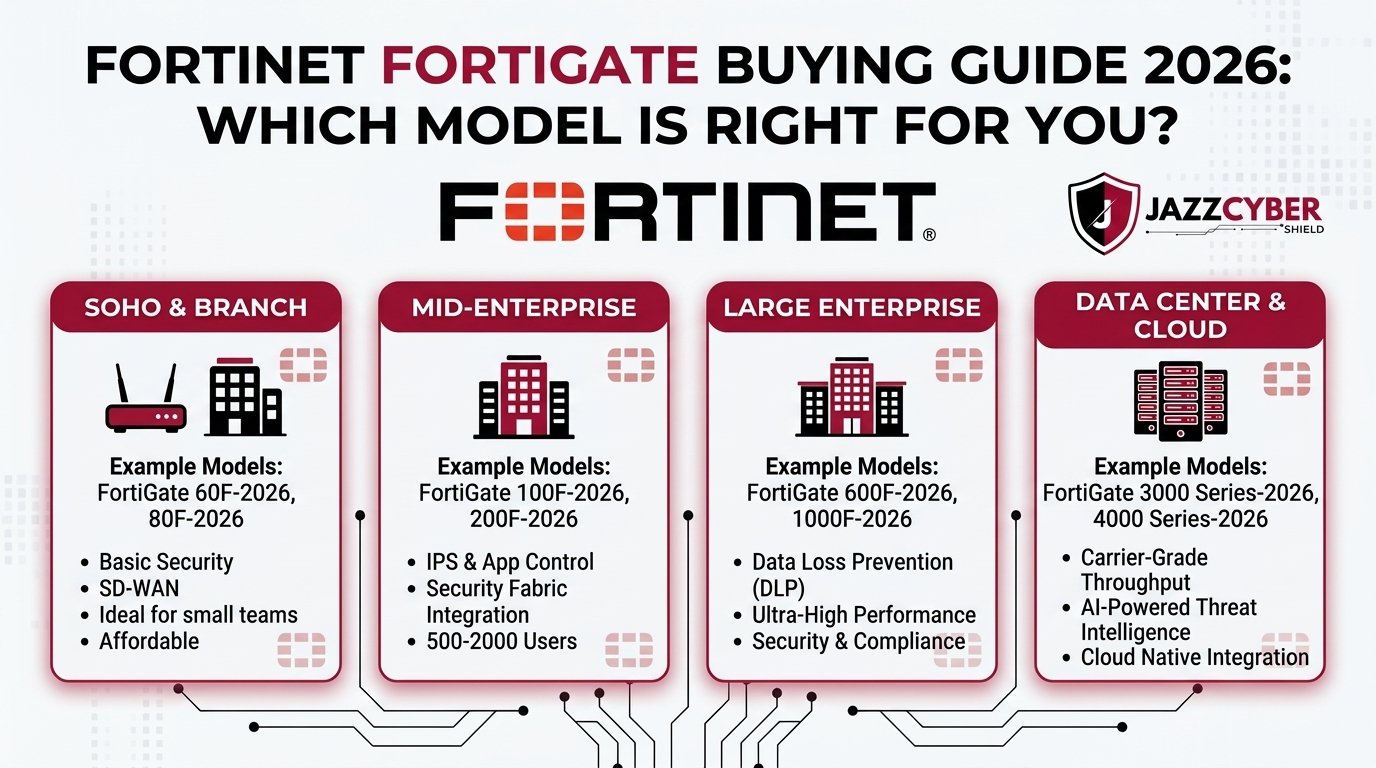
Stop Guessing — Getting the wrong FortiGate will cost you more than you think
Picking the right Fortinet FortiGate firewall isnt just a purchase move — it’s a security decision that kind of sets the tone for your whole network for the next 3–5 years.
You’ve probably already searched “best FortiGate model” and somehow ended up more mixed up than before. Entry level? Mid range? SMB? Enterprise? Even the model numbers — 40F, 60F, 100F, 200F, 600F — kind of feel like somebody just flinged darts at a label maker, and then shrugged.
Here’s the actual thing: Fortinet makes serious, solid hardware. But the wrong model either leaves cash sitting around, or—worse—leaves your network a little too open for comfort. A 40F just can’t cover a 500 user campus. Meanwhile a 600F can be complete extra for a 20 person office, especially when you’re spending $4,000 on features you will never use properly.
So this is meant to cut through all that noise. We’ve mapped the bigger FortiGate model options in 2026 to real deployment situations, and we’re giving you a decision framework that’s actually usable. No jargon walls, not that soft marketing fog, just the straightforward answer.
If you need a trusted place to shop vetted Fortinet hardware, check out our Fortinet firewall collection at Jazz Cyber Shield — every unit is genuine, licensed, and ready to deploy.
Table of Contents
The Scale of Fortinet’s Dominance in 2026
Fortinet isn’t only a firewall vendor either. It’s basically the most deployed network security platform out there.
In 2026, Fortinet has over 19% of the global firewall market share — more than any other single competitor. Their FortiGate family shows up across hospitals, school districts, banking and financial operations, government agencies, and Fortune 500 data centers.
And why should you care when you’re buying? Because scale means:
- Firmware updates tend to be quicker, and they get tested against real world attack patterns
- Community support is huge — you won’t be stuck alone when there’s a config issue that needs a human answer
- Third-party integrations (SIEM,SASE, SD-WAN) are pretty mature and stable, you know, most days it just works
⚠️ ALERT: Gartner’s 2025 Magic Quadrant placed Fortinet as a Leader in Network Firewalls for the 13th consecutive year. That’s not marketing — that’s institutional trust.
The Verizon 2025 Data Breach Investigations Report (opens in new tab) said 74% of breaches had network perimeter failures. FortiGate directly hits this attack surface— but only if you take the right model, not the first one you see.
Understanding FortiGate Buying Criteria
Before you pick a model number, lock in four things. Miss any one of them and yeah, you’ll end up buying kinda wrong
1. Throughput — What Your Network Actually pushes
Fortinet lists firewall throughput, threat protection throughput, and SSL inspection throughput. And yeah, these are three different kinds of numbers. The threat protection throughput , the one that includes IPS, Application Control, and AV on… is really the figure you should care about in production, no question.
Take a FortiGate 60F. It lists 10 Gbps firewall throughput, but once full threat protection is switched on, that drops down to roughly 700 Mbps. So if your ISP is really giving you 1 Gbps fiber, the 60F can end up acting like the bottleneck, almost immediately after you enable those security features.
2. Concurrent Sessions and New Sessions Per Second
High traffic places— like retail POS setups, healthcare portals, and education campus networks— tend to smash concurrent session totals. Sometimes a model looks fine on paper, then under everyday usage it basically chokes a bit, you know, like it can’t keep up.
3. User Count vs. Device Count
These words get blended together a lot. They are not the same, not even close. A 100 user office with BYOD behavior and a handful of IoT gadgets can easily turn into 400+ connected devices, and it happens faster than people expect. So you should size it based on devices , not just headcount.
4. Form Factor
Desktop-style boxes (40F, 60F, 80F) fit branch offices and smaller businesses. Meanwhile 1U rackmount units, the 100F up through 600F and beyond, are more at home in server rooms and data centers.
🔴 WARNING: Never buy a FortiGate based on firewall throughput alone. That number is measured with zero security features enabled. Always check the Threat Protection throughput figure — that’s your real-world ceiling.
You can also see how VLANs play with your FortiGate deployment in our guide on VLAN setup, both for home networks and business networks.
FortiGate Models: Full 2026 Lineup Breakdown
Here’s the complete breakdown of the main FortiGate models for 2026, but only with the numbers that truly affect what you buy.
🖥️ Entry-Level — Desktop Series
| Model | Best For | Threat Protection Throughput | Max Users (Recommended) | Price Range |
|---|---|---|---|---|
| FortiGate 40F | SOHO / Home Office | 200 Mbps | Up to 25 | ~$350–$500 |
| FortiGate 60F | Small Office | 700 Mbps | Up to 50 | ~$600–$900 |
| FortiGate 80F | Branch Office | 900 Mbps | Up to 75 | ~$900–$1,300 |
FortiGate 40F — The starting point. It’s pretty solid for remote workers, home offices, and tiny micro-businesses. It supports SD-WAN, some baseline IPS, and FortiGuard services. But don’t assume it will be all smooth if you push it past around 25 users, or if you keep it busy with more than 200 Mbps of active traffic, day after day.
FortiGate 60F — probably the default SMB selection in 2026. NP6Lite network processor means it has more performance room to work with. This one fits small retail, dental practices, and professional
FortiGate 80F — basically the bridge, between small and mid-market, it adds more ports, more session capacity, and SSL inspection performance that actually feels noticeably better. So yeah, the price jump is usually worth it if you’re growing past 50 users, or you can feel you’re about to.
🗄️ Mid-Range — 1U Rackmount Series
| Model | Best For | Threat Protection Throughput | Max Users (Recommended) | Price Range |
|---|---|---|---|---|
| FortiGate 100F | SMB / Multi-site | 1 Gbps | Up to 150 | ~$1,800–$2,800 |
| FortiGate 200F | Mid-Market | 3 Gbps | Up to 300 | ~$4,000–$6,500 |
| FortiGate 400F | Large Branch / Mid-Enterprise | 9 Gbps | Up to 600 | ~$10,000–$15,000 |
FortiGate 100F — this is when the networking starts getting “serious”. The FG-100F runs on Fortinet’s NP6 and CP9 ASICs, so you get hardware-accelerated threat protection, not just vague marketing stuff. It’s a strong fit for multi-location businesses, managed service providers, and organizations that have compliance requirements (HIPAA, PCI-DSS) and need things to stay tight.
FortiGate 200F — the workhorse of the mid-market, plain and simple. If you’re sitting around 100–300 users with active SSL inspection, IPS, and application control enabled, this is the unit you tend to land on. It handles encrypted traffic at scale without turning your usable performance into a sad, choppy mess, and honestly that matters more than most teams want to admit.
FortiGate 400F — enterprise level muscle, yet still priced in a way that ambitious mid market buyers can justify. Full NP7 ASIC acceleration. A solid fit for big campuses, regional HQ deployments, or MSPs that deal with heavy traffic customers over and over.
FORTINET FORTIGATE LATEST PERFORMANCE TIERS — 2026

┌────────────────────────────────────────────────────────┐
│  ENTRY          MID-RANGE          ENTERPRISE          │
│                                                        │
│  40F  60F  80F  100F  200F  400F  600F  1000F  3000F  │
│  │    │    │    │     │     │     │     │       │      │
│  └─SOHO─┘  └BR┘ └────SMB────┘    └───ENTERPRISE───┘  │
│                                                        │
│  Threat Protection: 200M → 700M → 9G → 30G → 100G+   │
│  Users:           25 → 50 → 150 → 600 → 5,000+        │
└────────────────────────────────────────────────────────┘
🏢 Enterprise Series — 600F and Above
The FortiGate 600F delivers up to 9 Gbps threat protection throughput and is built for large enterprise edge deployments. After that, you’re looking at the 1000F, 2000F, 3000F, and 7000 series — and honestly that’s carrier-grade or hyperscale data center territory, not “standard office” territory.
For most businesses reading this guide, the 40F through 400F covers basically every real-world scenario you’ll run into. If you’re evaluating 600F+, then you already have a Fortinet reseller relationship, and this isn’t your first firewall purchase either.
Shop our full lineup of business firewalls including FortiGate models ready to ship.
Which FortiGate Model Is Right for Your Business?
Stop overthinking it. Just match your scenario to this grid, ok.
You’re a home office or freelancer (1–5 users) → FortiGate 40F. Done… clean, affordable, and more than enough firewall for your connection.
If you’re running a small business, under 50 users → get a FortiGate 60F if you’re staying under about 500 Mbps active throughput. If you’re getting close to that ceiling, or you expect growth in the next 18 months, then the step up is the 80F
Now if you’re in that50–150 users range , plus a server room and you know you’ll have real internal traffic → FortiGate 100F. Honestly this is probably the most under-specified zone. You’ll see people grab a 60F for 100 users , then they’re like “why does everything crawl” , and it’s usually because the box is just not sized right
When you have multiple locations, an actual IT team, and compliance expectations → FortiGate 200F at minimum. If you’re managing SD-WAN across sites, this is also where the ROI on that ASIC acceleration starts looking pretty undeniable, in a pretty practical way
For an enterprise, or an MSP running large environments → FortiGate 400F or 600F. And if you’re living in cloud-hybrid reality, don’t forget to look at the FortiGate VM options too, those can fit cleanly
🔴 WARNING: Buying a model that’s “just enough” today usually means buying again in 18 months. Factor 30–40% headroom into your throughput calculations.
FortiGate vs. the Competition in 2026
How does FortiGate stack up against the other major players in 2026?
| Feature | FortiGate | SonicWall | WatchGuard | Cisco Firepower |
|---|---|---|---|---|
| ASIC Hardware Acceleration | ✅ Yes (NP7) | ❌ No | ❌ No | ❌ No |
| SD-WAN Built-In | ✅ Yes | ⚠️ Limited | ⚠️ Limited | ❌ Separate license |
| SSL Inspection at Scale | ✅ Strong | ⚠️ Performance drops | ⚠️ Moderate | ✅ Strong |
| Licensing Simplicity | ⚠️ Complex bundles | ✅ Simpler | ✅ Simple | ❌ Very complex |
| Entry Price | $$ | $ | $$ | $$$ |
| Best For | SMB to Enterprise | SMB | SMB | Enterprise |
Fortinet’s biggest differentiator is their custom ASIC chips. Every other vendor mostly runs the security functions on general-purpose CPUs. So when you enable IPS, AV, and SSL inspection at the same time, the throughput on everyone else tends to fall off hard. FortiGate does drop as well, but much less , because the heavy lifting is offloaded to dedicated silicon
If you’re comparing SonicWall or WatchGuard as alternatives, it’s worth checking their ranges side by side with what you’re considering, especially the SonicWall firewall range and the WatchGuard firewall options
FortiGate Licensing: What You Actually Need
This part is where buyers get burned. The hardware is just the chassis. FortiGuard subscription services are where the real security power shows up — and the bundle structure confuses a lot of people
The three main bundles:
UTP (Unified Threat Protection) — IPS, Application Control , Web Filtering, Antivirus, Antispam, FortiCare support. It’s basically the usual SMB package, and yeah most companies can start here.
ENT (Enterprise) — Everything in UTP plus Industrial Security, OT security features, and extra threat intelligence, more or less. This one is for regulated environments where compliance matters.
ATP (Advanced Threat Protection) — Everything in UTP plus FortiSandbox Cloud, plus deeper malware analysis. Think high-security setups that handle sensitive data, end of story.
CISA guidance on network perimeter security (opens in new tab) — available at cisa.gov — really pushes the idea of keeping security appliances on active update subscriptions. NIST SP 800-41 on firewall policies (opens in new tab) at nist.gov lines up with that pretty directly.
Licensing terms are usually 1, 3, or 5 years. If you can, grab the 3-year bundles, because the per-year cost drops a lot , and you keep pricing locked in longer.
How to Buy FortiGate the Right Way
Don’t just toss a model number into a cart. Do the process, kinda in order.
Step 1: Audit your current throughput. Grab real numbers from your ISP and from your current router logs. You want peak concurrent sessions, not just what your ISP says the bandwidth “should” be.
Step 2: Plan for growth over 24 months. If you’re at 80 users now , and you expect 130 in two years, size for 130 right away. Hardware is cheaper than a forklift upgrade halfway through the contract, generally.
Step 3: Figure out your security feature stack. Are you going full UTM (IPS + AV + Web Filter + App Control + SSL inspection) or a pared down approach. Keep in mind you’ll need to budget for that performance hit on the hardware side, and plan the licensing bundle around it kinda early before you buy anything.
Step 4: Decide on new versus refurbished. Certified refurbished FortiGate units are legit, especially for budget aware SMBs. You should confirm the unit is de-registered from any previous owner’s FortiCloud account, and make sure it’s eligible for a fresh FortiGuard subscription , so you’re not stuck.
Step 5: Buy from an authorized source. There are gray market FortiGate devices floating around. They’re cheaper for a reason: firmware is often locked , licenses are expired and not really renew able, or the unit is registered in some other region where the encryption export rules are different or weird.
Also check our post about router settings you need to change before deployment — these line up directly with FortiGate initial setup stuff.
Quick Reference Checklist
Use this before you finalize any FortiGate purchase.
PRE-PURCHASE FORTIGATE CHECKLIST — 2026
━━━━━━━━━━━━━━━━━━━━━━━━━━━━━━━━━━━━━━

SIZING
[ ] Know your THREAT PROTECTION throughput ceiling (not firewall throughput)
[ ] Counted devices — not just users
[ ] Added 30-40% headroom for growth
[ ] Matched form factor (desktop vs. rackmount) to physical space

FEATURES
[ ] Decided on SSL inspection (yes = need more throughput)
[ ] Confirmed SD-WAN requirement (yes = FortiGate is even stronger choice)
[ ] Identified compliance requirements (HIPAA/PCI = 100F minimum + UTP or ENT bundle)

LICENSING
[ ] Chosen FortiGuard bundle (UTP / ATP / ENT)
[ ] Selected subscription term (3-year recommended)
[ ] Verified firmware is current on unit before deployment

PURCHASE
[ ] Buying from authorized reseller
[ ] Confirmed no previous owner registration
[ ] Verified eligible for fresh FortiGuard subscription
[ ] Have support contact for initial configuration

━━━━━━━━━━━━━━━━━━━━━━━━━━━━━━━━━━━━━━
Frequently Asked Questions
Q: Can I run a FortiGate without FortiGuard subscription services?
A: Technically yes. The hardware still works as a stateful firewall. But then you lose IPS signature updates, the threat intel feeds, web filtering categories , and antivirus definitions. You’d basically be running a firewall with 2023 threat knowledge in 2026. That’s not the move.
Q: Is a refurbished FortiGate a good buy?
A: Usually yes, as long as it comes from a reputable source. Verify FortiCloud de-registration, check the hardware revision, and confirm it can take a new FortiGuard license. Jazz Cyber Shield sells certified units, not gray market hardware.
Q: What FortiGate model do I need for HIPAA or PCI compliance?
A: A minimum of FortiGate 100F, with a UTP or ENT bundle. You’ll need SSL inspection, IPS, application control, and solid logging to satisfy the technical safeguard requirements. Smaller models often can’t handle the throughput to run everything at once under real production load, so they get strained quickly.
Q: How long does a FortiGate last before replacement?
A: Usually about 5–7 years on the hardware side, though you really should plan around Fortinet’s End of Support lifecycle. Once a model hits EOS, firmware updates stop, and FortiGuard compatibility stops too. So I’d buy units that still have at least 4-5 years of remaining support life, ok?
Conclusion
Honestly, the FortiGate lineup in 2026 is the strongest it’s ever looked. ASIC acceleration, built in SD-WAN, a mature security fabric, and then models that stretch from home offices all the way to hyperscale data centers. It’s genuinely one of the most complete firewall platforms out there.
Still, none of that matters if you pick the wrong model. Size for threat protection throughput, don’t just “feel it” later. Count endpoints and access devices, not only users. Leave some headroom for growth, because things will expand even if you don’t plan for it. And make sure the licensing bundle matches your actual risk profile, not what you wish your risk profile was.
For small businesses: FG-60F or FG-80F. For SMB and mid-market: FG-100F or FG-200F.
For enterprise: 400F and up. It really is that straightforward once you have the right data.
Browse our Fortinet firewall collection and pick the right FortiGate model — every unit is genuine, properly licensable, and ready to deploy. Questions? Our team knows this product line pretty deep.
Related Reading
- VLAN Setup for Home and Business Networks in 2026
- Router Settings You Must Change Before Going Live
- WPA2 vs WPA3: What’s the Real Difference?

