



A critical cPanel vulnerability tracked as CVE-2026-41940 is now the most dangerous flaw of 2026, putting roughly 1.5 million internet-exposed servers at risk of complete takeover. With a CVSS score of 9.8, no authentication required, and confirmed in-the-wild exploitation since February — two months before the patch dropped — this is one of the most consequential web hosting bugs of the decade. If your business runs WordPress on shared hosting, manages a reseller account, or operates any cPanel/WHM control panel, you need to patch in the next few hours, not days.
This guide breaks down exactly what the cPanel vulnerability does, who is being targeted, how attackers chain it into root access, and the 7-step emergency response every IT team should run today. We have also included detection signatures, indicators of compromise, and the firewall rules that should sit in front of every WHM port from now on.
Quick TL;DR CVE-2026-41940 is a CRLF-injection authentication bypass in cPanel & WHM. An unauthenticated attacker injects fake “already authenticated” flags into a session file, then reloads the session as root — no password, no 2FA, no logs of a failed login. Patch to cPanel 11.136.0.5 (or your branch’s fixed version) and audit
/var/cpanel/sessions/raw/immediately.
Table of Contents
What Is the cPanel Vulnerability CVE-2026-41940?
The cPanel vulnerability is a pre-authentication remote attack against the cpsrvd service daemon — the process that handles every cPanel, WHM, and Webmail login on ports 2082, 2083, 2086, 2087, 2095, and 2096.
Here is the technical core in plain English. When you hit the cPanel login page, the server creates a temporary “guest” session file on disk before your password is ever checked. Researchers at Rapid7 and watchTowr Labs found that the server writes the contents of your HTTP Authorization header into that session file without sanitising newline characters. By injecting raw \r\n sequences, an attacker can append fake key-value pairs into the file — including user=root, hasroot=1, tfa_verified=1, and successful_internal_auth_with_timestamp. The next time the server reads that session, it treats the request as a fully authenticated root login. Password validation is skipped entirely — the system literally never consults /etc/shadow.
Key facts about the cPanel vulnerability:
- CVE ID: CVE-2026-41940
- CVSS v3.1 score: 9.8 (Critical)
- CWE classification: CWE-306 — Missing Authentication for Critical Function
- Disclosure date: April 28, 2026 (cPanel TSR advisory)
- Public PoC released: April 29, 2026 (watchTowr Labs)
- CISA KEV listing: April 30, 2026
- Exploitation observed since: February 23, 2026 (60+ days as a zero-day)
- Affected products: All cPanel & WHM versions after 11.40, including DNSOnly, plus WP Squared
- Fixed versions: cPanel & WHM 11.136.0.5; WP Squared 136.1.7
- Authentication required: None
- User interaction required: None
- Internet-exposed targets: ~1.5 million per Shodan
- Active scanner IPs: ~44,000 unique sources (Shadowserver Foundation)
Why This cPanel Vulnerability Is the Most Dangerous Flaw of 2026
Three factors stack up to make this cPanel vulnerability an industry-wide emergency rather than a routine patch.
First, the install base is enormous. cPanel sits underneath an estimated 70+ million domains and roughly 94% of the world’s hosting control panel market. Almost every shared hosting provider on earth — including major brands like Bluehost, HostGator, Namecheap, A2 Hosting, and SiteGround variants — runs cPanel/WHM at the infrastructure layer. One bug equals a massive blast radius.
Second, exploitation is trivial. The attack is a handful of HTTP requests with no credentials and no user interaction. Anyone who can reach ports 2083 or 2087 over the internet can take over the host in seconds. A naive Shodan query returns about 1.5 million exposed instances.
Third, the patch is two months late. KnownHost and watchTowr both confirm exploitation predates the public advisory by roughly 60 days. That means many compromised servers already have web shells, cron-job backdoors, and SSH key persistence in place — patching alone will not evict an attacker who is already inside. This is why every responder must treat the patch as Step 1, not the final step.
For a deeper look at how 2026’s CVE-driven attacks fit together, our team’s earlier breakdown of the SonicWall CVE-2026-0204 firewall flaw shows the same pattern: silent zero-day exploitation, late vendor disclosure, and a frantic 72-hour patch window.
Who Is Affected by This cPanel Vulnerability?
If you fall into any of these buckets, you must assume you are a target.
- Shared hosting customers — even if you do not manage the server, your WordPress site, database, and email are all stored on a cPanel host. A compromised host equals compromised tenants.
- Reseller hosts — every cPanel account you provision sits on a shared WHM that an attacker can fully control.
- Managed WordPress providers — WP Squared customers are explicitly in scope.
- MSPs and IT service providers — CVE-2026-41940 has already enabled 44,000 IP attacks across global networks within 24 hours of disclosure, with MSPs as a primary target because compromising one MSP yields hundreds of downstream tenants.
- Government and military domains — confirmed targeting includes
.mil.ph,.gov.la, and government domains in Canada, South Africa, and the United States. - Small business owners running on cPanel VPS — DigitalOcean, Linode, Hetzner, and AWS Lightsail customers who installed cPanel themselves are 100% on the hook for patching.
Bottom line: if you cannot say with certainty that your stack does not include cPanel anywhere, treat yourself as exposed.
How Hackers Exploit the cPanel Vulnerability — The 4-Stage Attack Chain
Cato Networks and watchTowr have documented the full exploitation chain. Understanding each step helps your blue team write the right detections.
Stage 1 — Pre-auth session creation. The attacker sends a deliberately failing login request to /login/?login_only=1. cpsrvd still creates a temporary session file under /var/cpanel/sessions/raw/ and hands the attacker a whostmgrsession cookie that maps to it.
Stage 2 — CRLF injection. Using a crafted Basic auth header, the attacker injects \r\n characters into the password field. The unsanitised payload — typically containing user=root, hasroot=1, tfa_verified=1, and a successful_internal_auth_with_timestamp line — gets appended to the session file as new top-level entries.
Stage 3 — Session reload as root. The attacker triggers a re-read of the session file. cpsrvd parses the injected lines as legitimate session state and promotes the connection to a fully authenticated root WHM session.
Stage 4 — Persistence and lateral movement. With WHM root API access, attackers commonly drop SSH keys into /root/.ssh/authorized_keys, install custom WHM hooks, abuse package management for code execution, weaponise PHP-FPM configurations, and pivot to every cPanel tenant on the box. From there, the host becomes infrastructure for phishing pages, malware staging, JavaScript injection on every hosted site, and SEO poisoning campaigns.
The whole chain is about a dozen HTTP requests and zero credentials.
7 Signs Your Server Is Already Compromised
Before you patch, run these triage checks. Patching a server that is already compromised will leave the attacker in place.
- Suspicious session files. Inspect
/var/cpanel/sessions/raw/for files containinguser=root,hasroot=1,tfa_verified=1, orsuccessful_internal_auth_with_timestamp— especially in pre-auth (failed-login) sessions. - CRLF artefacts in
pass=fields. Look for embedded\ror\nbytes inside any session file’spass=value, or apass=line followed on the next line by another key-value pair. - Anomalous cpsrvd logs. Search for 401 responses on
/login/?login_only=1immediately followed by a successful Basic-auth request to a non-/loginURL from the same IP. - New WHM users you did not create. Audit WHM → “List Accounts” and
/etc/passwdfor unfamiliar entries. - Unexpected SSH keys in
/root/.ssh/authorized_keysor any tenant home directory’s.ssh/. - New cron jobs in
/etc/cron.d/,/var/spool/cron/, or any user crontab. - Modified bash profiles — check
/root/.bashrc,/root/.bash_profile, and any shell-rc file for outbound callbacks or curl-piped scripts.
If any of these light up, treat the box as fully compromised and rebuild from clean media — do not just remove the artefacts.
How to Patch the cPanel Vulnerability in 7 Steps
Here is the exact sequence every IT team should run today.
Step 1 — Patch cPanel & WHM immediately. Run /scripts/upcp --force to pull the latest version. Confirm with /usr/local/cpanel/cpanel -V — you need 11.136.0.5 or your branch’s fixed release. WP Squared customers need 136.1.7 or later.
Step 2 — Run the cPanel detection script. cPanel’s official advisory ships a filesystem-triage script. Run it as root and review every flagged session file.
Step 3 — Restrict WHM and cPanel ports. Lock ports 2082, 2083, 2086, 2087, 2095, and 2096 to known administrative IP ranges only. This single change neutralises 95% of the public attack surface.
Step 4 — Rotate every credential. Reset the root password, every WHM user password, every cPanel tenant password, every email account, and every API token issued before April 28, 2026. Assume they all leaked.
Step 5 — Audit persistence locations. Check /etc/, /usr/local/cpanel/, ~/.bashrc, ~/.ssh/authorized_keys, every cron path, and every PHP-FPM pool config for unauthorised modifications.
Step 6 — Deploy a next-gen firewall in front of cPanel. A properly configured firewall with IPS signatures for CVE-2026-41940 will block the exploit even on unpatched hosts. We strongly recommend running a SonicWall, Fortinet, or WatchGuard appliance from our enterprise firewalls collection in front of any internet-exposed control panel.
Step 7 — Subscribe to managed threat intelligence. Enable IPS virtual patching from your firewall vendor and integrate CISA KEV alerts into your patch-management workflow. Time-to-exploit is now sub-24 hours for most critical CVEs in 2026.
Long-Term Defense — Architect Around the Next cPanel Vulnerability
This will not be the last critical bug in cPanel, WHM, or any control panel. The 2026 threat landscape — driven by AI-assisted exploit development — has collapsed the patch window to hours, not weeks. Your architecture has to assume the next zero-day is already live.
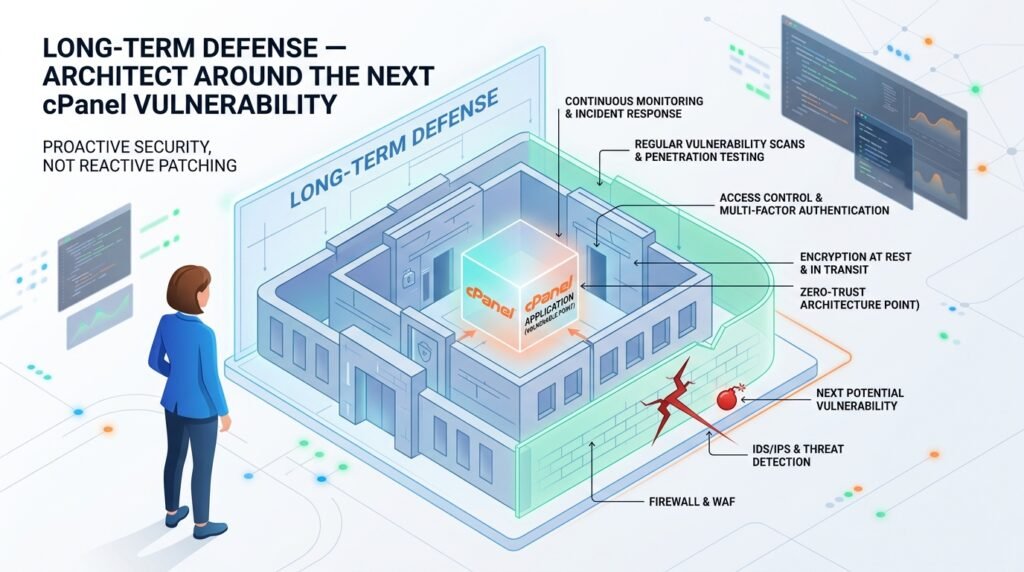
Adopt zero trust at the edge. Never expose a hosting control panel directly to the public internet. Place every WHM, Plesk, DirectAdmin, and Webmin behind a Zero Trust Network Access (ZTNA) gateway that requires identity-based authentication before the TCP handshake even completes. Our complete Zero Trust Network Security guide for 2026 walks through the implementation path step by step.
Layer in a next-gen firewall. A modern UTM appliance with deep packet inspection, IPS signatures, and geo-IP blocking shuts down 44,000 scanner IPs in a single rule. The 2026 attack data clearly shows that small businesses without a perimeter firewall are being hit first. Our buyer’s guide to the best firewalls for small businesses in 2026 compares SonicWall, Fortinet, and Cisco hardware at every price point.
Monitor every device on your network in real time. If you cannot see it, you cannot protect it. Use the workflow in our free network monitoring tools guide to baseline normal traffic and catch the post-compromise lateral movement that always follows a CVE like this one.
Take ransomware preparation seriously. Akira and other groups are now using firewall and control-panel CVEs as their primary entry vector. Read our Akira ransomware SonicWall survival guide for the playbook on stopping the second-stage encryption that follows credential theft.
Frequently Asked Questions About the cPanel Vulnerability
Q1. Is the cPanel vulnerability fixed if my host upgraded yesterday? The patch closes the bug, but it does not remove an attacker who got in during the 60-day zero-day window. Patch first, then audit for persistence.
Q2. Does this cPanel vulnerability affect Plesk or DirectAdmin? No — CVE-2026-41940 is specific to cPanel & WHM and WP Squared. However, Plesk and DirectAdmin have had their own auth-bypass issues in 2025-2026 and should be patched on the same urgency level.
Q3. My host says they are not affected. How do I verify? Ask them for the exact cPanel build number — it must be 11.136.0.5 or the equivalent on your branch. If they cannot give you a build number, assume unpatched.
Q4. Should I take my site offline to patch? No. The upgrade itself is non-disruptive. Restricting ports 2087/2083 to admin IPs (Step 3) is the single change that immediately stops external exploitation while you patch.
Q5. Will a Web Application Firewall (WAF) protect me? Cloudflare, Cato, and most enterprise WAF vendors released emergency rules for CVE-2026-41940 between April 30 and May 2, 2026. A WAF helps but is not a substitute for patching the host itself.
Q6. Is WordPress affected by this cPanel vulnerability? WordPress itself is not vulnerable, but every WordPress site hosted on a compromised cPanel server is fully exposed — attackers can read wp-config.php, swap admin passwords, inject malware into themes, and exfiltrate the database in seconds.
Final Word — The cPanel Vulnerability Is a Wake-Up Call for 2026
The cPanel vulnerability CVE-2026-41940 is the third critical perimeter bug of 2026 after the SonicWall and Cisco firewall flaws, and the pattern is now unmistakable: pre-authentication, zero-click, network-reachable bugs are being weaponised within hours of disclosure — and frequently before disclosure. Time-to-exploit has effectively gone negative.
For every business that runs websites, email, or applications on cPanel hosting — which is most of the internet — the answer is not just to patch this one CVE. It is to architect every server, every control panel, and every admin interface as if a remote root bug is sitting in it right now. Patch fast, restrict by IP, place a next-gen firewall in front of everything, and assume the next zero-day arrives next month.
If you need the hardware to build that perimeter, the team at Jazz Cyber Shield stocks SonicWall, Fortinet, Cisco, WatchGuard, and HPE Aruba appliances at authorised-reseller pricing, with US shipping and full configuration support. The cost of a firewall is always lower than the cost of a single ransom payment after a control panel compromise.
Patch CVE-2026-41940 today. Then build the architecture that survives the next one.


The urgency around CVE-2026-41940 is staggering given the CVSS 9.8 score and the fact that it requires no authentication to bypass. It really highlights how critical immediate patching is for any server still running exposed cPanel instances in 2026. Are you seeing many organizations successfully mitigating this by segmenting their network access while waiting for the full patch deployment?
This vulnerability really underscores how many servers are exposed, especially those running older cPanel versions. It seems like a critical moment for admins to not only patch but also review access controls and monitoring practices to minimize risk.