



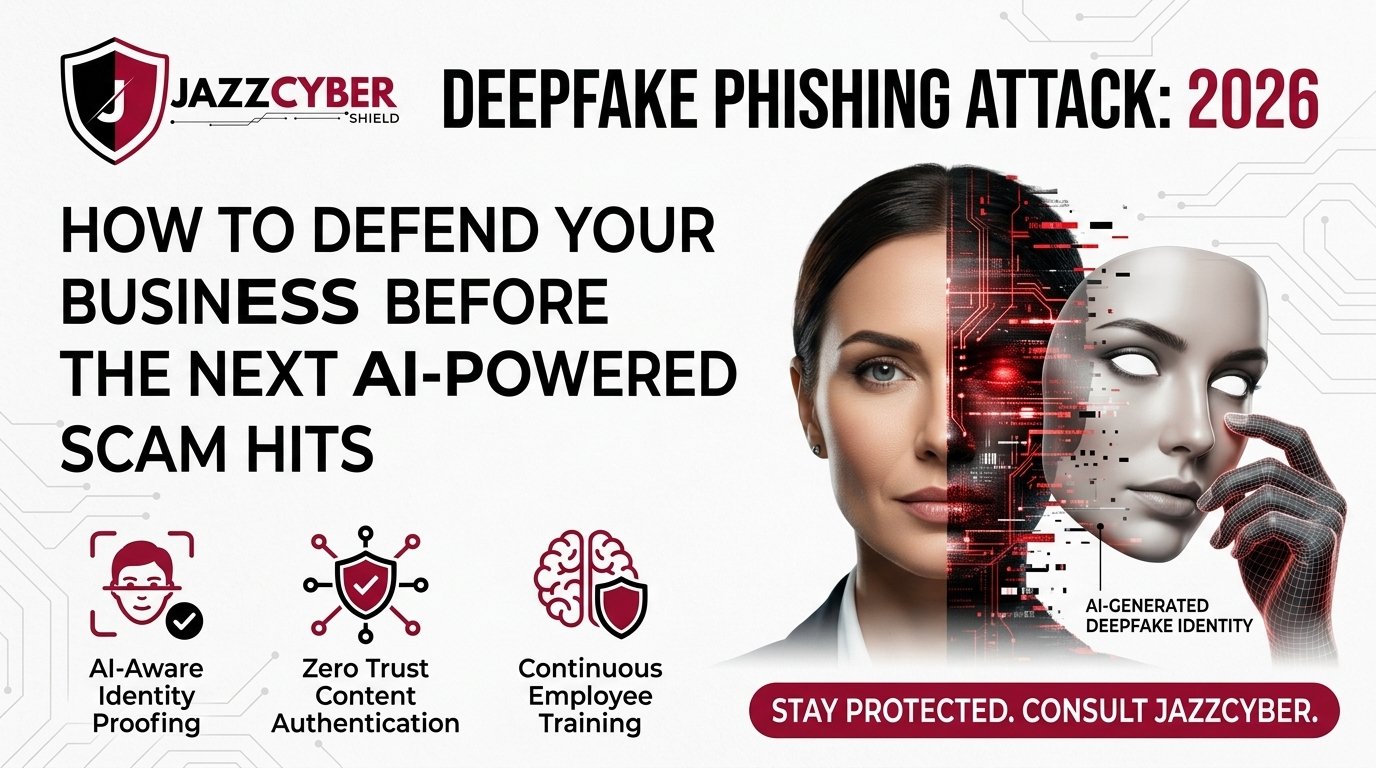
A deepfake phishing attack in 2026 no longer looks like the broken-English email scam your team learned to ignore a decade ago. It now sounds exactly like your CFO on a Zoom call asking for an urgent wire transfer, or like your IT manager leaving a calm voicemail asking you to reset a password. Generative AI has compressed what used to take a skilled fraudster weeks of research into a 30-second voice clone and a real-time video filter — and the financial damage is showing up everywhere.
This guide breaks down how a modern deepfake phishing attack actually works, why small and mid-sized businesses are the prime target, and the seven layered defenses that actually stop it before money leaves your account.
Table of Contents
What Is a Deepfake Phishing Attack?
A deepfake phishing attack is a social engineering scam that uses AI-generated voice, video, or text to impersonate a real, trusted person — usually a CEO, CFO, IT administrator, vendor, or banker — in order to trick an employee into transferring money, sharing credentials, approving a contract, or installing malware.
Three things separate it from old-school phishing:
- Realism. AI voice cloning needs as little as three seconds of public audio — a podcast clip, a webinar recording, a LinkedIn video — to clone a voice convincingly.
- Speed. A single attacker can generate thousands of personalized phishing emails per hour using large language models, each one tuned to a specific recipient.
- Multimodality. A single campaign can blend an AI-written email, a deepfake voicemail, and a fake video meeting in the same workflow, defeating most “check by phone” verification habits.
The FBI’s Internet Crime Complaint Center already attributes more than $6.3 billion in 2024 alone to business email compromise — and the 2025 Verizon Data Breach Investigations Report identified phishing as the driver of 36% of confirmed breaches. AI tooling has only accelerated the curve.
How a Deepfake Phishing Attack Works in 2026
Most successful deepfake phishing campaigns follow a predictable five-stage chain:
Stage 1: OSINT and target selection
Attackers scrape LinkedIn, company websites, podcast archives, YouTube, conference recordings, and social media for two things: a target’s role and their boss’s voice. Anyone with public audio is now a viable impersonation target.
Stage 2: AI voice or video cloning
Using freely available text-to-speech and face-swap tools, the attacker builds a voice model that captures intonation, accent, and breathing patterns. For high-value targets, they also build a real-time video filter that runs during a Zoom or Teams call.
Stage 3: AI-generated lure
A large language model writes a personalized email or chat message in the target’s writing style — often referencing a recent product launch, quarterly close, vendor invoice, or HR change pulled from public news.
Stage 4: Multi-channel pressure
The attacker stacks channels: an email arrives “from the CEO,” followed by a voicemail, followed by a Slack or Teams message. The redundancy is the trap. Each new channel feels like extra confirmation, not extra suspicion.
Stage 5: The ask
The final request is always urgent and always financial: a wire transfer to a “new vendor,” a credential reset, an approval for a payroll change, or a request to install a “secure remote access” tool that is actually malware.
In recent SMB cases, this entire sequence — recon to payout — completes in under two business days. For deeper context on how attackers chain these techniques into ransomware deployments, read our analysis of SonicWall CVE-2026-0204 and the broader edge attack surface.
Real-World Examples of Deepfake Phishing in 2026
The threat is not theoretical. Across the past year, defenders have documented:
- A finance employee at a multinational firm who joined what appeared to be a video call with the CFO and several colleagues — every face on the call was an AI deepfake. The employee approved a multi-million-dollar transfer.
- A wave of vishing campaigns where AI-cloned voices of IT support staff convinced employees to read out MFA codes during “scheduled” password resets.
- A series of BEC attacks where AI-written emails referenced internal project names and recent acquisitions with enough accuracy to bypass employee suspicion.
- Insurance and managed IT firms reporting a surge in claims tied to deepfake-driven payroll diversion fraud.
Microsoft’s recent SMB research found that 88% of ransomware breaches now hit small and mid-sized businesses — and a growing share of those incidents start with an AI-augmented social engineering call rather than a malware-laden attachment.
Why Small Businesses Are the Prime Target
Three structural realities make SMBs the favorite target of deepfake phishing operators:
- Thinner defenses. Fewer than one in five organizations has deployed any form of deepfake-specific detection, according to recent industry data.
- Less mature verification culture. Smaller teams are more likely to take a “the boss called, just do it” approach than a verification-heavy enterprise process.
- Higher emotional leverage. In a 50-person company, ignoring a call from the founder feels professionally risky — exactly the pressure attackers exploit.
The result: SMBs absorb the largest share of attempted fraud, and attackers know it. Average ransom demands now exceed $120,000 for SMBs, and total recovery costs typically run two to three times that figure.
7 Defenses That Actually Stop a Deepfake Phishing Attack
A modern deepfake phishing attack cannot be stopped by employee training alone. It needs a layered defensive stack — every layer below has been independently validated by CISA, the FBI, and major incident response firms.
1. Phishing-resistant MFA
Standard SMS and app-based MFA can be defeated by real-time phishing kits. Hardware security keys based on FIDO2 / WebAuthn are dramatically harder to bypass and are the single highest-impact upgrade most SMBs can make this quarter. Microsoft has reported that MFA blocks more than 99% of opportunistic credential attacks.
2. Out-of-band verification for any financial request
Build a non-negotiable rule: any wire transfer, vendor change, payroll modification, or credential reset request must be verified through a pre-agreed second channel — and never the channel the request arrived on. If the email asks, the verification happens by phone. If the call asks, the verification happens in person or via a known internal app.
3. Modern email security with AI-aware filtering
Legacy spam filters built around keyword and reputation scoring miss most AI-generated phishing because the grammar is clean and the domains are aged. A modern email gateway that scores intent, behavior, and sender anomalies catches what classic filters cannot.
4. Updated security awareness training
Training built around the “Nigerian prince” archetype is now actively misleading. Modern training has to show employees real deepfake voice samples, AI-cloned video clips, and BEC emails written in their CEO’s actual style. Quarterly refreshes are no longer optional.
5. Zero Trust network architecture
If a credential is compromised by a deepfake phishing attack, Zero Trust limits the blast radius. Network segmentation, conditional access, least-privilege role design, and continuous verification mean a compromised user account does not equal a compromised network. A modern, properly licensed Fortinet, SonicWall, or Cisco firewall is the foundation that makes this practical for SMBs.
6. Strong endpoint detection and response
Deepfake-driven attacks frequently end with the user clicking a “secure remote access” link or installing what looks like a vendor app. EDR catches the behavior even when the human has been deceived. Pair it with strict application allow-listing on finance and IT workstations.
7. Hardware-backed visibility on the network
You cannot defend what you cannot see. Modern managed switches and access points push detailed flow data, anomalous DNS lookups, and unusual outbound connections to your security stack. If your switching and Wi-Fi are unmanaged, the deepfake-driven session that ends in data exfiltration will look identical to normal traffic until the bank statement arrives.
Hardware and Tools That Reduce Your Deepfake Phishing Exposure
The defensive stack above only works when the underlying network is built right. The most cost-effective upgrades for SMBs in 2026 are:
- A current-generation NGFW with active threat prevention and SSL inspection — Fortinet, SonicWall, WatchGuard, and Cisco all qualify when properly licensed.
- Cloud-managed switches with full network visibility — HPE Aruba and Cisco Catalyst lines are the SMB sweet spot.
- Centrally managed access points with rogue-AP detection and 802.1X support.
- FIDO2 hardware keys for every administrative account.
- An offline, immutable backup target sized for 3-2-1 compliance.
If your existing perimeter was deployed more than three years ago, it almost certainly lacks the AI-aware filtering and SSL inspection horsepower needed to see modern phishing payloads. Browse the Jazz Cyber Shield enterprise networking catalog for current-generation hardware from every major vendor — and ask for a same-day quote if you need to move quickly.
For broader context on the active threat environment driving these upgrades, see our analysis of SonicWall and Fortinet firewall attacks dominating Q1 2026 and our deep dive on the Akira ransomware SonicWall connection.
Frequently Asked Questions About Deepfake Phishing Attacks
How much audio does an attacker need to clone a voice?
Modern voice cloning models can produce a convincing clone from as little as three to ten seconds of clean audio. Anyone with a public podcast appearance, conference talk, webinar recording, or LinkedIn video is a viable target.
Can email filters catch a deepfake phishing attack?
Standard filters miss most AI-generated emails because they no longer contain the grammatical and structural red flags filters were trained to detect. AI-aware secure email gateways that score intent, behavior, and sender anomalies catch a much higher percentage but are not a silver bullet on their own.
Is a phone callback enough to verify a suspicious request?
Only if the callback uses a number from your internal directory — never the number provided in the original message. Attackers routinely supply spoofed callback numbers that route into their own AI voice infrastructure.
Does cyber insurance cover losses from a deepfake phishing attack?
Coverage varies widely. Many policies now exclude social-engineering-driven fund transfers unless specific verification controls and training programs are in place. Read your policy carefully and document your verification procedures.
What is the single highest-impact change a small business can make today?
Move every administrator and finance user onto phishing-resistant FIDO2 hardware keys and implement a strict out-of-band verification rule for any financial request. Together, these two changes neutralize the vast majority of real-world deepfake phishing attempts.
Final Word: Verification Is the New Perimeter
The hardest thing about defending against a deepfake phishing attack in 2026 is that the attack itself is no longer suspicious. The voice is right, the email reads right, the video looks right — the only thing wrong is the person behind it. That means the perimeter has shifted from your firewall into your verification process. Build that process now, harden it with phishing-resistant MFA and segmented network architecture, and back the whole thing with a current-generation security stack.
If your team needs help benchmarking your current defenses or replacing aging firewall, switching, and access point hardware, our specialists at Jazz Cyber Shield work with US SMBs every day to retire legacy gear and deploy modern, AI-aware perimeter and endpoint stacks. The deepfake era rewards the prepared — and the cost of preparation is still far lower than the cost of a single successful AI-driven fraud.


The shift from broken English text to hyper-realistic AI voice and video calls is a terrifyingly effective evolution of social engineering. It highlights that technical firewalls alone won’t suffice; businesses must now implement human verification protocols and cross-channel validation for any urgent financial requests. Preparing teams to trust their instincts rather than just the medium is likely the most critical defense we can build right now.
This really highlights how traditional email filters aren’t enough anymore. Companies need to combine staff training with clear verification steps to stay ahead of these AI-powered scams. Even simple practices like double-checking requests from colleagues can make a big difference.