


Let’s be real for a second.
When you’re running a small business, cybersecurity isn’t always the first thing on your morning checklist. You’re juggling payroll, customers, suppliers, and a hundred other things before lunch. But here’s a truth that doesn’t get said enough — one single cyberattack can shut down everything you’ve spent years building. That’s not a scare tactic. That’s just the landscape we’re living in right now.
If you’ve been searching for the best firewall for small business and keep landing on pages stuffed with technical jargon and zero practical answers, you’re in the right place today.
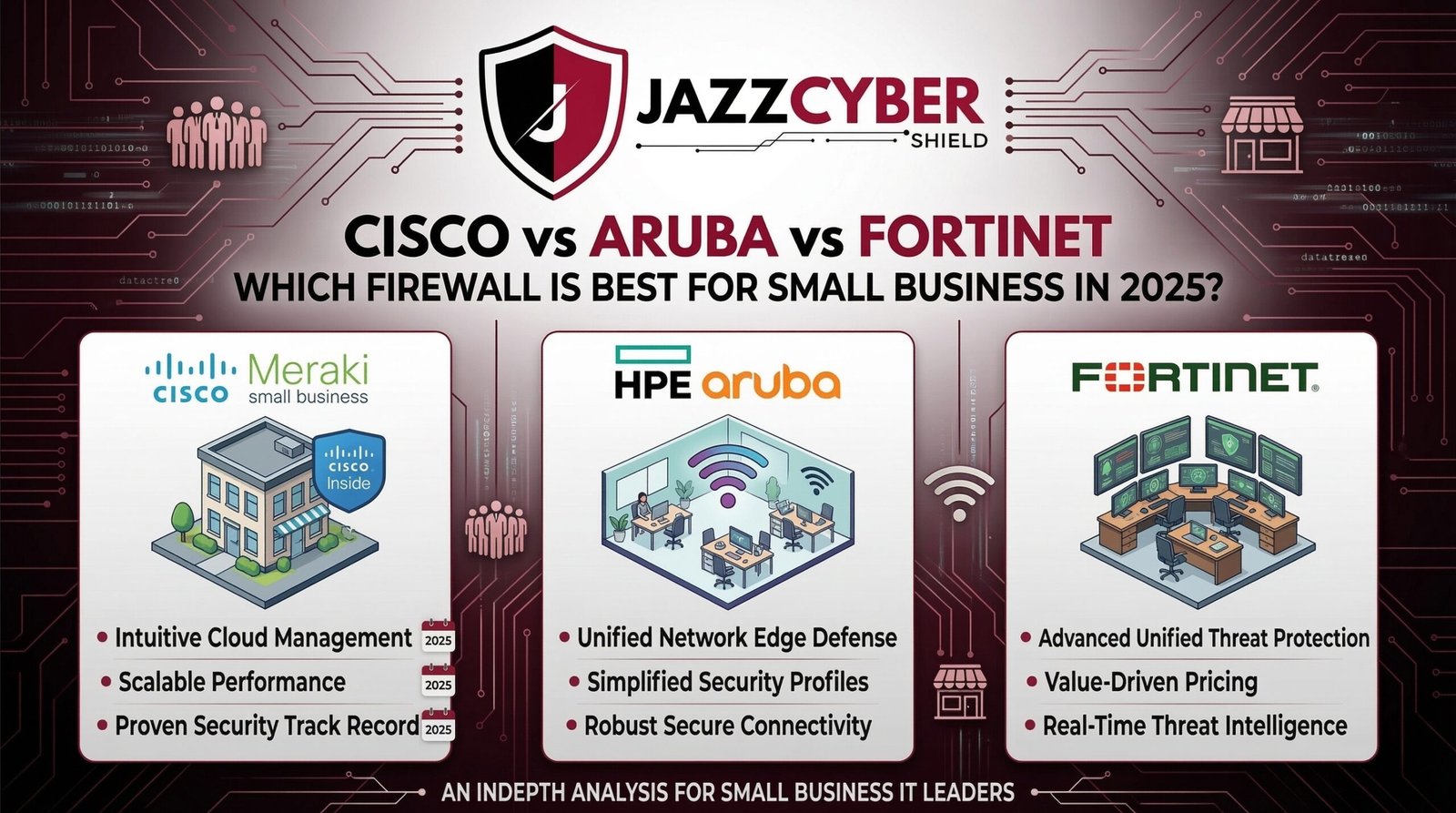
We’re putting three of the most talked-about names in network security under the microscope — Cisco, Aruba, and Fortinet — and giving you a straight, no-fluff breakdown of which one actually makes sense for a small business in 2026.
If you want expert help selecting and deploying the right firewall for your specific setup before you even finish reading, the team at Jazz Cyber Shield specializes in exactly this — helping small and medium businesses build real protection without overpaying or overcomplicating things.
Why Every Small Business Needs a Next-Generation Firewall Right Now
Before we get into the product comparisons, we need to address something that still surprises people.
A huge number of small business owners genuinely believe firewalls are only for large enterprises. This is one of the most dangerous myths in cybersecurity today. According to the Verizon Data Breach Investigations Report, small businesses account for over 43% of all cyberattack targets globally — and the majority of those attacks succeed because basic protections were either absent or improperly configured.
A modern next-generation firewall (NGFW) does far more than block suspicious traffic. It performs deep packet inspection, monitors application behavior, filters harmful content, supports secure remote access through VPN, and generates the kind of logs your business needs for compliance audits.
Think of a firewall as the immune system of your network. Without it, every device, every login, and every piece of customer data you hold is exposed.
Not sure what level of protection your business currently has? Read this practical guide on cybersecurity for small businesses over at the Jazz Cyber Shield blog — it’s written for business owners, not IT departments, and breaks everything down clearly.
Quick Overview: Who Are These Three Companies?
Cisco — Founded in 1984, Cisco is arguably the most recognized networking and security brand on the planet. Used by Fortune 500 companies and government agencies worldwide. Their firewall products sit at the premium end of the market.
Aruba Networks — Now a subsidiary of Hewlett Packard Enterprise (HPE), Aruba built its reputation on enterprise wireless networking. Their security portfolio has expanded significantly but networking remains their strongest suit.
Fortinet — A cybersecurity-first company founded in 2000 that has quietly become one of the most respected names in the firewall market. Consistently ranked by Gartner as a Magic Quadrant Leader for Network Firewalls year after year.
Each brings something genuinely different to the table. Let’s break them all down properly.
Cisco Firewall for Small Business: Enterprise Power, Enterprise Price
When IT professionals talk about enterprise-grade firewalls, Cisco is almost always the first name that comes up. Their two main product lines relevant to small businesses are the Cisco Meraki MX Series and the Cisco Secure Firewall (formerly ASA with Firepower services).
What Makes Cisco Stand Out
The biggest differentiator for Cisco is their threat intelligence engine — Cisco Talos. Talos is one of the largest commercial threat research organizations in the world, processing billions of threat signals every single day. When a new exploit is discovered anywhere on the planet, Talos knows about it fast — and that intelligence feeds directly into your Cisco firewall’s defenses.
The Cisco Meraki MX is specifically worth mentioning here because it was practically designed for businesses without a full-time network engineer. The cloud-based dashboard is clean, intuitive, and manageable from anywhere. You can push policies, check logs, and troubleshoot issues from your phone if needed. For multi-location businesses, this centralized management is a genuine game-changer.
From a compliance standpoint, Cisco is arguably the gold standard. If your business operates under HIPAA, PCI-DSS, or SOC 2 requirements, Cisco’s audit logging, reporting capabilities, and documentation support will make your compliance officer very happy.
Need a full network security audit before deciding? Jazz Cyber Shield offers professional security assessments that identify your compliance gaps and tell you exactly what you need — so you’re not buying more firewall than necessary.
Where Cisco Hurts Small Businesses
The cost is the honest problem here. Cisco Meraki hardware is expensive upfront — but the annual licensing is where many small businesses get genuinely surprised. Advanced security features like malware protection, intrusion prevention, and content filtering are sold as separate license tiers — and each one adds to your annual bill.
A fully-loaded Cisco Meraki MX deployment with all security features enabled can easily run a small business $1,500–$3,000 or more per year when you combine hardware depreciation, licensing, and support. That’s a serious commitment for a 10–25 person office.
Setup complexity is another real consideration. While Meraki simplifies things compared to traditional Cisco, it still assumes a level of networking knowledge that most small business owners simply don’t have. Misconfigurations are common and dangerous.
Cisco Verdict for Small Business
✅ Outstanding threat intelligence via Talos ✅ Best-in-class compliance support ✅ Excellent cloud management with Meraki ❌ High licensing costs ❌ Requires technical knowledge or a partner ❌ Expensive for full feature set
Best For: Compliance-heavy industries, businesses already in the Cisco ecosystem, fast-growing companies.
Realistic Annual Cost: $1,200 – $3,500+ (hardware + licensing)
Aruba Firewall for Small Business: Brilliant Networking, Developing Security
Aruba Networks has built one of the most respected reputations in enterprise wireless networking. Their access points, switches, and SD-WAN solutions are used by some of the world’s largest retailers, hospitals, and universities. But how do they stack up as a firewall vendor for small businesses specifically?
What Makes Aruba Stand Out
If your business environment is heavily wireless-dependent — think retail stores, hotels, restaurants, clinics, or co-working spaces — Aruba’s wireless infrastructure genuinely has no equal at most price points. The integration between Aruba access points, switches, and their Aruba Central cloud management platform is seamless and visually impressive.
The Aruba EdgeConnect SD-WAN platform is excellent for businesses with multiple branches or a distributed workforce. It intelligently routes traffic, optimizes performance, and provides consistent connectivity across locations — something that’s increasingly important as remote work becomes permanent for many businesses.
ClearPass Policy Manager is another Aruba tool worth knowing. It handles network access control — essentially deciding who can connect to your network and what they can access based on their identity, device type, and location. For businesses managing a mix of company devices and employee personal phones, this is valuable.
Where Aruba Falls Short
Here’s the frank assessment: Aruba is primarily a networking company that has added security features, not a security-first company. This distinction matters when you’re choosing a firewall.
Their next-generation firewall capabilities — specifically deep packet inspection, advanced threat prevention, and application-layer security — simply don’t match the depth of Fortinet or Cisco at comparable price points. If your primary concern is network threat prevention rather than network management, Aruba’s security stack may leave you wanting more.
Independent firewall performance benchmarks from NSS Labs and similar organizations have consistently placed Fortinet and Cisco ahead of Aruba in pure threat detection effectiveness — something worth factoring into your decision.
For an honest comparison of how these platforms perform in real office deployments, the Jazz Cyber Shield blog covers hands-on testing and real-world performance that goes well beyond vendor marketing materials.
Aruba Verdict for Small Business
✅ Best-in-class wireless networking ✅ Excellent SD-WAN for multi-location businesses ✅ Clean, intuitive Aruba Central management ❌ Security depth lags behind Cisco and Fortinet ❌ Not ideal as a standalone NGFW solution ❌ Full ecosystem cost can be high
Best For: Retail, hospitality, healthcare facilities with heavy wireless demands, multi-site businesses.
Realistic Annual Cost: $500 – $2,500+ depending on deployment scale
Fortinet Firewall for Small Business: Enterprise Security at SMB Pricing
Now we get to the firewall that genuinely surprises most people who haven’t looked closely at the market lately — Fortinet.
The FortiGate Next-Generation Firewall lineup has been a consistent Gartner Magic Quadrant Leader for over a decade. What makes Fortinet genuinely remarkable for small businesses is that they’ve built enterprise-level security features into hardware price points that won’t require a second mortgage.
What Makes Fortinet Stand Out
The secret behind FortiGate’s performance is Fortinet’s proprietary Security Processing Units (SPUs) — custom-built chips designed specifically for security processing tasks. Most competitor firewalls run on standard commercial processors (the same kind you’d find in a regular server or desktop). Fortinet’s purpose-built chips mean their firewalls can process threats faster, handle more simultaneous connections, and maintain lower latency — even when every single security feature is running at full capacity simultaneously.
The FortiGate 40F, 60F, and 80F are the models built specifically for small businesses and branch offices. Here’s what you get right out of the box:
- Deep Packet Inspection (DPI) — analyzing traffic at the application layer
- Intrusion Prevention System (IPS) — blocking known and emerging attack patterns
- SSL/TLS Inspection — examining encrypted traffic that most firewalls miss
- Application Control — seeing and controlling exactly which apps your team uses
- Web Filtering — blocking malicious sites, phishing pages, and inappropriate content
- Anti-Malware and Sandboxing — catching threats before they reach your devices
- Built-in SD-WAN — at zero extra licensing cost (Cisco charges separately for this)
- Zero Trust Network Access (ZTNA) — the modern security model replacing traditional VPN
Powering all of this is FortiGuard Labs — Fortinet’s threat intelligence service that monitors over 100 billion security events daily across its global sensor network. When new malware, ransomware strains, or zero-day exploits are discovered, FortiGuard pushes updates to every FortiGate device globally within minutes.
Need help deploying a FortiGate for your office? Jazz Cyber Shield provides full Fortinet deployment services — from choosing the right model to configuring every security policy correctly from day one.
You can also shop Fortinet firewall solutions with professional guidance directly through Jazz Cyber Shield — their team will match you with the right device for your business size, industry, and budget.
Fortinet’s Security Subscription Bundles Explained
One thing that confuses new buyers is Fortinet’s subscription model. Here’s how it works simply:
Hardware Only — The base FortiGate unit with basic firewall capabilities. Not recommended without a subscription.
UTM Bundle — Adds IPS, application control, web filtering, antivirus, and FortiCare support. This is the sweet spot for most small businesses.
Enterprise Bundle — Everything in UTM plus advanced threat protection, FortiSandbox Cloud, and security rating services. Recommended for businesses handling sensitive data or with compliance requirements.
FortiCloud — Cloud-based management and logging platform, free tier available, making remote management accessible even without a dedicated IT team.
For a step-by-step walkthrough of which Fortinet subscription bundle actually fits a small business and what each feature does in plain language, check out this breakdown on the Jazz Cyber Shield blog.
Where Fortinet Falls Short
No product is perfect, and Fortinet is no exception. Their direct customer support — particularly the global support queue — can be slower than Cisco’s when you’re dealing with a critical network issue at an inconvenient hour. This is a genuine consideration.
The subscription model, while affordable, can also surprise buyers who budget only for the hardware. Always calculate total cost of ownership including the annual subscription before committing.
Some users also find the FortiOS interface (Fortinet’s operating system) has a steeper initial learning curve compared to Cisco Meraki’s simplified dashboard. However, working with a certified Fortinet partner like Jazz Cyber Shield completely eliminates this problem — they handle configuration and provide ongoing management support.
Fortinet Verdict for Small Business
✅ Purpose-built security hardware (SPU chips) ✅ Enterprise threat intelligence via FortiGuard Labs ✅ Most affordable pricing for full feature set ✅ Built-in SD-WAN at no extra cost ✅ Consistent Gartner Magic Quadrant Leader ❌ Direct support can be slow ❌ Subscription model requires careful budgeting ❌ Interface has initial learning curve
Best For: Small businesses wanting maximum security per dollar spent, remote workforces, multi-site businesses, compliance-sensitive industries.
Realistic Annual Cost: $600 – $1,200 (hardware + UTM Bundle subscription) — significantly lower than equivalent Cisco configurations.
Full Head-to-Head Comparison Table
| Category | Cisco (Meraki MX) | Aruba (EdgeConnect) | Fortinet (FortiGate) |
|---|---|---|---|
| Core Strength | Ecosystem & Compliance | Wireless Networking | Security Performance |
| Threat Intelligence | Talos (World-Class) | Good | FortiGuard (World-Class) |
| Hardware Performance | Strong | Moderate | Excellent (Custom SPU) |
| Ease of Setup | Moderate | Easy–Moderate | Moderate |
| Cloud Management | Meraki Dashboard | Aruba Central | FortiCloud |
| SD-WAN | Yes (Extra Cost) | Yes (EdgeConnect) | Yes (Free Built-In) |
| IPS/IDS | Yes | Basic | Excellent |
| SSL Inspection | Yes | Limited | Excellent |
| Zero Trust (ZTNA) | Yes | Partial | Yes (Full) |
| Wireless Integration | Strong (Meraki AP) | Excellent | Good (FortiAP) |
| HIPAA/PCI Compliance | Excellent | Good | Very Good |
| VPN Performance | Very Good | Good | Excellent |
| SMB Hardware Cost | $400–$700 | $150–$500 | $250–$400 |
| Annual Subscription | $300–$600+ | $200–$500+ | $300–$700 |
| Total Year 1 Cost | $1,200–$3,500+ | $800–$2,500+ | $600–$1,200 |
| Gartner Rating | Leader | Challenger | Leader |
| Best SMB Model | Meraki MX67 | Instant On Series | FortiGate 60F |
| Overall SMB Value | Moderate | Moderate | High |
Real-World Scenarios: Which Firewall Fits Your Business?
Scenario 1: A 15-Person Accounting Firm Handling Client Financial Data
Best Choice: Fortinet FortiGate 60F You need strong encryption, SSL inspection, IPS, and solid compliance logging for PCI-DSS. Fortinet delivers all of this at a cost that makes sense for a firm your size. Jazz Cyber Shield can configure it with the correct compliance policies from day one.
Scenario 2: A 3-Location Retail Chain With Heavy Wi-Fi Demands
Best Choice: Aruba (or Fortinet with FortiAP) If wireless performance and seamless roaming across locations is the top priority, Aruba’s infrastructure is hard to beat. However, if threat protection matters equally, a FortiGate paired with FortiAP access points gives you a unified security and networking stack that rivals Aruba at a better price point.
Scenario 3: A Fast-Growing Tech Startup With 30+ Remote Employees
Best Choice: Cisco Meraki MX or Fortinet FortiGate For a tech company scaling rapidly with a distributed workforce, both Cisco and Fortinet are strong choices. If budget is a concern, Fortinet’s built-in SD-WAN and ZTNA capabilities handle remote workers exceptionally well. If you need deep Cisco ecosystem integration for future enterprise readiness, Meraki is the path forward.
Scenario 4: A Small Medical Practice Needing HIPAA Compliance
Best Choice: Fortinet FortiGate with UTM Bundle HIPAA compliance requires specific logging, access controls, and encryption standards. Fortinet’s UTM bundle covers all of these requirements at a price point realistic for a small medical practice. For compliance setup and documentation support, Jazz Cyber Shield offers HIPAA-aligned firewall configuration services.
6 Critical Questions to Answer Before You Buy Any Firewall
1. How many users, devices, and locations do you have? Firewall throughput is rated in Mbps and concurrent sessions. A 10-person office has very different requirements than a 75-person business with three locations. Undersizing your firewall causes performance bottlenecks.
2. Do you support remote workers or hybrid teams? Remote work VPN security requires robust SSL-VPN or ZTNA capabilities. Fortinet’s ZTNA implementation is particularly strong for distributed teams. All three vendors support this, but performance varies significantly.
3. Are you subject to industry compliance requirements? HIPAA, PCI-DSS, SOC 2, and GDPR all have specific technical controls that your firewall must support and document. Read this compliance guide on the Jazz Cyber Shield blog before purchasing.
4. Do you have in-house IT staff? If not, you need either a cloud-managed solution with a simple interface or a managed security partner who handles configuration and monitoring for you. Jazz Cyber Shield offers ongoing managed firewall services for businesses without dedicated IT teams.
5. What is your realistic total annual budget? Calculate hardware purchase price + annual security subscription + installation + ongoing support. Many businesses budget only for the hardware and are surprised by the annual subscription cost. Get the full number before committing.
6. What will your network look like in 3 years? Buy a firewall that can scale with you. Upgrading too soon is expensive. A Jazz Cyber Shield network assessment includes a growth projection so you buy the right size from the start.
The Top 5 Firewall Mistakes Small Businesses Make
We see these same mistakes repeatedly — and every single one of them creates real vulnerabilities.
Mistake 1: Running Default Configurations Out-of-the-box firewall settings are deliberately permissive to ensure the device works on installation. They are not secure. Every firewall needs proper policy configuration tailored to your business. Jazz Cyber Shield handles this as part of every deployment.
Mistake 2: Never Updating Firmware Cybersecurity agencies like CISA maintain a live catalog of known exploited vulnerabilities. Many of these target outdated firewall firmware. Regular updates are non-negotiable.
Mistake 3: No Active Monitoring A firewall that isn’t being actively monitored is like a security camera with no one watching the footage. Threats can sit undetected on your network for weeks. Active monitoring — or a partner providing it — is essential.
Mistake 4: Forgetting Internal Threats According to IBM’s Cost of a Data Breach Report, a significant percentage of breaches involve insider threats or compromised internal credentials. Your firewall needs internal segmentation policies, not just perimeter protection.
Mistake 5: Buying Hardware Without a Subscription A FortiGate, Cisco, or Aruba firewall without an active security subscription is running with outdated threat signatures. It’s better than nothing — but not by much. Always budget for the subscription from day one.
For a full checklist of what to look for when reviewing your current firewall setup, visit the Jazz Cyber Shield blog — there’s a free security checklist article specifically written for small business owners.
Independent Research and Industry Recognition Worth Knowing
Before wrapping up, here’s what the industry’s most credible sources say about these vendors:
Gartner Magic Quadrant for Network Firewalls — Both Cisco and Fortinet are consistently recognized as Leaders. Aruba is growing but hasn’t reached that tier in the firewall category specifically.
MITRE ATT&CK Evaluations — An independent security evaluation framework that tests how well vendors detect and respond to real attack techniques. Fortinet and Cisco both perform strongly.
NSS Labs / CyberRatings.org — Independent testing organization that evaluates firewall effectiveness against real threats. FortiGate firewalls have consistently received strong security effectiveness scores.
Forrester Wave: Enterprise Firewalls — Both Cisco and Fortinet feature prominently as strong performers in Forrester’s enterprise security evaluations.
This independent recognition matters because it means you’re not just taking vendor marketing at face value — you’re buying products that have been validated by security researchers who don’t have a financial stake in the outcome.
Where to Buy and Who to Trust for Setup
Here’s something worth saying plainly: the firewall brand matters less than the quality of its deployment.
You can buy the best Fortinet FortiGate 60F on the market, and if it’s configured incorrectly — wrong policies, open ports, weak logging — you’re still exposed. This is why purchasing through a certified cybersecurity partner rather than just buying hardware online is genuinely the smarter investment.
At Jazz Cyber Shield, the process is fundamentally different from just buying a box:
- They assess your current network and identify real risks
- They recommend the right device for your size, industry, and compliance needs
- They handle full configuration and security policy setup
- They test the deployment before going live
- They provide ongoing monitoring, updates, and support
That’s an entirely different experience from ordering hardware, watching tutorials, and hoping you didn’t miss a critical setting.
Shop cybersecurity solutions and book your network assessment at Jazz Cyber Shield — their team works specifically with small and medium businesses and understands the real-world budget and operational constraints you’re actually working with.
For ongoing cybersecurity education, threat news, product comparisons, and practical guides written specifically for business owners (not enterprise IT departments), make sure you’re following the Jazz Cyber Shield blog — it’s consistently updated with content that helps you make smarter security decisions.
Final Verdict: Cisco vs Aruba vs Fortinet for Small Business
After everything we’ve covered, here’s the honest summary:
Choose Cisco if — You’re already inside the Cisco ecosystem, have the budget to match the licensing model, need enterprise-grade compliance documentation, and are planning significant growth. Cisco is the Cadillac. It’s exceptional — but you’ll pay full Cadillac prices for every feature.
Choose Aruba if — Your primary pain point is managing a complex wireless environment across multiple locations, and you want a unified networking platform with security built in. Just understand that Aruba’s security depth isn’t at the same level as the other two for dedicated threat prevention.
Choose Fortinet if — You want genuine enterprise-level threat protection at pricing that actually works for a small business. The FortiGate lineup, backed by FortiGuard Labs intelligence and custom SPU hardware, delivers more security value per dollar than anything else in this comparison. For most small businesses in 2026, Fortinet is the clear recommendation.
The right firewall, properly configured and actively monitored, is one of the best investments your small business can make this year. Don’t wait for an incident to make it a priority.
Visit Jazz Cyber Shield today to speak with a cybersecurity specialist, explore firewall options, and get a network security assessment tailored to your business. And for everything else — tips, tools, threat updates, and honest reviews — the Jazz Cyber Shield blog has you covered.
Stay protected. Stay smart. And don’t let your business become the next statistic.

