



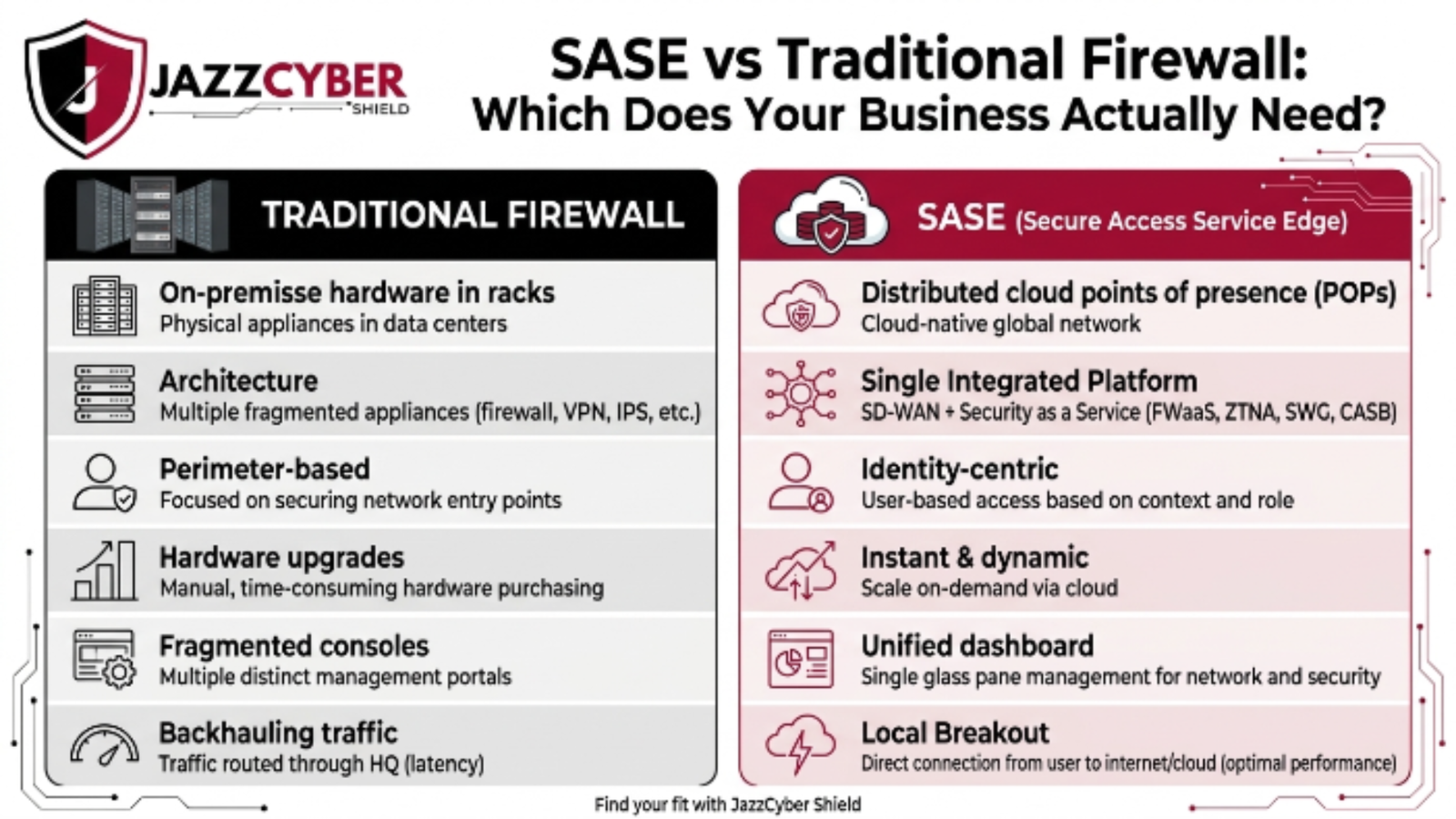
The SASE vs traditional firewall debate is no longer theoretical — it’s the decision every IT team faces as workforces go hybrid and attackers get smarter.
Your traditional firewall made perfect sense when your users sat inside your building, your servers lived in your server room, and your perimeter had a clear edge. That world is gone.
Today your employees work from home, hotel lobbies, and coffee shops. Your apps live in AWS, Azure, and SaaS platforms. Your data moves across networks you don’t own and can’t inspect. A box sitting at the edge of your office network can’t protect any of that — and attackers know it.
SASE — Secure Access Service Edge — promises to fix this. But it’s not the right answer for every organization. This guide cuts through the vendor noise and gives you a straight comparison so you can make the call that actually fits your business.
Table of Contents
The State of Network Security in 2026
The network security market is splitting in two. On one side: organizations clinging to on-premise perimeter defense. On the other: businesses moving security to the cloud where their users and data already live.
Here’s what the data shows in 2026:
- Gartner projects that over 60% of enterprises will have explicit SASE adoption strategies by 2026, up from 10% in 2020
- IBM’s Cost of a Data Breach Report puts the average breach cost at $4.88 million — and hybrid work environments rank among the top contributing factors
- Verizon’s Data Breach Investigations Report confirms that 74% of breaches involve the human element — people operating outside hardened network perimeters
⚠️ ALERT: CISA’s 2025 cybersecurity advisory specifically calls out perimeter-only defense models as inadequate for organizations with remote or hybrid workforces. The guidance recommends Zero Trust principles — which SASE implements natively — for any organization where users access resources outside the physical network. (opens in new tab)
The market is moving. That doesn’t mean every business should follow immediately — but ignoring the shift is its own kind of risk.
SASE vs Traditional Firewall: What They Actually Are
Before you can choose, you need to understand what you’re actually comparing.
Traditional Firewall — A hardware or software appliance that inspects traffic at the network perimeter. It enforces rules about what traffic can enter or leave your network. Next-Generation Firewalls (NGFWs) added deep packet inspection, application awareness, intrusion prevention, and SSL decryption on top of basic packet filtering.
SASE (Secure Access Service Edge) — A cloud-native framework that combines network connectivity (SD-WAN) and security functions (ZTNA, CASB, SWG, FWaaS) into a single cloud-delivered service. Instead of routing traffic through a central firewall, SASE enforces policy at the edge — wherever the user or device actually is.
Think of it this way:
- Traditional firewall: Security checkpoint at the city gate. Everyone must pass through it.
- SASE: Security travels with the user. Wherever they go, policy follows.
Neither is universally superior. The right answer depends on your architecture, your workforce, your budget, and your risk profile.
How Traditional Firewalls Work — and Where They Break
Traditional firewalls — including modern NGFWs — are purpose-built, proven, and excellent at what they do. Don’t let SASE marketing convince you otherwise.
TRADITIONAL FIREWALL ARCHITECTURE
══════════════════════════════════════════════════════════
INTERNET
    │
    ▼
┌─────────────────────────────────┐
│   PERIMETER FIREWALL / NGFW     │  ← All traffic inspected here
│  (DPI, IPS, App Control, VPN)   │
└─────────────────────────────────┘
    │
    ▼
┌─────────────────────────────────┐
│       INTERNAL NETWORK          │
│  Servers │ Workstations │ Wi-Fi  │
└─────────────────────────────────┘
    │
    ▼
REMOTE USERS → VPN tunnel → Back through firewall

CLOUD APPS → User → Internet → Cloud
             ✗ Firewall never sees this traffic
══════════════════════════════════════════════════════════
The architectural problem is clear. Cloud traffic bypasses your on-premise firewall entirely. A remote employee connecting directly to Microsoft 365 or Salesforce never touches your perimeter device.
VPNs try to fix this by routing all traffic through headquarters — but that creates latency, bandwidth strain, and a single point of failure. In a workforce that’s 50%+ remote, hairpinning all cloud traffic through a physical appliance is both slow and expensive.
🔴 WARNING: Many businesses running traditional firewalls have zero visibility into what their remote employees are actually doing in cloud applications. If a remote worker’s credentials get compromised, attackers access cloud resources directly — and your firewall never generates a single alert.
Where traditional firewalls still dominate:
- Physical locations with clear perimeters (offices, data centers, manufacturing floors)
- Regulated industries requiring on-premise data control
- Organizations with on-premise application portfolios
- Businesses with dedicated IT staff managing hardware
For companies running on-site infrastructure, a properly configured NGFW remains one of the strongest security investments available. Browse our selection of business firewalls — including Fortinet, SonicWall, and WatchGuard NGFWs used by thousands of US businesses.
SASE vs Traditional Firewall: Architecture Compared
Let’s put both architectures side by side so the tradeoffs are obvious.
| Feature | Traditional Firewall / NGFW | SASE |
|---|---|---|
| Deployment model | On-premise hardware | Cloud-delivered service |
| Security location | Network edge (HQ/DC) | Distributed edge (everywhere) |
| Remote user protection | VPN back to perimeter | Native, always-on protection |
| Cloud app visibility | Limited / none | Full CASB inspection |
| Zero Trust support | Add-on, complex | Built-in by design |
| Latency for remote users | High (VPN hairpin) | Low (local PoP) |
| Management | Per-device, per-site | Single cloud console |
| Hardware dependency | High | None |
| CapEx cost | High upfront | Low upfront |
| OpEx cost | Lower ongoing | Subscription-based |
| Setup complexity | Moderate to high | High initially |
| Mature ecosystem | Yes (decades) | Growing (5-7 years) |
| Regulatory compliance | Well-documented | Varies by vendor |
| Best for | Office-centric orgs | Distributed/hybrid orgs |
⚠️ ALERT: SASE isn’t a single product — it’s a framework. When vendors sell you “SASE,” they’re selling you their interpretation of it. Some include full ZTNA and CASB. Others bundle SD-WAN with a basic cloud firewall and call it SASE. Evaluate what’s actually in the package, not just the label.
NIST’s Zero Trust Architecture guidelines (SP 800-207) provide the foundational framework that legitimate SASE implementations should align with. If your vendor can’t map their offering to NIST ZTA principles, keep shopping. (opens in new tab)
Cost: What You’ll Actually Pay for Each
Budget is real. Let’s talk numbers — not list prices, but real-world deployment costs for a 100-user US business.
Traditional NGFW deployment (100 users, single site):
- Hardware: $3,000–$15,000 (varies by throughput/feature tier)
- Implementation: $2,000–$5,000
- Annual maintenance/support: $800–$3,000/year
- VPN infrastructure for remote users: Add $1,000–$3,000
- 3-year total: ~$15,000–$35,000
SASE deployment (100 users, hybrid workforce):
- Per-user licensing: $15–$40/user/month (depending on features included)
- Implementation and migration: $5,000–$15,000
- 3-year total: ~$54,000–$144,000 + implementation
The math is stark. SASE costs more — often significantly more — especially at smaller scale. That premium buys you cloud-native architecture, reduced IT management burden, and protection that follows users wherever they go.
For sub-200-user organizations, the financial case for SASE requires a clear business driver — typically a distributed workforce, cloud-first application stack, or a compliance requirement that traditional perimeter security can’t cleanly satisfy.
For 500+ user enterprises with complex multi-site environments and heavy cloud adoption, SASE’s consolidated management and reduced VPN infrastructure can flip the math over a 5-year horizon.
When a Traditional Firewall Is Still the Right Answer
Traditional firewalls aren’t legacy — they’re purpose-fit for specific environments. Here’s when they win.
Your workforce is primarily on-site. If 80%+ of your users work in a physical location — a manufacturing plant, a medical office, a law firm — a perimeter firewall protecting that location makes complete sense. Your traffic flows through it. Your security controls apply.
Your applications are on-premise. If your ERP, database, and critical applications run in your server room or data center, a physical firewall protecting that data center is the right tool. Cloud security for on-premise apps adds complexity without adding value.
You’re in a regulated industry with on-premise data requirements. Healthcare organizations under HIPAA, financial firms under SOX, and government contractors under CMMC often have specific requirements about where data lives and how it’s controlled. Traditional firewalls with documented configurations fit these frameworks cleanly.
Your IT team is small and hardware-focused. SASE migration requires cloud security expertise that not every IT team has. A well-configured NGFW managed by a team that knows it cold beats a misconfigured SASE deployment every time.
You have existing hardware under contract. If you bought a 5-year NGFW contract two years ago, you have three years of depreciation left. Running parallel SASE on top doesn’t make financial sense — optimize what you have and plan the migration for refresh time.
For Fortinet, SonicWall, and WatchGuard users, current-generation NGFWs include enough cloud integration — SD-WAN, cloud management, remote access — to extend their useful life significantly before a full SASE migration makes sense.
When SASE Wins — and Why
SASE earns its price premium in specific conditions. These are the scenarios where the architecture genuinely outperforms traditional approaches.
Your workforce is distributed or fully remote. If 40%+ of your team works remotely or you have users across multiple cities, protecting them through a central firewall means backhauling all their traffic — slow, expensive, and creating a single point of failure. SASE enforces policy at the edge, where users actually are.
Your application stack is primarily cloud and SaaS. Microsoft 365, Salesforce, Workday, AWS — if this is your stack, your data lives in the cloud. A CASB (Cloud Access Security Broker) built into SASE gives you visibility and control over cloud app usage that a perimeter firewall can’t provide.
You’re consolidating multiple point solutions. If you’re running a firewall, a separate VPN, a standalone web proxy, a CASB, and a ZTNA solution — that’s four or five vendors, four or five management consoles, four or five contracts. SASE consolidates this stack under one framework.
You’re opening new locations frequently. Traditional firewall deployments require shipping hardware, configuring devices, and managing ongoing maintenance per site. SASE brings up a new location by adding users to a cloud policy — no hardware to rack, no truck roll required.
Zero Trust is a compliance or board-level requirement. SASE implements Zero Trust natively. If your industry or insurers are pushing Zero Trust adoption, SASE is the most direct path to demonstrating compliance with NIST ZTA guidelines.
How to Choose: Step-by-Step Decision Guide
Walk through this process before you spend a dollar.
- Map your workforce distribution. What percentage of users work on-site vs. remote vs. hybrid? If it’s under 30% remote, traditional firewall with VPN likely covers you. Over 50% remote is a serious argument for SASE.
- Audit your application stack. List every application your employees use. How many are cloud/SaaS vs. on-premise? Heavy SaaS usage means your firewall isn’t seeing the traffic that matters most.
- Identify your specific security gaps. Are you getting alerts on remote user behavior? Can you see what your employees do in cloud apps? If you can’t answer yes to both, you have a visibility gap — assess whether SASE or firewall add-ons close it.
- Check your compliance requirements. What frameworks do you report against? HIPAA, SOC 2, PCI-DSS, CMMC? Work with your compliance team to understand whether SASE or traditional architecture better supports your audit posture.
- Assess your IT team’s capabilities. SASE migrations require cloud security expertise. If your team manages on-premise hardware well but has no cloud security experience, factor in training, hiring, or MSSP costs before the SASE math looks attractive.
- Calculate 3-year TCO for both options. Include hardware, licensing, implementation, management labor, and projected support costs. For under 150 users, traditional firewall usually wins on cost unless you have a strong architectural driver.
- Consider a hybrid approach. Most SASE vendors support a phased transition — traditional firewall for the physical perimeter, SASE for remote and cloud. This is the most common real-world deployment and reduces migration risk significantly.
- Evaluate your network segmentation. Regardless of which direction you go, proper VLAN segmentation within your network is critical. Read our guide on VLAN setup for business networks before you finalize any architecture decision.
✅ Quick Reference Checklist
SASE vs TRADITIONAL FIREWALL — DECISION CHECKLIST 2026
══════════════════════════════════════════════════════════

YOUR ENVIRONMENT
[ ] Documented % of remote vs on-site users
[ ] Application inventory complete (cloud vs on-prem)
[ ] Current security stack mapped (all tools listed)
[ ] Compliance framework requirements confirmed
[ ] 3-year TCO calculated for both options

CHOOSE TRADITIONAL FIREWALL IF:
[ ] 70%+ users work on-site
[ ] Primary apps are on-premise
[ ] Regulated industry with on-prem data requirements
[ ] Sub-150 users, budget is a key factor
[ ] Existing hardware under active contract
[ ] IT team is hardware-focused

CHOOSE SASE IF:
[ ] 40%+ users are remote or hybrid
[ ] Cloud/SaaS is primary app stack
[ ] Managing 3+ separate security point solutions
[ ] Expanding to new locations frequently
[ ] Zero Trust is a board or compliance requirement
[ ] 500+ users where consolidation delivers ROI

FIREWALL HARDENING (do these regardless of choice):
[ ] Default admin credentials changed
[ ] Firmware on current patch version
[ ] Unused ports and services disabled
[ ] Intrusion prevention signatures updated
[ ] SSL inspection enabled for outbound traffic
[ ] Geo-blocking rules applied
[ ] Log forwarding to SIEM active
[ ] Annual firewall rule audit scheduled

SASE DEPLOYMENT ESSENTIALS:
[ ] ZTNA policies mapped to user roles
[ ] CASB configured for all SaaS platforms
[ ] Secure Web Gateway rules established
[ ] MFA enforced at identity layer
[ ] Device posture checks enabled
[ ] Split tunnel policies documented
══════════════════════════════════════════════════════════
Frequently Asked Questions
Q: Can I run SASE and a traditional firewall at the same time?
A: Yes — and most mid-size organizations do exactly this during transition. A traditional NGFW protects the physical perimeter and on-premise resources. SASE handles remote user access and cloud traffic. This hybrid model is the most common real-world deployment, and most SASE vendors design their onboarding process around it.
Q: Is SASE just a rebranded VPN?
A: No — and this is an important distinction. A VPN creates an encrypted tunnel and routes traffic through a central point. SASE enforces policy at the edge using Zero Trust principles, meaning every access request gets authenticated and authorized individually, regardless of location. SASE also includes cloud app visibility (CASB), secure web browsing (SWG), and identity-aware access control — none of which traditional VPNs provide.
Q: What’s the biggest mistake companies make when evaluating SASE?
A: Buying a label instead of a capability. Many vendors market their product as SASE when it’s really an SD-WAN with a cloud firewall bolted on. A complete SASE solution should include ZTNA, CASB, SWG, and FWaaS at minimum. Demand a capability map against NIST ZTA guidelines before signing any contract.
Q: Does a traditional firewall protect against ransomware?
A: A modern NGFW with IPS, SSL inspection, and DNS filtering provides solid ransomware protection for on-premise traffic. The gap is remote users — if a remote employee downloads ransomware on a home network and connects via VPN, the damage is already done before your firewall sees anything. SASE closes this gap by inspecting traffic at the endpoint regardless of location. Read more on why businesses close after cyberattacks to understand what’s really at stake.
Q: How do I know if my current firewall configuration is actually secure?
A: Most businesses run firewalls with outdated rules — permit entries added for a project years ago and never removed. Start with a firewall rule audit and a firmware check. Our guide to router settings you must change immediately covers the essential hardening steps that apply to most business firewalls.
Conclusion
The SASE vs traditional firewall decision doesn’t have a universal answer — it has the right answer for your specific workforce, your specific application stack, and your specific budget.
Traditional firewalls remain excellent tools for office-centric organizations, regulated industries, and businesses with primarily on-premise infrastructure. SASE delivers genuinely superior protection for distributed teams, cloud-heavy environments, and organizations serious about implementing Zero Trust.
Most businesses in 2026 fall somewhere in between — and a hybrid approach that preserves the perimeter firewall while layering SASE for remote and cloud access is a pragmatic, lower-risk path forward.
Whatever architecture you run, the fundamentals still apply. Patch your firmware. Audit your rules. Segment your network. And don’t let the firewall become the only layer between your business and a breach.
Ready to evaluate or upgrade your perimeter protection? Browse our full range of business firewalls from Fortinet, SonicWall, WatchGuard, and more — trusted by IT teams across the US, UK, Canada, and Australia.
Related Reading
- Why Small Businesses Close After a Cyberattack
- Router Settings You Must Change Right Now
- VLAN Setup for Business Networks in 2026
- WPA2 vs WPA3: Which Encryption Does Your Network Need?
- The Hidden Dangers of Public WiFi in 2026

