


Most small business owners think they’re too small to get hacked. That’s exactly what makes enterprise firewalls for small businesses the most overlooked security investment of 2026.
A ransomware gang doesn’t care that you run a 12-person accounting firm in Austin or a boutique law office in Chicago. They run automated scans 24/7. If your network has a weak perimeter, they find it — fast.
Here’s the hard truth: consumer-grade routers and basic ISP modems weren’t built to stop modern threats. Deep packet inspection, intrusion prevention, SSL decryption, zero-day sandboxing — these aren’t enterprise buzzwords. They’re the baseline you need to keep your business running.
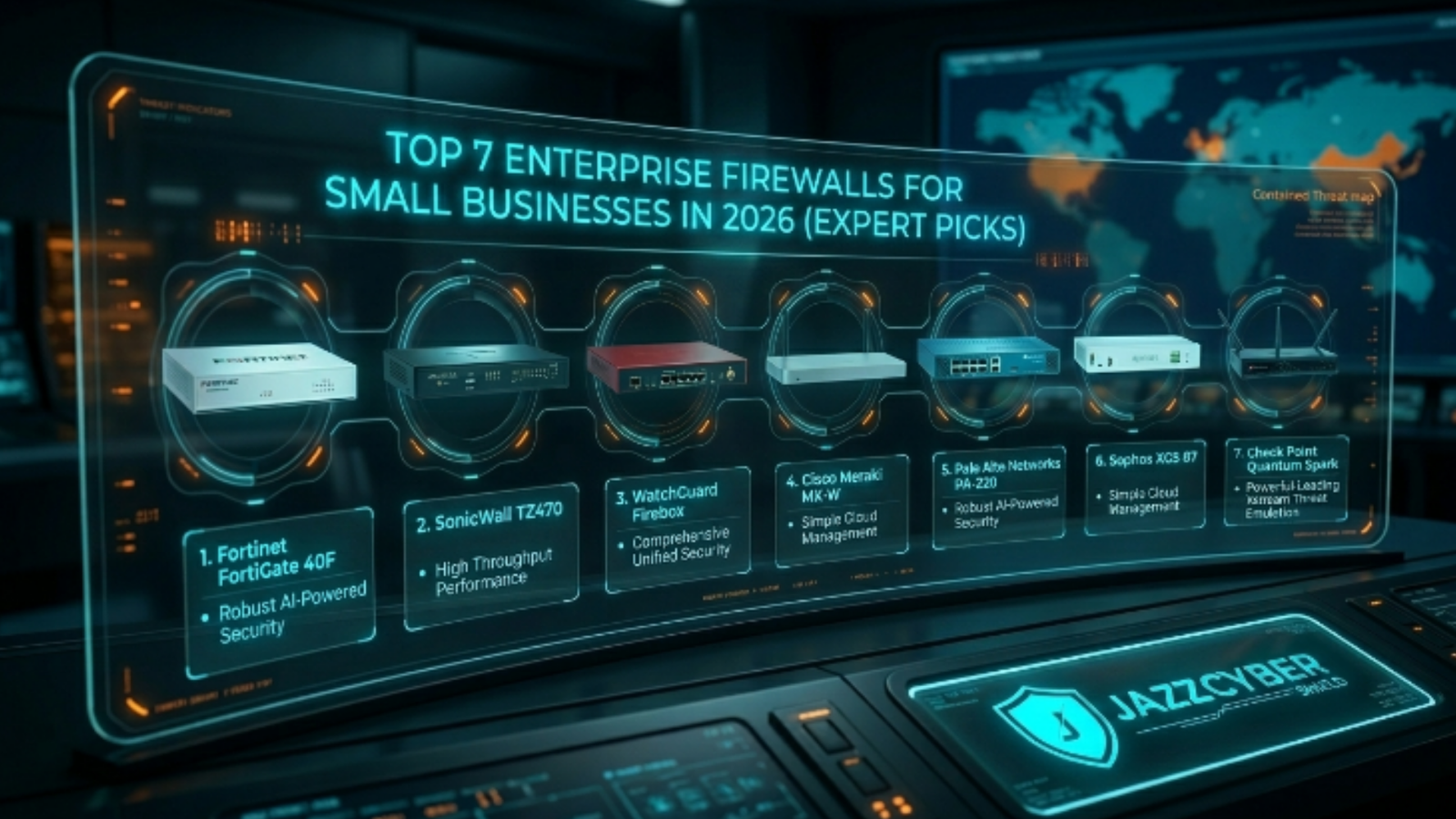
This guide covers the top 7 enterprise firewalls for small businesses in 2026 — real picks, tested in the field, from brands your IT team will actually recognize.
Table of Contents
The Scale of Small Business Cyber Threats in 2026
Small businesses are not safe by obscurity. The numbers say otherwise.
According to the Verizon 2024 Data Breach Investigations Report (opens in new tab), 43% of all cyberattacks target small and medium-sized businesses. And over 60% of those businesses close within six months of a major breach.
The threat landscape shifted again in 2025. AI-powered phishing, automated lateral movement, and ransomware-as-a-service kits lowered the skill floor for attackers dramatically. You don’t need to be a Fortune 500 to get hit with a $200,000 ransom demand.
⚠️ ALERT: The CISA 2025 Threat Advisory (opens in new tab) confirmed a 67% year-over-year increase in attacks on businesses with fewer than 100 employees. Perimeter security is no longer optional — it’s the minimum standard.
The firewall market responded. Enterprise-grade appliances that used to cost $15,000+ now start under $1,000. The gap between “enterprise protection” and “small business budget” closed. You have no excuse not to upgrade.
What Makes Enterprise Firewalls Different for Small Businesses
Enterprise firewalls are not just expensive routers. The difference is fundamental.
A consumer router does basic NAT and maybe some port filtering. An enterprise firewall runs a full security stack — simultaneously, in real time, at wire speed.
Here’s what you actually get:
Consumer Router               Enterprise Firewall
─────────────────────         ─────────────────────────────────
Basic NAT                     Deep Packet Inspection (DPI)
Port filtering                Intrusion Prevention System (IPS)
Wi-Fi passthrough             SSL/TLS Decryption
No threat intelligence        Real-time Threat Intelligence Feeds
Manual updates                Automated Security Subscriptions
No visibility                 Full Traffic Visibility + Logging
The key difference for small businesses is total cost of ownership. Modern enterprise firewalls bundle threat subscriptions, cloud management, and automatic updates into a single license. You don’t need a full IT department to run them.
🔴 WARNING: Running a business network on a $60 consumer router in 2026 is the equivalent of leaving your front door unlocked and hoping no one notices. Attackers run automated scans across every IP block, every day.
The NIST Cybersecurity Framework (opens in new tab) specifically recommends network segmentation and perimeter security controls as foundational requirements — not optional add-ons. An enterprise firewall delivers both.
Ready to upgrade? Browse our full enterprise firewall collection at Jazz Cyber Shield to see the exact models covered in this guide.
Top 7 Enterprise Firewalls for Small Businesses — Full Breakdown
1. Fortinet FortiGate 40F — Best Overall for Small Business
The FortiGate 40F is the gold standard for small business network security. Full stop.
Fortinet built this appliance on their custom FortiASIC NP6Lite processor — hardware-accelerated threat inspection that hits 5 Gbps of firewall throughput without breaking a sweat. For a business running 10–50 users with cloud apps, VoIP, and daily SaaS traffic, that headroom matters.
What makes it stand out:
- FortiGuard AI-powered threat intelligence updates every 60 minutes
- Integrated SD-WAN — no additional licensing needed
- SSL inspection at full throughput (rare at this price point)
- Single pane of glass management via FortiManager or cloud
- Compact desktop form factor — fits on any desk
The FortiGate 40F runs FortiOS, one of the most battle-tested firewall operating systems in the industry. Updates come through automatically. Zero-day sandboxing runs in FortiSandbox cloud — no extra hardware required.
Price range: ~$500–$700 for the appliance. Annual UTM bundle ~$300–$400/year.
Ideal for: Professional services, retail, healthcare practices, remote offices.
⚠️ ALERT: Fortinet regularly patches critical CVEs faster than any competitor. Make sure auto-update is enabled — unpatched FortiGates were the #1 exploited SMB firewall in 2024–2025.
Shop Fortinet FortiGate firewalls at Jazz Cyber Shield and get the exact model for your user count and throughput needs.
2. SonicWall TZ470 — Best for Threat Prevention Per Dollar
SonicWall has been protecting small businesses for 30 years. The TZ470 is their best SMB appliance yet.
The TZ470 runs Real-Time Deep Memory Inspection (RTDMI) — SonicWall’s proprietary engine that catches memory-based attacks and never-before-seen malware variants. This is not signature matching. It catches zero-days by analyzing what code actually does in memory, not what it looks like.
Key specs:
- Firewall throughput: 3.5 Gbps
- Threat prevention: 1 Gbps
- 8x GbE ports + 2x SFP+
- Simultaneous client license: 200 users
SonicWall’s cloud management platform (Network Security Manager) gives you full visibility across multiple sites from one dashboard. If you manage several locations, that’s a huge operational win.
Price range: ~$800–$1,000 appliance. TotalSecure bundle ~$500/year.
Ideal for: Multi-site businesses, legal offices, financial services, education.
Shop SonicWall firewall appliances at Jazz Cyber Shield for current availability and bundle pricing.
3. WatchGuard Firebox T45 — Best for Simplicity and Compliance
WatchGuard built the Firebox T45 for business owners who don’t have an IT team — and need enterprise protection anyway.
The Firebox T45 runs WatchGuard’s Total Security Suite, which layers 12 security services into one subscription: antivirus, anti-bot, intrusion prevention, application control, reputation lookup, DNS filtering, DLP, and more. You don’t assemble a security stack. You turn on the appliance, activate the bundle, and you’re done.
What makes the T45 special:
- Built-in Wi-Fi 6 on the T45-W variant — eliminates a separate AP
- DNSWatch for DNS-layer blocking of phishing and C2 domains
- Compliance-ready logging for PCI-DSS and HIPAA
- WatchGuard Cloud management with 30-day free trial
The zero-touch deployment is legitimately impressive. Ship the device to a remote office, plug it in, and it auto-provisions from the cloud. No on-site tech needed.
Price range: ~$600–$850 appliance. Total Security Suite ~$400–$500/year.
Ideal for: Healthcare, retail, education, remote branch offices.
Shop WatchGuard Firebox appliances at Jazz Cyber Shield for T45 and T85 models.
4. Cisco Meraki MX68 — Best for Cloud-First Teams
If your business runs on cloud apps and you want zero local management overhead, the Meraki MX68 is in a class by itself.
Cisco Meraki invented cloud-managed networking. The MX68 has no local CLI — every configuration happens through the Meraki dashboard, a browser-based interface that requires no firewall expertise to use. That’s a feature, not a limitation.
Highlights:
- Auto-VPN: site-to-site tunnels set up in three clicks
- Cisco Talos threat intelligence — one of the largest threat intel networks on earth
- Content filtering, intrusion prevention, malware scanning — all cloud-managed
- Integrated SD-WAN with application-aware routing
- Real-time alerts and one-click diagnostics
The catch: Meraki licenses are expensive at renewal. The appliance seems affordable until the 3-year license comes due. Budget for it upfront.
Price range: ~$700–$900 appliance. 3-year license ~$500–$700.
Ideal for: Distributed teams, cloud-native businesses, businesses with remote workers in multiple states.
Shop Cisco networking equipment at Jazz Cyber Shield for Meraki and Cisco Firepower options.
5. Palo Alto Networks PA-220 — Best for Advanced Threat Prevention
Palo Alto invented the next-generation firewall category. The PA-220 brings that DNA to small business budgets.
The PA-220 runs PAN-OS — the same operating system as the $300,000 enterprise chassis units. App-ID, User-ID, Content-ID. These are Palo Alto’s core technologies that identify exactly what application is running on any port, who is running it, and what data it’s moving — regardless of port, protocol, or encryption.
No other firewall at this price point offers this level of application visibility.
Specs:
- Firewall throughput: 500 Mbps
- Threat prevention: 100 Mbps
- WildFire cloud sandboxing included
- Panorama-ready for multi-device management
The throughput numbers are modest compared to Fortinet. But the visibility and control depth are unmatched. If you run a regulated industry — healthcare, finance, legal — the PA-220’s logging and policy granularity is worth it.
Price range: ~$1,200–$1,500 appliance. Threat prevention subscription ~$600–$800/year.
Ideal for: Regulated industries, high-security environments, businesses with compliance requirements.
6. Sophos XGS 87 — Best for Endpoint + Network Integration
Sophos does something no other firewall vendor does well: it makes your firewall and your endpoint security talk to each other.
Sophos Synchronized Security lets the XGS 87 receive real-time health status from Sophos Intercept X endpoint agents running on your laptops and desktops. If a device gets infected, the firewall isolates it instantly — before the infection spreads to the rest of the network.
That’s genuinely unique at any price point.
Key features:
- Xstream Architecture for TLS 1.3 inspection at full speed
- AI-powered threat detection with deep learning models
- Lateral movement protection through network segmentation
- Sophos Central cloud management
- Integrated reporting for compliance
The XGS 87 also includes a free Sophos Intercept X trial for all endpoints — significant cost savings if you’re also shopping for EDR.
Price range: ~$700–$900 appliance. Xstream Protection bundle ~$400–$550/year.
Ideal for: Businesses running Sophos or looking for combined firewall + endpoint security.
7. Check Point Quantum Spark 1535W — Best for Branch Offices
Check Point’s Quantum Spark series is purpose-built for small business and branch environments. The 1535W is the standout model.
Check Point brings decades of enterprise threat intelligence to an appliance designed for sub-50 user deployments. The 1535W includes integrated Wi-Fi, LTE failover, and a built-in security gateway running Check Point’s R81 OS — the same OS protecting Fortune 100 networks.
What you get:
- SandBlast zero-day protection (Check Point’s proprietary sandbox)
- ThreatCloud AI — 3 billion IoCs updated daily
- Integrated 4G LTE failover for connectivity resilience
- Dual-band Wi-Fi 5 built in
- SmartConsole cloud management
The 1535W is the best choice if you need a single appliance to replace your firewall, Wi-Fi router, and cellular backup all in one.
Price range: ~$900–$1,200 appliance. Next Generation Threat Prevention subscription ~$500–$700/year.
Ideal for: Branch offices, retail locations, businesses needing LTE failover.
Side-by-Side Comparison Table
| Firewall | Best For | Firewall Throughput | Starting Price | Subscription/Year |
|---|---|---|---|---|
| Fortinet FortiGate 40F | Best Overall | 5 Gbps | ~$600 | ~$350 |
| SonicWall TZ470 | Threat Prevention Value | 3.5 Gbps | ~$850 | ~$500 |
| WatchGuard Firebox T45 | Simplicity & Compliance | 1.7 Gbps | ~$700 | ~$450 |
| Cisco Meraki MX68 | Cloud-First Teams | 450 Mbps | ~$800 | ~$600 |
| Palo Alto PA-220 | Advanced Visibility | 500 Mbps | ~$1,300 | ~$700 |
| Sophos XGS 87 | Endpoint Integration | 1.5 Gbps | ~$800 | ~$500 |
| Check Point 1535W | Branch Offices | 1 Gbps | ~$1,000 | ~$600 |
Prices are approximate street prices as of early 2026. Subscription costs vary by bundle level.
How to Choose the Right Enterprise Firewall for Small Business
Don’t overthink it. Answer these five questions:
1. How many users do you have? Under 25 users: FortiGate 40F, WatchGuard T45, SonicWall TZ370. 25–75 users: SonicWall TZ470, Fortinet 60F, Meraki MX68. 75+ users: Step up to the next tier — Fortinet 80F, SonicWall NSa 2700.
2. Do you have a dedicated IT person? No IT staff: WatchGuard or Cisco Meraki — cloud-managed, easy interface. IT-capable team: Fortinet or SonicWall — deeper configuration options.
3. Are you in a regulated industry? HIPAA, PCI-DSS, SOX: Fortinet, WatchGuard, or Palo Alto — strong compliance reporting.
4. Do you have multiple locations? WatchGuard Cloud or Cisco Meraki make multi-site management simple. SonicWall NSM handles larger distributed deployments well.
5. What’s your total budget (appliance + 3 years of subscription)?
- $2,000–$2,500: FortiGate 40F or WatchGuard T45
- $2,500–$3,500: SonicWall TZ470 or Sophos XGS 87
- $3,500–$5,000: Palo Alto PA-220 or Check Point 1535W
See the Microsoft Security SMB Guidance (opens in new tab) for additional buying framework.
Also read: Why Small Businesses Close After a Cyberattack — the real cost breakdown every owner needs to see.
✅ Quick Reference Checklist
Before you buy any enterprise firewall for your small business, run through this:
FIREWALL BUYING CHECKLIST — 2026

Hardware
[ ] Throughput matches your current + projected internet speed
[ ] Enough LAN ports for your switch and segment needs
[ ] Desktop or rack-mount form factor for your space
[ ] Built-in Wi-Fi needed, or separate APs?
[ ] LTE failover needed for connectivity resilience?

Security Features
[ ] Deep Packet Inspection (DPI) enabled at full throughput
[ ] Intrusion Prevention System (IPS) included in license
[ ] SSL/TLS inspection available (critical for 2026 threats)
[ ] DNS filtering or web content filtering included
[ ] Cloud sandboxing for zero-day detection
[ ] Threat intelligence feed auto-updates

Management
[ ] Cloud management portal available
[ ] Multi-site support if needed
[ ] Alerting and logging to SIEM or cloud storage
[ ] Easy VPN setup for remote workers

Compliance
[ ] Logging meets your industry requirements (HIPAA, PCI-DSS)
[ ] Role-based access for audit trails
[ ] Traffic reports exportable

Budget
[ ] 3-year total cost calculated (hardware + subscriptions)
[ ] Renewal pricing confirmed — no surprises
[ ] Vendor support SLA reviewed
Frequently Asked Questions
Q: What’s the difference between a UTM and a next-gen firewall (NGFW)?
A: UTM (Unified Threat Management) bundles multiple security services into one appliance — AV, IPS, web filtering, VPN. NGFW adds deep application awareness and user identity into the security policy. In practice, most modern enterprise firewalls include both. The FortiGate, SonicWall, and WatchGuard models in this list are all NGFW-class with UTM features.
Q: How often do I need to update my firewall?
A: Firmware and threat intelligence updates should be automatic and happening continuously. The threat intelligence feeds (signatures, IP reputation, DNS blacklists) update every 1–24 hours depending on the vendor. Firmware major releases — apply within 30 days of release. Critical patches — apply within 72 hours.
Q: Can I manage these firewalls without a dedicated IT person?
A: WatchGuard Firebox and Cisco Meraki are the most accessible for non-technical owners. WatchGuard’s guided setup and Meraki’s browser dashboard require no command-line knowledge. Fortinet and SonicWall are more feature-rich but have steeper learning curves.
Q: Should I buy firewall hardware outright or go with a subscription service?
A: Buy the hardware outright. Firewall-as-a-Service (FWaaS) cloud offerings have their place in larger organizations, but for most small businesses, an on-premises appliance gives you better throughput, lower latency, and full control. Just budget for the annual security subscription — the hardware without active threat feeds is dramatically less effective.
Conclusion
Enterprise firewalls for small businesses aren’t a luxury anymore. They’re the minimum viable security stack for 2026.
The attackers running ransomware campaigns, credential stuffing bots, and supply chain attacks don’t distinguish between a 10-person firm and a 10,000-person enterprise. Your network perimeter either holds or it doesn’t.
The good news: the top enterprise firewalls for small businesses now cost less than a single employee’s monthly salary. The FortiGate 40F, SonicWall TZ470, and WatchGuard T45 all deliver genuine enterprise-grade protection at prices that fit a small business budget.
Pick one. Deploy it this month. Run the checklist. Your business depends on it.
Browse our full selection of enterprise firewalls at Jazz Cyber Shield — every brand covered in this guide is in stock, and our team can help you match the right model to your user count and budget.
Related Reading
- Why Small Businesses Close After a Cyberattack — The Real Numbers
- VLAN for Home Network 2026 — Segment and Secure Your Traffic
- Router Settings You Must Change Before You Go Live
- WPA2 vs WPA3 — Which Wi-Fi Security Standard Do You Actually Need?
- Hidden Dangers of Public Wi-Fi in 2026

