



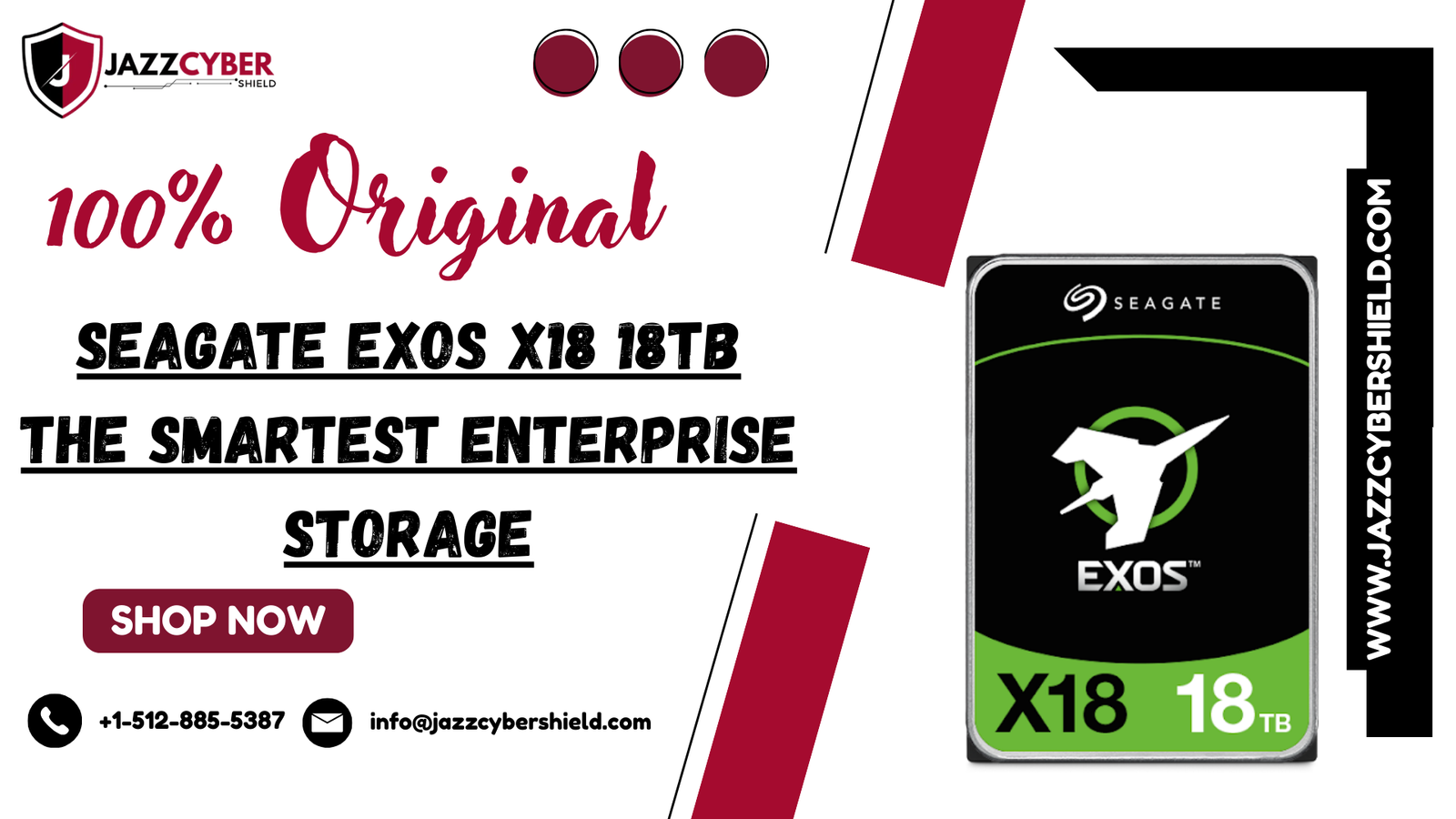
Enterprise storage requirements grow relentlessly. Data centers need more capacity, NAS arrays need larger drives, and surveillance systems record more cameras at higher resolutions every year. Consumer and NAS-class drives cannot keep pace with these demands reliably. The Seagate Exos X18 ST18000NM000J answers with 18TB of enterprise-grade capacity, 7200 RPM performance, and a feature set engineered for continuous 24/7 operation under the heaviest workloads modern data infrastructure generates.
What Is the Seagate Exos X18 ST18000NM000J?
The Seagate Exos X18 is a 3.5-inch enterprise hard drive from Seagate’s Exos product line — the same line that produces the Exos X14 and Exos X16 drives trusted by hyperscale data centers and enterprise IT departments worldwide. The ST18000NM000J is the SATA 6Gb/s interface variant delivering 18TB of formatted capacity.
Seagate fills the Exos X18 enclosure with helium rather than air. Helium’s lower molecular density reduces internal friction, lowers heat generation, and enables the higher platter count that 18TB capacity requires within the standard 3.5-inch form factor. The hermetically sealed enclosure maintains the helium environment throughout the drive’s operational life.
Seagate designs the X18 for hyperscale cloud storage, enterprise data centers, high-capacity NAS arrays, video surveillance systems, and backup target infrastructure that demands maximum capacity at the enterprise reliability level.
Technical Specifications
The drive spins at 7200 RPM and achieves a sustained transfer rate of up to 270 MB/s — one of the highest sequential throughput figures available in spinning disk storage. This speed advantage over slower-spinning NAS drives makes a measurable difference in backup windows, large file transfers, and sequential data ingest workloads.
The annual workload rating reaches 550TB per year — identical to the Exos X14 but applied to a drive with 50 percent more capacity. This rating confirms the X18’s suitability for demanding continuous workloads that would quickly exceed the endurance limits of NAS-class drives rated at 180 TB per year.
The drive carries a five-year limited warranty — standard for enterprise-class storage and significantly longer than the two and three-year coverage that consumer and NAS drives provide.
Helium Design and High Capacity Engineering
Achieving 18TB in a standard 3.5-inch form factor requires engineering innovation that helium-sealed drive technology enables directly.
The hermetically sealed enclosure prevents helium leakage over the drive’s operational lifespan. Seagate validates this seal integrity through rigorous testing that covers the temperature extremes, vibration levels, and pressure variations that data center environments generate across years of continuous operation.
Enterprise Reliability Features
Seagate builds several reliability and protection technologies into the Exos X18 that enterprise deployments require from high-capacity storage.
Rotational Vibration Compensation: Dense storage enclosures generate significant mechanical vibration from multiple simultaneously spinning drives. The Exos X18 uses dual-plane balance control and rotational vibration sensors that actively detect and compensate for this vibration, maintaining consistent read/write accuracy in 60-bay JBODs and fully populated NAS enclosures.
RAID-Optimized Error Recovery: Standard consumer drives execute long error recovery sequences that RAID controllers misinterpret as drive failure, triggering unnecessary array rebuilds. The Exos X18’s configurable error recovery timing aligns with RAID controller expectations, preventing false drive failures and maintaining array integrity during recoverable read errors.
PowerChoice Technology: Multiple configurable power states allow storage systems to balance between maximum performance availability and energy savings based on workload patterns. Data center operators reduce idle power consumption significantly across large drive populations without sacrificing access latency when workloads resume.
Seagate Secure Encryption: Hardware-based 256-bit AES encryption protects data at rest across the full 18TB capacity. Enterprises retiring or reallocating drives eliminate data exposure risk through cryptographic. Erasure rather than physical destruction, reducing drive disposal costs and environmental impact simultaneously.
Performance in Real-World Enterprise Workloads
Sequential backup workloads benefit most from the 270 MB/s sustained transfer rate. Large backup windows that strain slower drives complete faster on the X18, improving recovery point objectives and reducing. The nightly backup window that competes with production workload availability.
Cold storage and archival workloads maximize the X18’s 18TB capacity advantage. Data centers tiering infrequently accessed data to high-capacity spinning disk. Achieve a lower cost per terabyte than any SSD alternative while maintaining acceptable access latency for cold-tier retrieval workloads.
Virtualization environments use the X18 for VM storage in configurations. Where cost per terabyte matters more than the IOPS density that SSD storage provides. The X18 handles the mixed sequential and random access patterns of virtualized server workloads acceptably for capacity-tier storage roles.
Seagate Exos X18 vs Exos X14: When to Choose X18
The X18 delivers 50 percent more capacity per drive than the X14 at a higher cost per unit but a lower cost per terabyte at current market pricing. Organizations building large-capacity storage systems. Where the total drive count directly affects enclosure costs, cabling complexity, and rack space requirements. Achieve better economics from X18 drives despite the higher unit price.
The X14 suits deployments where individual drive capacity is less important. Than per-unit cost and the X18’s premium is not justified by capacity requirements. Mixed environments often standardize on X18 drives for new deployments while running existing X14 drives through their operational life.
Deployment Scenarios
Hyperscale and Enterprise Data Centers: Cloud storage providers and large enterprise IT departments deploy the Exos X18 in JBODs, storage area networks. And object storage systems where maximum capacity density and enterprise reliability combine to minimize infrastructure footprint and total cost of ownership.
High-Capacity NAS Arrays: Organizations running eight-bay, twelve-bay, and larger NAS enclosures from Synology, QNAP, and TrueNAS populate them. With Exos X18 drives to maximize usable storage capacity while maintaining RAID redundancy and enterprise drive reliability.
Enterprise Video Surveillance: Security systems recording large camera arrays at 4K and 8K resolution generate petabytes of video data annually. The Exos X18’s combination of 18TB capacity, sustained write performance. And 550TB/year workload rating makes it the preferred choice for enterprise-scale surveillance storage infrastructure.
Backup and Disaster Recovery Infrastructure: Backup appliances and secondary storage targets need maximum capacity at reliable sustained write performance. The Exos X18 serves this role in both tape replacement scenarios and disk-based backup architectures.
Pricing and Value
The Seagate Exos X18 18TB retails at approximately 280 to 350 dollars depending on purchase channel and market pricing at the time of purchase. This delivers a cost per terabyte of approximately 16 to 20 dollars. Competitive with the Western Digital Gold 18TB and Toshiba MG09 series at comparable capacity.
The enterprise premium over NAS-class 18TB drives reflects the X18’s 550TB/year workload rating, 2.5 million hour MTBF, five-year warranty, vibration compensation, RAID-optimized error recovery, and hardware encryption. For deployments where these features determine operational reliability. The premium delivers measurable return through reduced failures, lower recovery costs, and longer operational lifespan.
Conclusion
The Seagate Exos X18 ST18000NM000J delivers the highest capacity enterprise SATA hard drive performance. That data centers, NAS arrays, surveillance systems, and backup infrastructure need in 2026. Its combination of 18TB helium-filled capacity, 270 MB/s sustained transfer rate, 550TB annual workload rating, 2.5 million hour MTBF, vibration compensation. RAID-optimized error recovery, hardware encryption.

