



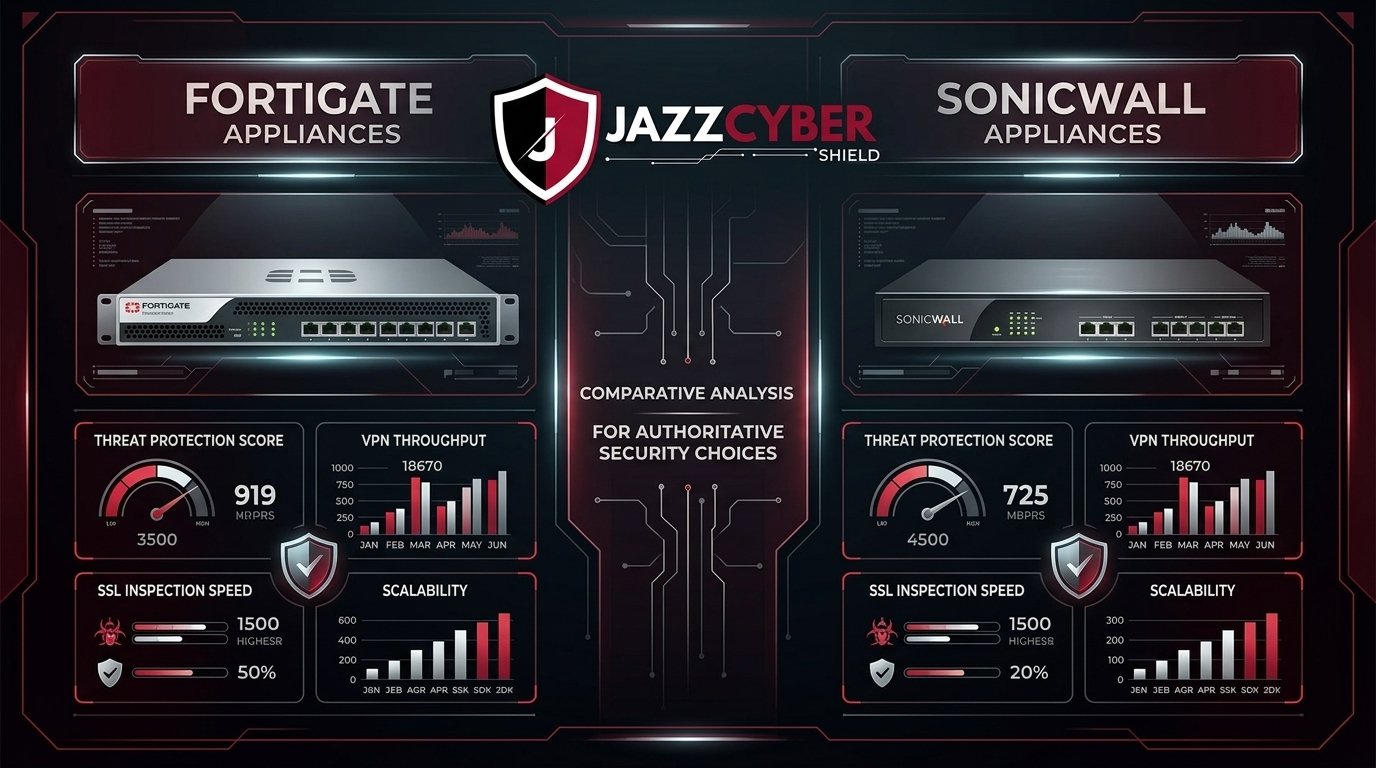
If you run a small business in the USA and you are shopping for a firewall right now, you have almost certainly landed on the same two models: the Fortinet FortiGate 60F and the SonicWall TZ370.
Both are among the highest-selling SMB firewalls in the US market in 2026. Both get recommended by IT consultants, managed service providers, and resellers constantly. And both will protect your network — but they do it differently, and picking the wrong one is an expensive mistake.
This guide cuts through the vendor marketing and gives you a straight, honest comparison of the FortiGate 60F vs SonicWall TZ370 — specs, real-world performance, licensing costs, and which one actually fits your situation.
Table of Contents
Why This Comparison Matters Right Now
The SMB firewall market looks very different from what it was two or three years ago. Ransomware-as-a-service has made small businesses the primary target — not enterprises. AI-driven phishing campaigns now bypass traditional email filters with minimal effort. And with hybrid work now standard, your firewall needs to handle VPN, Zero Trust access, and cloud application traffic all at once.
Both the FortiGate 60F and the SonicWall TZ370 are next-generation firewalls (NGFWs) built for this environment. But they approach architecture, licensing, and management in ways that matter depending on your setup — your internet speed, your IT capability, and your three-year budget.
Quick Specs: FortiGate 60F vs SonicWall TZ370
FortiGate 60F — Key Specifications
The Fortinet FortiGate 60F runs on Fortinet’s custom NP6Lite and CP9 security processors. It is designed for small offices and branch deployments up to 50 users.
- Firewall Throughput: 10 Gbps
- Threat Protection Throughput (full UTM on): 700 Mbps
- SSL Inspection Throughput: 630 Mbps
- Concurrent Sessions: 700,000
- New Sessions Per Second: 35,000
- IPsec VPN Throughput: 6.5 Gbps
- Interfaces: 10x GE RJ45 ports
- SD-WAN: Built in — no extra license required
- ZTNA: Included in FortiGuard subscription
- Management: FortiCloud, FortiManager
- Hardware Street Price (USA): $450–$550
- FortiGuard UTP 1-Year License: $450–$600
SonicWall TZ370 — Key Specifications
The SonicWall TZ370 is a Gen 7 desktop NGFW running SonicOS 7. It sits in the mid-range of SonicWall’s TZ Series and is one of the highest-volume sellers in the SMB firewall market.
- Firewall Throughput: 3 Gbps
- Threat Prevention Throughput (full UTM on): 1.0 Gbps
- SSL Inspection Throughput: 800 Mbps
- Concurrent Sessions: 200,000
- New Sessions Per Second: 15,000
- IPsec VPN Throughput: 1.5 Gbps
- Interfaces: 8x GE + 2x 2.5 GE ports
- SD-WAN: Requires add-on subscription
- ZTNA: Available via Cloud Edge add-on
- Management: MySonicWall cloud portal, on-premise
- Hardware Street Price (USA): $490–$650
- Advanced Protection Security Suite 1-Year: $400–$550
FortiGate 60F vs SonicWall TZ370 — Detailed Head-to-Head
1. Raw Firewall Performance
On paper, the FortiGate 60F has a large firewall throughput advantage — 10 Gbps compared to the TZ370’s 3 Gbps. For most small offices, this number is mostly irrelevant because your internet connection is the actual bottleneck, not the firewall hardware.
The number that matters in a real-world SMB environment is threat protection throughput — the speed the firewall can inspect traffic with every security service running simultaneously. Here the gap narrows and reverses: the TZ370 delivers approximately 1.0 Gbps with full UTM active, while the FortiGate 60F delivers approximately 700 Mbps.
For businesses on a 200–500 Mbps fiber connection with full deep packet inspection enabled, the TZ370 handles that sustained load slightly better. For businesses on gigabit fiber planning to scale, the FortiGate 60F’s dedicated security processors give it a stronger long-term ceiling.
Verdict: SonicWall TZ370 wins on SSL inspection throughput at typical SMB bandwidth ranges. FortiGate 60F wins on overall throughput ceiling and long-term scalability.
2. Licensing and Total Cost of Ownership
This is the part of the FortiGate 60F vs SonicWall TZ370 comparison that catches the most buyers off guard.
Both firewalls use a hardware-plus-subscription model. You pay for the appliance upfront, then pay annually to keep threat intelligence, IPS signatures, antivirus, and cloud management active. If your subscription lapses, the firewall still works as a basic stateful packet filter — but active threat prevention stops updating. Against modern ransomware and AI-driven attacks, that is not adequate protection.
FortiGate 60F Licensing: Fortinet’s FortiGuard Unified Threat Protection (UTP) bundle covers IPS, Application Control, URL Filtering, Antivirus, Antimalware, and FortiCare support. A 1-year UTP bundle runs approximately $450–$600. A 3-year bundle is the recommended purchase for most clients and brings the per-year cost down considerably.
SonicWall TZ370 Licensing: SonicWall’s Advanced Protection Security Suite (APSS) covers the same categories at approximately $400–$550 per year. SonicWall also sells hardware-plus-multiyear bundles that reduce per-year cost.
Over three years, both devices land in a similar total cost of ownership range of $1,800–$2,400 all in for hardware and subscription. The FortiGate 60F hardware tends to run slightly higher upfront. The TZ370 is typically cheaper to get started with.
Verdict: Comparable TCO over three years. SonicWall TZ370 has a lower upfront hardware cost. FortiGate 60F holds resale value better and has a longer supported lifecycle.
3. Ease of Setup and Daily Management
SonicOS 7 on the TZ370 is widely regarded as one of the most intuitive firewall management interfaces in the SMB market. The setup wizard works reliably, the dashboard is clean, and a non-technical administrator can get the device running and configure basic policies without calling an IT consultant. The MySonicWall cloud portal makes remote management straightforward for smaller teams.
FortiOS on the FortiGate 60F is more powerful and more flexible — but that comes with a steeper learning curve. The configuration options are deep, and getting full value out of FortiGuard services, SD-WAN policies, and ZTNA requires someone who knows Fortinet’s platform or is willing to invest time in learning it properly.
If your business has no dedicated IT staff and you plan to manage the firewall yourself, the TZ370 gets you operational faster and with fewer configuration errors. If you work with a Fortinet-certified MSP or have an IT-trained employee, the FortiGate 60F’s configurability pays off over the long term.
Verdict: SonicWall TZ370 wins for self-managed businesses. FortiGate 60F wins for MSP-managed or IT-staffed environments.
4. SD-WAN and Remote Work Support
SD-WAN (Software-Defined Wide Area Networking) lets the firewall intelligently route traffic across multiple internet connections — useful for businesses running backup connections, multiple office locations, or supporting a hybrid remote workforce.
The FortiGate 60F includes full SD-WAN natively in FortiOS at no additional licensing cost. Application-aware routing, WAN health monitoring, and automatic failover are all included without a separate subscription. This is a real advantage for growing businesses.
The SonicWall TZ370 supports SD-WAN but requires an add-on license. If SD-WAN is important to your network setup, that additional cost needs to go into your comparison numbers.
For Zero Trust Network Access (ZTNA) — increasingly important as businesses replace legacy VPN with Zero Trust policies — FortiGate includes ZTNA client licensing in its standard FortiGuard subscription. SonicWall’s ZTNA solution requires Cloud Edge as a separate add-on.
Verdict: FortiGate 60F wins clearly on SD-WAN and ZTNA for hybrid teams and multi-site businesses that do not want to pay extra.
5. Security Effectiveness and Threat Intelligence
Both Fortinet and SonicWall operate large global threat intelligence networks that feed real-time signature updates into their hardware.
FortiGuard Labs processes a large volume of threat events daily and runs AI-powered detection through the dedicated CP9 security processor built directly into the FortiGate 60F hardware. Because security processing happens on a dedicated chip rather than the main CPU, threat prevention runs without significantly degrading firewall throughput.
SonicWall’s Capture Labs network provides real-time updates and includes Capture Advanced Threat Protection (CATP) sandboxing — suspicious files are submitted to a cloud sandbox for zero-day malware detection. This is a genuinely useful feature for businesses that handle file attachments regularly.
Both solutions perform well in independent testing. The FortiGate platform has historically scored slightly better in third-party certifications, but for a 25–50 person US small business, both provide solid, enterprise-grade threat prevention.
Verdict: Tie for most SMB use cases. FortiGate 60F has a marginal edge in independent security lab testing.
Who Should Buy the FortiGate 60F?
The FortiGate 60F is the right choice when:
- Your business works with a Fortinet-certified MSP or has an in-house IT person trained on the platform
- You are on a gigabit fiber connection and need maximum throughput with all security services enabled
- You need SD-WAN across multiple locations without paying an extra subscription
- You are implementing a Zero Trust security model and want ZTNA included at no extra cost
- You want a path to expand into Fortinet’s full Security Fabric — FortiAP wireless access points, FortiSwitch network switches, and FortiAnalyzer log management as your business grows
Browse our current FortiGate inventory and pricing at Jazz Cyber Shield’s Fortinet firewall collection.
Who Should Buy the SonicWall TZ370?
The SonicWall TZ370 is the right choice when:
- You manage your own network without deep IT expertise or a full-time IT person
- You need something that works reliably out of the box with minimal configuration
- Your internet connection is under 500 Mbps and UTM throughput is your primary performance concern
- You already have SonicWall devices and want a consistent management interface across your network
- Your upfront hardware budget is tight and you need to minimize the initial investment
Browse our SonicWall TZ Series firewall inventory at Jazz Cyber Shield’s SonicWall collection.
FortiGate 60F vs SonicWall TZ370 — Final Verdict
Neither firewall wins in every situation. Both are proven products that protect US small businesses well when properly configured. The decision comes down to three things: how technically capable your team is, how fast your internet connection is, and what your network looks like in three years.
- Performance-focused businesses with IT support: FortiGate 60F
- Self-managed deployments without deep IT staff: SonicWall TZ370
- SD-WAN and ZTNA at no extra cost: FortiGate 60F
- Lowest upfront hardware investment: SonicWall TZ370
- Fortinet Security Fabric ecosystem growth: FortiGate 60F
If you are still not sure which model fits your environment, our team at Jazz Cyber Shield can help. We are a USA-based authorized reseller of both Fortinet and SonicWall, located in St. Petersburg, FL, with genuine in-stock inventory and fast nationwide shipping. Contact us for a free recommendation and current pricing.
Frequently Asked Questions
Is the FortiGate 60F better than the SonicWall TZ370?
It depends on your use case. The FortiGate 60F has higher raw throughput, built-in SD-WAN, and ZTNA included in the standard subscription — making it stronger for technically managed environments. The SonicWall TZ370 is easier to set up and has higher SSL inspection throughput at typical SMB bandwidth levels. Neither is objectively better for every situation.
What is the price difference between FortiGate 60F and SonicWall TZ370?
Both appliances have similar street prices in the USA — roughly $450–$650 for hardware. Annual subscription licensing runs approximately $400–$600 per year for both platforms. Total three-year cost of ownership is comparable for both devices.
Does SonicWall TZ370 include SD-WAN?
No, not by default. SD-WAN on the SonicWall TZ370 requires an additional subscription license. The FortiGate 60F includes full SD-WAN natively in FortiOS at no extra cost — which is a meaningful advantage for businesses that need it.
Can I manage the FortiGate 60F from the cloud?
Yes. The FortiGate 60F works with FortiCloud for cloud-based management and FortiManager for on-premise centralized management across multiple FortiGate devices at different locations.
Which firewall is easier to set up — FortiGate 60F or SonicWall TZ370?
The SonicWall TZ370 running SonicOS 7 is easier to configure, particularly for administrators who are not Fortinet-trained. The FortiGate 60F offers more advanced configurability but requires greater networking knowledge to get right.
Related Articles and Resources
Before you buy, these guides are worth reading:
- Top 7 Enterprise Firewalls for Small Businesses in 2026
- Fortinet FortiGate Buying Guide 2026 — Which Model Is Right for You
- SASE vs Traditional Firewall — Which Does Your Business Actually Need
You can also browse all Fortinet and SonicWall firewall models in stock at Jazz Cyber Shield — genuine products, fast US nationwide shipping, and expert pre-sales support from St. Petersburg, FL.

