



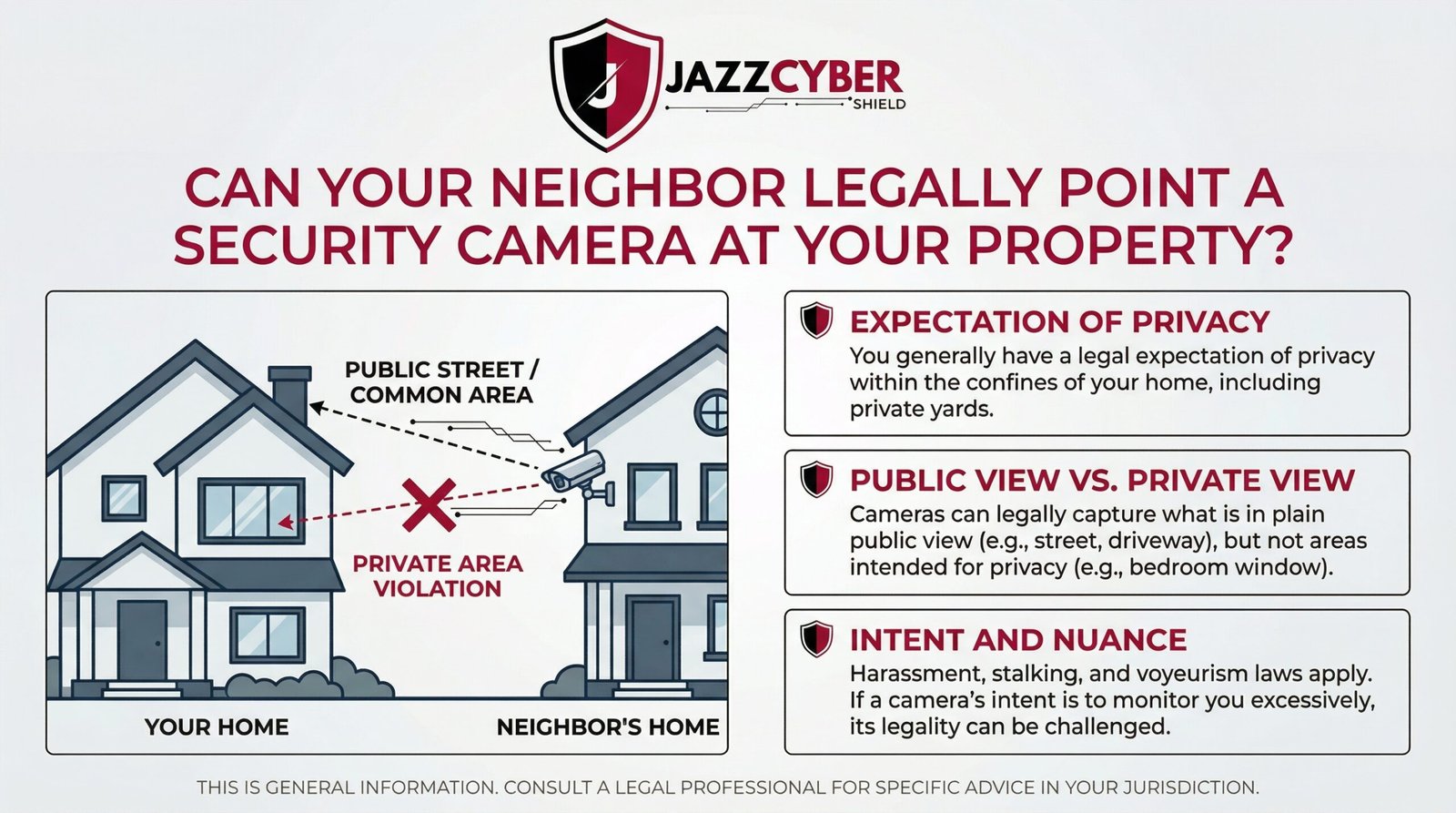
The short answer is: it depends on what the camera captures and where you live. While homeowners have the right to protect their property with surveillance cameras, these rights collide with your privacy when cameras capture areas where you have a “reasonable expectation of privacy.”
In this comprehensive guide, we’ll explore the legal landscape of neighbor surveillance across the United States, Canada, and Europe, helping you understand your rights and practical solutions.
Understanding the “Reasonable Expectation of Privacy”
The cornerstone of security camera privacy laws across most jurisdictions is the concept of “reasonable expectation of privacy.” This legal principle determines whether you have a right to privacy in a particular space.
Areas with HIGH privacy expectations:
- Bedrooms and bathrooms
- Fenced backyards
- Private patios and pool areas
- Inside your home
- Changing rooms or private dressing areas
Areas with LOW privacy expectations:
- Front yards visible from the street
- Public sidewalks
- Driveways (partially)
- Areas visible to passersby
According to legal experts, “a home security camera is generally legal if it’s recording areas of a neighbor’s property where someone would not have a reasonable expectation of privacy.”
Security Camera Laws in the United States
Federal Laws
At the federal level, there is no comprehensive law guaranteeing privacy from neighbor surveillance. However, two key federal frameworks apply:
- Expectation of Privacy Laws: Generally legal to record video in public spaces and within your property, except in areas with greater privacy expectations.
- One-Party Consent Laws (18 U.S.C. 2511): For audio recording, at least one party must consent. This becomes crucial if your neighbor’s camera records audio of your conversations.
State-by-State Variations
Only 15 states have specific security camera laws, but local county and city ordinances may apply:Table
| State | Key Restrictions |
|---|---|
| California | All-party consent for audio; illegal to record confidential communications |
| Florida | All-party consent; strict digital voyeurism laws (upgraded to felony in 2024) |
| Massachusetts | Right of Privacy law; two-party consent for audio; cannot record people in the nude in private areas |
| New York | 2017 law allows lawsuits if camera intended to “harass, annoy or alarm” |
| Texas | Invasive visual recording is criminal offense if recording intimate areas without consent |
| Georgia | Cameras must be in plain sight |
| Hawaii | Consent required from those being recorded |
Important: In all-party consent states (California, Connecticut, Delaware, Florida, Illinois, Maryland, Massachusetts, Montana, Nevada, New Hampshire, Oregon, Pennsylvania, and Washington), recording audio without everyone’s consent is illegal.
When Is It Illegal in the US?
Your neighbor’s camera may be illegal if it:
- Records inside your home through windows
- Captures your fenced backyard where you have privacy expectations
- Records audio of your private conversations (in all-party consent states)
- Is positioned with intent to harass, stalk, or intimidate
- Captures you in the nude or engaged in private activities
Security Camera Laws in Canada
Canada takes a balanced approach through the Personal Information Protection and Electronic Documents Act (PIPEDA) and provincial privacy laws.
Key Canadian Privacy Principles:
- Reasonable Expectation of Privacy: Cameras cannot point toward private spaces like bedrooms, bathrooms, or fenced backyards where neighbors expect privacy.
- Audio Recording Restrictions: Recording audio is illegal without explicit consent from all parties, as it violates Criminal Code provisions on intercepting private communications.
- Nuisance Laws: If cameras are installed specifically to annoy or provoke neighbors, they may constitute a “private nuisance” under tort law.
- Voyeurism Laws: Criminal Code Section 162 prohibits secretly observing or recording anyone in the nude or engaged in sexual activities without consent.
Best Practices for Canadian Homeowners:
- Install cameras only on your property
- Point cameras toward your own property (front door, yard, patio)
- Disable audio recording unless you have explicit consent
- Avoid capturing neighbors’ windows, backyards, or private areas
- Post signage if cameras capture shared spaces
Security Camera Laws in Europe (GDPR & Beyond)
Europe has the strictest privacy protections globally, governed primarily by the General Data Protection Regulation (GDPR).
GDPR Requirements for Security Cameras:
Under GDPR, video footage is considered personal data when individuals are identifiable. This triggers strict compliance requirements:
- Legitimate Purpose: You must have a valid, proportionate reason for recording (e.g., security, preventing crime).
- Transparency: You must inform people they’re being recorded through clear signage stating:
- That CCTV is in operation
- Who is responsible
- Why it’s being used
- Data Minimization: Only record what’s necessary. Use privacy zones or masking features to block out neighbors’ properties.
- Storage Limitations: Don’t keep footage longer than necessary (typically 30-90 days).
- Right of Access: Anyone recorded can request to see footage of themselves (Subject Access Request).
- Security: Footage must be encrypted and stored securely.
Country-Specific Regulations:
Table
| Country | Specific Requirements |
|---|---|
| United Kingdom | UK GDPR and Data Protection Act 2018 apply if cameras capture beyond property boundaries |
| Germany | Section 201a of Criminal Code prohibits recording in private environments; strictest enforcement in Europe |
| France | CNIL requires prior approval in certain cases; strict redaction measures; Article 226-1 prohibits capturing images in private spaces without consent |
| Spain | AEPD guidelines require cameras only on host property, not shared hallways |
The “Household Exemption” in Europe
GDPR includes a “household exemption” for cameras used purely for personal/household purposes. However, this exemption disappears if your camera captures:
- Public streets or sidewalks
- Shared driveways or hallways
- Neighboring properties
Once the exemption doesn’t apply, you become a “data controller” with full GDPR obligations.
What To Do If Your Neighbor’s Camera Violates Your Privacy
Step 1: Have a Conversation
Start with a friendly, non-confrontational approach. Your neighbor may not realize their camera captures your private areas.
Sample conversation starter:
“Hi [Neighbor’s Name], I noticed your new security camera. I completely understand wanting to protect your property, but I wanted to let you know it seems to capture my [backyard/bedroom window]. Would you be open to adjusting the angle?”
Step 2: Document Everything
If talking doesn’t work, document:
- Photos of the camera and its position
- Video showing what the camera captures
- Dates and times of intrusive recording
- Records of your conversations with the neighbor
Step 3: Use Self-Help Privacy Measures
While pursuing legal options, consider:
- Installing privacy screens or tall fences (check local height ordinances)
- Planting trees or tall shrubs to block the view
- Using garden umbrellas or outdoor curtains
- Installing window tinting or privacy film
Step 4: Mediation
If direct conversation fails, consider neutral third-party mediation services. Many communities offer free or low-cost mediation.
Step 5: Legal Action
If all else fails, consult an attorney. Depending on your jurisdiction, you may:
- File a complaint with your local privacy commissioner (Canada/Europe)
- Contact the Information Commissioner’s Office (UK)
- File a lawsuit for invasion of privacy or nuisance
- Request a court order to remove or adjust the camera
- In severe cases, contact police if voyeurism laws are violated
How to Install Your Own Cameras Legally
If you’re considering installing home security cameras, follow these best practices to avoid becoming the “problem neighbor”:
Camera Placement Guidelines:
✅ DO:
- Position cameras to capture only your property
- Use motion zones to avoid recording neighbors’ windows
- Inform neighbors about camera placement
- Post visible signage about surveillance
- Disable audio recording unless legally permitted
- Use privacy masking features for adjacent properties
❌ DON’T:
- Point cameras directly at neighbors’ windows or private areas
- Record audio without consent (especially in all-party consent states)
- Capture shared spaces without transparency
- Keep footage longer than necessary
- Share footage publicly or on social media
Recommended Privacy-Respecting Security Solutions
At Jazz Cyber Shield, we offer security cameras with advanced privacy features:
- Motion Zones: Define specific areas for monitoring while excluding neighbors’ properties
- Privacy Masking: Black out specific areas from recording
- Local Storage: Keep your footage secure without cloud vulnerabilities
- Audio Disable Options: Easily turn off audio to comply with consent laws
Explore Our Privacy-Compliant Security Cameras →
Key Takeaways
Table
| Region | Key Rule |
|---|---|
| USA | Varies by state; “reasonable expectation of privacy” standard; audio restrictions vary |
| Canada | PIPEDA compliance; no audio without consent; no recording of private spaces |
| Europe | Strict GDPR rules; signage required; data minimization; right of access |
Remember: The law generally balances your neighbor’s right to security with your right to privacy. Cameras capturing public areas (front yards, streets) are typically legal, while cameras targeting private spaces (bedrooms, fenced backyards) may violate privacy laws.
Frequently Asked Questions (FAQ)
Can my neighbor legally record my backyard with their security camera?
Generally, if your backyard is fenced and you have a reasonable expectation of privacy, your neighbor cannot legally record it. However, if the camera captures your backyard incidentally while monitoring their own property, it may be legal depending on your jurisdiction.
Is it illegal for my neighbor to point a camera at my bedroom window?
Yes, this is likely illegal in most jurisdictions. Recording inside someone’s home or targeting private areas like bedrooms violates “reasonable expectation of privacy” laws and may constitute voyeurism or harassment.
Can I sue my neighbor for invasion of privacy due to their security camera?
Yes, you may have grounds for a lawsuit if the camera intentionally records private areas where you have a reasonable expectation of privacy, especially if you’ve asked them to stop. Consult a local attorney familiar with privacy torts in your state or country.
Do security cameras violate GDPR in Europe?
Security cameras are legal under GDPR if they comply with data protection principles: legitimate purpose, transparency (signage), data minimization, and secure storage. However, if cameras capture public spaces or neighboring properties, full GDPR compliance is required.
Can my neighbor record audio of my conversations on their security camera?
In all-party consent states (USA) and Canada, recording audio without consent is illegal. In Europe, audio recording triggers stricter GDPR requirements. Even in one-party consent states, recording neighbors’ private conversations may violate wiretapping laws.
What should I do first if I feel my privacy is violated?
Start with a friendly conversation with your neighbor. Many people don’t realize their camera’s field of view extends into private areas. If that fails, document the situation and consider mediation before pursuing legal action.
Are doorbell cameras legal if they capture the street?
Yes, doorbell cameras are generally legal because they capture public areas where there’s no reasonable expectation of privacy. However, if they capture significant portions of neighbors’ private property, adjustments may be needed.
How long can my neighbor keep security footage?
Under GDPR (Europe), footage should not be kept longer than necessary (typically 30-90 days). In the US and Canada, retention periods vary by jurisdiction, but best practice is to delete footage once its purpose (security) is no longer served.
Conclusion
Understanding the balance between security and privacy is essential for modern neighborhoods. While your neighbor has the right to protect their property, this right doesn’t extend to violating your reasonable expectation of privacy. By knowing the laws in your region and approaching conflicts diplomatically, you can protect your privacy while maintaining good neighbor relations.
Need expert advice on privacy-compliant security solutions? Visit Jazz Cyber Shield for professional-grade security cameras with advanced privacy features, or check out our Cybersecurity Blog for more guides on protecting your home legally and effectively.

