



Last updated: October 30, 2026 · By the Jazz Cyber Shield team
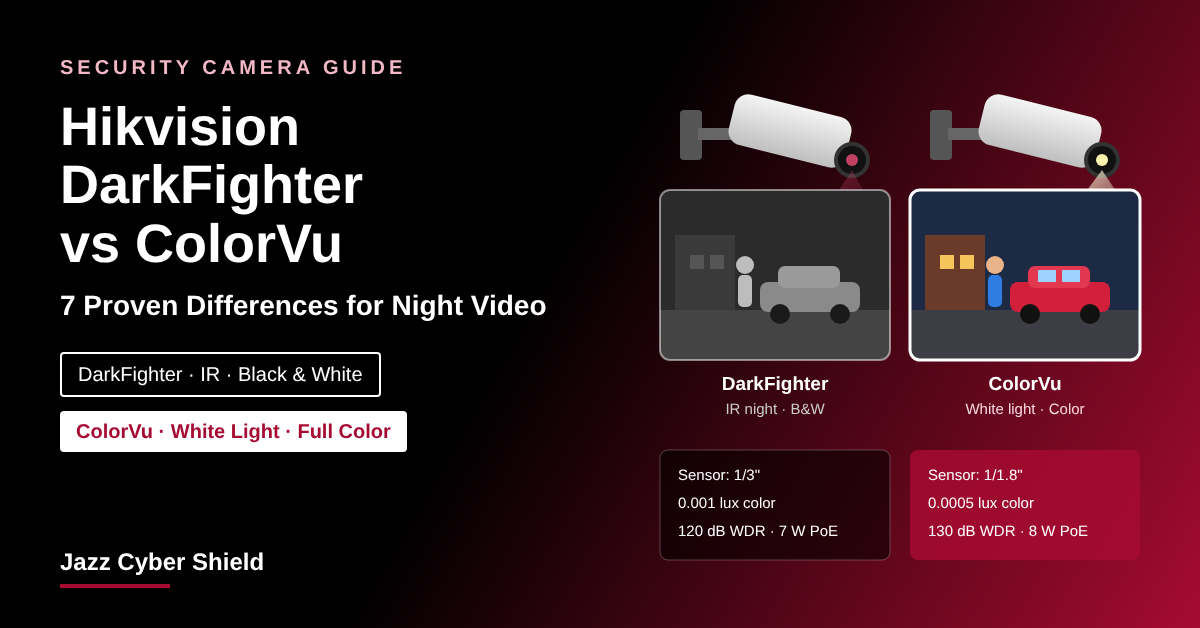
Hikvision DarkFighter vs ColorVu comes down to what you need to see at night. A “powered by DarkFighter” camera uses a fast F1.0 lens and infrared light, so it records black-and-white video in the dark. A ColorVu camera pairs F1.0 with a larger sensor and white light, so it can record full color at night and flash a deterrent.
Key takeaways
- DarkFighter means infrared at night: video turns black and white once the scene gets dark.
- ColorVu Smart Hybrid Light cameras carry both IR and white light, so they can switch to color when a person or vehicle appears.
- In Hikvision’s 4 MP mini bullets, ColorVu uses a 1/1.8-inch sensor; the DarkFighter model uses 1/3-inch.
- ColorVu draws a little more power (8 W max on PoE vs 7 W) and adds a strobe and speaker on the -LIU/SL model.
- Settle Hikvision DarkFighter vs ColorVu per location: DarkFighter for discreet coverage, ColorVu where color evidence and deterrence matter.
Jazz Cyber Shield is a US-based reseller of networking and cybersecurity hardware, and Hikvision cameras are among the products we quote most often. The question we hear on almost every camera project is the one this guide answers: Hikvision DarkFighter vs ColorVu, which one belongs on each wall of the building? The short answer is that both lines are good in the dark, but they solve different problems.
To keep the comparison fair, we use two current 4 MP mini bullet cameras from the same family: the DS-2CD2046G2H-IU, sold as “powered by DarkFighter,” and the DS-2CD2047G2H-LIU/SL, sold as “Smart Hybrid Light with ColorVu.” Every specification in this Hikvision DarkFighter vs ColorVu comparison comes from Hikvision’s own datasheets, linked in the text and in the sources list. You can compare current models in our Hikvision security camera range.
What is the difference in Hikvision DarkFighter vs ColorVu?
DarkFighter is Hikvision’s low-light imaging with infrared fill light, so night video is monochrome. ColorVu adds a larger sensor and visible white light, so night video can stay in color.
Both names describe how the camera handles darkness, not a separate product category. The two cameras we compare share the same 4 MP resolution (2688 × 1520), the same F1.0 aperture, the same IP67 rating and the same deep-learning human and vehicle classification. The night strategy is what separates them in any Hikvision DarkFighter vs ColorVu decision, and it changes what your recordings look like at 2 a.m.
What does “powered by DarkFighter” mean?
It means the camera is built to gather as much light as possible and then fall back to infrared when there is not enough. Hikvision’s datasheet for the DS-2CD2046G2H-IU DarkFighter mini bullet lists color down to 0.001 lux at F1.0 and “B/W: 0 Lux with IR.”
In practice, the camera keeps color in dim light such as a lit parking lot. Once the scene drops below that level, the camera switches to its 850 nm infrared LEDs, which reach up to 40 m. Infrared is invisible to people, so the scene does not light up, but the recording turns black and white. That trade-off sits at the center of Hikvision DarkFighter vs ColorVu.
What does ColorVu mean on a Smart Hybrid Light camera?
It means the camera can produce color at night by combining a more sensitive sensor with its own visible white light. The DS-2CD2047G2H-LIU/SL ColorVu datasheet lists color at 0.0005 lux and “0 Lux with light.”
The “Smart Hybrid Light” part matters. This camera carries both IR and white light, each rated up to 40 m. It can sit quietly on infrared and only switch on the white light when it detects a person or vehicle. That gives you color evidence of the event without lighting the area all night, the main reason buyers ask about Hikvision DarkFighter vs ColorVu.
Hikvision DarkFighter vs ColorVu: spec comparison
On paper, the ColorVu model has the bigger sensor, the lower color lux rating, the wider WDR and the deterrence features. The DarkFighter model uses slightly less power and has no visible light.
The table below compares the two cameras line by line using Hikvision’s published figures. This is the most useful way to read Hikvision DarkFighter vs ColorVu, because the brand names alone hide the hardware differences.
| Specification | DS-2CD2046G2H-IU (DarkFighter) | DS-2CD2047G2H-LIU/SL (ColorVu) |
|---|---|---|
| Resolution | 4 MP, 2688 × 1520 | 4 MP, 2688 × 1520 |
| Image sensor | 1/3″ progressive scan CMOS | 1/1.8″ progressive scan CMOS |
| Aperture | F1.0 | F1.0 |
| Minimum illumination (color) | 0.001 lux (F1.0, AGC on) | 0.0005 lux (F1.0, AGC on) |
| Night output in total darkness | Black and white, 0 lux with IR | Color with white light, or IR mode |
| Supplement light | IR, 850 nm, up to 40 m | IR (850 nm) and white light, up to 40 m |
| WDR | 120 dB | 130 dB |
| PoE | 802.3af, Class 3, max. 7 W | 802.3af, Class 3, max. 8 W |
| 12 VDC power | max. 5.5 W | max. 6.5 W |
| Audio | Built-in microphone | Two-way audio, built-in speaker |
| Active deterrence | None | Strobe light and audio alarm |
| Ingress protection | IP67 | IP67 |
Notice that both cameras share an F1.0 lens. Read the Hikvision DarkFighter vs ColorVu table as a ranking, not a guarantee. Older guides often say DarkFighter is “the low-light one” and ColorVu is “the F1.0 one,” but in this current generation both cameras open to F1.0. The real gaps are sensor size, the type of light on board and the extras.
7 differences that matter on a real site
Seven practical differences decide most Hikvision DarkFighter vs ColorVu projects: night color, sensor size, light modes, deterrence, backlight handling, power draw and glare. Here is how each one plays out after installation.
1. Which wins at night in Hikvision DarkFighter vs ColorVu: color or detail?
ColorVu wins when color is the evidence, such as a car’s paint or a jacket. DarkFighter gives clean monochrome detail that is often enough for movement and faces at close range.
Think about what an investigator will ask after an incident. “What color was the vehicle?” is a common question, and an infrared image cannot answer it. If your cameras watch a parking lot, gate or loading dock, that single question often settles the Hikvision DarkFighter vs ColorVu debate in favor of ColorVu.
2. Sensor size and the low-light rating
The ColorVu model uses a 1/1.8-inch sensor; the DarkFighter model uses 1/3-inch. A larger optical format collects more light per frame, which is why ColorVu is rated at half the lux figure.
Lux ratings are measured under ideal lab conditions, so treat them as a ranking rather than a promise. Still, the ranking is clear: in the same dark scene, the ColorVu camera holds color for longer before it needs any added light. In Hikvision DarkFighter vs ColorVu terms, the sensor is the biggest hardware gap between these two models.
3. Supplement light and its three modes
The DarkFighter camera has one night light: infrared. The ColorVu Smart Hybrid Light camera has three modes, according to Hikvision’s Smart Hybrid Light camera brochure.
- IR mode: the IR light stays on and low-light video stays black and white.
- White light mode: the visible light stays on and the camera captures color around the clock.
- Smart mode: the camera runs on IR until it detects a person or vehicle, then turns on white light for color and returns to IR afterward.
Smart mode is the default, but the brochure notes that Motion Detection 2.0 or Perimeter Protection must be enabled manually. Skipping that step is the most common reason a new ColorVu camera “never turns on its light.” This mode flexibility is the clearest Hikvision DarkFighter vs ColorVu feature gap, because the DarkFighter model simply has no visible light to manage.
4. Active deterrence
Only the ColorVu -LIU/SL model in this pair can warn an intruder. Its datasheet lists an active strobe light, an audio alarm and two-way audio through a built-in speaker.
For deterrence, Hikvision DarkFighter vs ColorVu is not close. That changes the camera’s job. A DarkFighter camera records what happened. A ColorVu camera with strobe and speaker can interrupt it, which is why we suggest it for after-hours yards, rear doors and equipment storage. If you only need a record, the extra hardware adds cost you will not use.
5. Backlight and WDR
The ColorVu model lists 130 dB WDR against 120 dB for the DarkFighter model. Higher WDR helps when a bright doorway or headlights sit in the same frame as a dark area.
For entrance doors facing a sunlit street, both cameras handle the job, but ColorVu has more headroom. For interior corridors with even lighting, the gap rarely shows in recordings. On WDR alone, Hikvision DarkFighter vs ColorVu favors ColorVu by 10 dB on paper.
6. Power draw and PoE budget
Both cameras are 802.3af Class 3 devices. The DarkFighter model peaks at 7 W on PoE; the ColorVu model peaks at 8 W, because white light and a speaker take power.
Power is the smallest Hikvision DarkFighter vs ColorVu gap, but it adds up. Sixteen ColorVu cameras at their 8 W maximum need 128 W of PoE, against 112 W for sixteen DarkFighter cameras. Size the switch or NVR PoE budget to the worst case, with every light on. Our PoE network switches for camera systems list the budget per model so you can compare quickly.
7. Light pollution and discretion
DarkFighter is the quieter choice: infrared is invisible, so neighbors and passing drivers see nothing. White light is visible by design, and that is not always welcome.
Hikvision presents smart mode as a way to avoid “unwanted or excessive light pollution,” because the light only fires on a detected target. Even so, a light that flicks on can annoy residents next to a shared fence. For covert coverage or windows facing homes, the Hikvision DarkFighter vs ColorVu choice usually leans toward DarkFighter.
Which one should you choose for each location?
Choose ColorVu for outdoor areas where color evidence or deterrence matters, and DarkFighter for discreet, indoor or residential-facing spots. Most mixed sites end up using both, which is the honest answer to Hikvision DarkFighter vs ColorVu.
We rarely recommend a single answer for an entire building. The table below is the starting point we use when quoting a project, based on the hardware differences above. Your own lighting, mounting height and local rules may shift a few rows.
| Location | Our usual pick | Why |
|---|---|---|
| Parking lot or driveway | ColorVu | Vehicle color is often the key detail after an incident. |
| Loading dock or after-hours yard | ColorVu (-LIU/SL) | Strobe and audio alarm can warn intruders off. |
| Main entrance facing the street | ColorVu | 130 dB WDR helps with bright backgrounds. |
| Side yard facing a neighbor’s home | DarkFighter | Invisible IR avoids complaints about light. |
| Interior hallway or stockroom | DarkFighter | Lights are often on, so the extras add little. |
| Covert or low-profile coverage | DarkFighter | No visible light gives the camera away. |
| Fence line or perimeter | ColorVu in smart mode | Light fires only when a person or vehicle is detected. |
Hikvision DarkFighter vs ColorVu for a small business with 8 cameras
For a typical 8-camera small business, we often suggest a split: ColorVu on the parking area, rear door and dock, and DarkFighter on interior and neighbor-facing views. That puts color and deterrence where incidents happen and saves budget elsewhere. This split also keeps the Hikvision DarkFighter vs ColorVu choice simple for whoever maintains the system later.
If you are planning the recorder at the same time, read our guide on choosing a Hikvision NVR hard drive. Color night footage tends to carry more detail than monochrome, so it is worth testing real bitrates before you lock in disk sizes.
Does range differ in Hikvision DarkFighter vs ColorVu?
Not in this pair. Both datasheets rate the supplement light at up to 40 m, so range should not drive your Hikvision DarkFighter vs ColorVu decision for these models.
What does change is the light you get at the edge of that range. Infrared at 40 m gives a usable monochrome image of movement, while white light at a distance helps keep color on a target that triggered it. For long fence lines, plan overlapping cameras rather than counting on the maximum figure.
How does this compare with AcuSense?
AcuSense is Hikvision’s human and vehicle classification, and both cameras in this guide include that type of detection. It is a separate feature from the night-imaging choice.
If you are weighing analytics rather than night imaging, our earlier breakdown of Hikvision ColorVu vs AcuSense differences covers that decision in detail.
How do you set the light modes after installation?
Setup is where Hikvision DarkFighter vs ColorVu differs most in daily work. Set the light mode in the camera’s web interface under the image or day/night settings, then enable the detection rule smart mode depends on. It takes about five minutes per camera.
Hikvision’s US support team documents the path for turning the supplemental light off: log in to the camera’s web GUI and go to Configuration > Image > Day/Night (see the Hikvision support article on the supplemental light). The same area is where you choose the mode.
- Log in to the camera directly from a browser, not only through the NVR.
- Open Configuration > Image > Day/Night and find the supplement light settings.
- Pick IR, white light or smart mode for that location.
- For smart mode, enable Motion Detection 2.0 or Perimeter Protection and tick human and vehicle targets.
- Walk the scene at night and confirm the light turns on and off as expected.
- Repeat the night test after any firmware update, since settings can change.
For DarkFighter cameras, the setup is simpler. Check that the day/night switch is on auto, and make sure no wall, eave or glass sits close to the lens, because IR reflects off nearby surfaces and washes out the image.
What mistakes should you avoid?
Most night-video complaints we see come from setup and placement, not from the Hikvision DarkFighter vs ColorVu line chosen. These are the ones to avoid.
- Buying on the brand name alone. Compare sensor size, lux and light type on the datasheet; the Hikvision DarkFighter vs ColorVu label does not tell you everything.
- Leaving smart mode without a detection rule. The white light never fires, and the camera behaves like an IR-only model.
- Running white light all night next to homes. Use smart or IR mode where light could bother neighbors.
- Undersizing PoE. Budget for every camera at its maximum draw, with lights and speakers active.
- Mounting IR cameras under an eave or behind glass. Reflected infrared ruins night images; mount the camera clear of surfaces.
- Skipping a night walk-through. Daytime testing hides almost every low-light problem.
Can US businesses use Hikvision cameras?
Private businesses can generally buy and use Hikvision cameras, but some uses are restricted. Check your industry and contract rules before you buy.
The FCC added “video surveillance and telecommunications equipment produced by Hangzhou Hikvision Digital Technology Company” to its Covered List on March 12, 2021, to the extent it is used for public safety, security of government facilities, critical infrastructure and other national security purposes. If you hold government contracts or protect critical infrastructure, talk to your compliance team first. This is general information, not legal advice.
FAQ
Is ColorVu better than DarkFighter?
ColorVu is better when you need color at night or active deterrence. DarkFighter is better for discreet coverage, neighbor-facing views and tighter budgets. Neither is better everywhere, so most sites use both.
Does a DarkFighter camera record color at night?
It records color in dim light, down to the 0.001 lux rating on the DS-2CD2046G2H-IU. In darker scenes it switches to infrared and records black and white.
Can I turn off the white light on a ColorVu camera?
Yes. Hikvision’s support guidance points to Configuration > Image > Day/Night in the camera’s web interface, where you can disable the supplemental light or choose IR mode instead.
Do ColorVu cameras need more PoE power?
Slightly. In the 4 MP mini bullets compared here, the ColorVu model peaks at 8 W on PoE and the DarkFighter model at 7 W. Both are 802.3af Class 3 devices.
What is the main Hikvision DarkFighter vs ColorVu difference for parking lots?
Color. A ColorVu camera can show vehicle and clothing colors at night, which infrared footage cannot. That is why we usually place ColorVu on parking lots and driveways.
Will DarkFighter and ColorVu cameras work on the same Hikvision NVR?
Generally yes, as long as the NVR supports the cameras’ resolution and has enough incoming bandwidth and PoE budget. Check the NVR datasheet against the camera count before ordering.
Get the right Hikvision camera from Jazz Cyber Shield
The Hikvision DarkFighter vs ColorVu decision is easiest when you plan by location, not by brand name. Put ColorVu where color and deterrence matter, DarkFighter where discretion matters, and size your PoE and storage for the mix.
Browse our Hikvision security cameras to compare current DarkFighter and ColorVu models. Planning a multi-camera site or a bulk order? Request a project quote from the Jazz Cyber Shield team and we will help you settle Hikvision DarkFighter vs ColorVu for each location and match it to the right Hikvision DarkFighter or ColorVu camera.

