



In May 2026, more than 80 US companies discovered they were victims of AI-powered phishing attacks that bypassed every traditional defense. The campaign, codenamed VENOMOUS#HELPER, used legitimate remote management tools to slip past firewalls, antivirus software, and even trained employees. This is not a one-off incident. AI-powered phishing attacks have officially become the defining cybersecurity threat of 2026, and most businesses are dangerously unprepared.
If you run a network, manage IT for a small business, or own an e-commerce store, this guide is essential reading. Below, we break down the seven most dangerous AI-driven phishing tactics circulating right now, why your current email filter cannot stop them, and the exact security stack you need to fight back.
Table of Contents
What Are AI-Powered Phishing Attacks (And Why They’re Different)
AI-powered phishing attacks are social engineering campaigns that use generative artificial intelligence — large language models, voice cloning, deepfake video, and automated reconnaissance — to craft and deliver fraudulent messages at scale. Unlike old-school phishing emails riddled with typos, these attacks produce flawless grammar, perfect brand impersonation, and personalized content that feels indistinguishable from a real coworker or vendor.
According to a recent Hacker News analysis on the 2026 threat landscape, several measures of cybercrime frequency and severity approximately doubled in 2025 once LLM-backed agents matured into full coding powerhouses. The barrier to launching a sophisticated phishing campaign has collapsed. A teenager with a chatbot can now generate the same quality lure that nation-state actors produced five years ago.
Three traits separate AI-powered phishing attacks from traditional phishing:
- Scale. A single attacker can generate thousands of unique, hyper-targeted emails in minutes.
- Personalization. AI scrapes LinkedIn, GitHub, company websites, and breach data to write messages that reference real projects, real coworkers, and real internal jargon.
- Multi-channel delivery. The same campaign hits email, SMS, voice calls, and Microsoft Teams in a coordinated sequence.
VENOMOUS#HELPER: The May 2026 Campaign That Hit 80+ Companies
The most prominent example of AI-powered phishing attacks this month is the VENOMOUS#HELPER campaign exposed by Securonix researchers in early May 2026. Attackers used legitimate Remote Monitoring and Management (RMM) software, specifically modified versions of SimpleHelp and ScreenConnect, to establish persistent remote access to victim networks.
Here is how the attack chain unfolds:
- An AI-generated phishing email arrives, perfectly impersonating an IT support vendor or invoice processor.
- The victim is tricked into installing what appears to be a routine RMM tool update.
- The attacker gains full remote access through legitimate, signed software that no antivirus flags.
- Lateral movement begins, often within minutes of the install.
- Data exfiltration or ransomware deployment follows, depending on the buyer of the access.
Securonix attributed the campaign to a likely Initial Access Broker, a financially motivated group that sells the breached access to other criminals, including ransomware affiliates like the ones we covered in our earlier Akira ransomware SonicWall analysis.
This is the new playbook. AI-powered phishing attacks are no longer the final attack. They are the front door for everything that follows.
Why Traditional Email Security Fails Against AI-Powered Phishing
If your business still relies on Microsoft 365’s default filter or a basic spam gateway, you are exposed. Here is why legacy email security cannot stop modern AI-powered phishing attacks:
- No grammar errors to flag. Generative AI writes cleaner English than most native speakers.
- No suspicious sender domains. Attackers compromise legitimate accounts first, then send from inside trusted relationships.
- Polymorphic content. Each AI-generated email is unique, so signature-based detection cannot match patterns.
- Legitimate payloads. Tools like SimpleHelp, AnyDesk, and ScreenConnect are commercial RMM products. Antivirus software gives them a free pass.
- Multi-channel pivots. When email is blocked, the attacker calls the user on Teams or sends an SMS with the same lure.
You need behavioral analysis, network segmentation, and zero-trust access controls — not just an email filter.
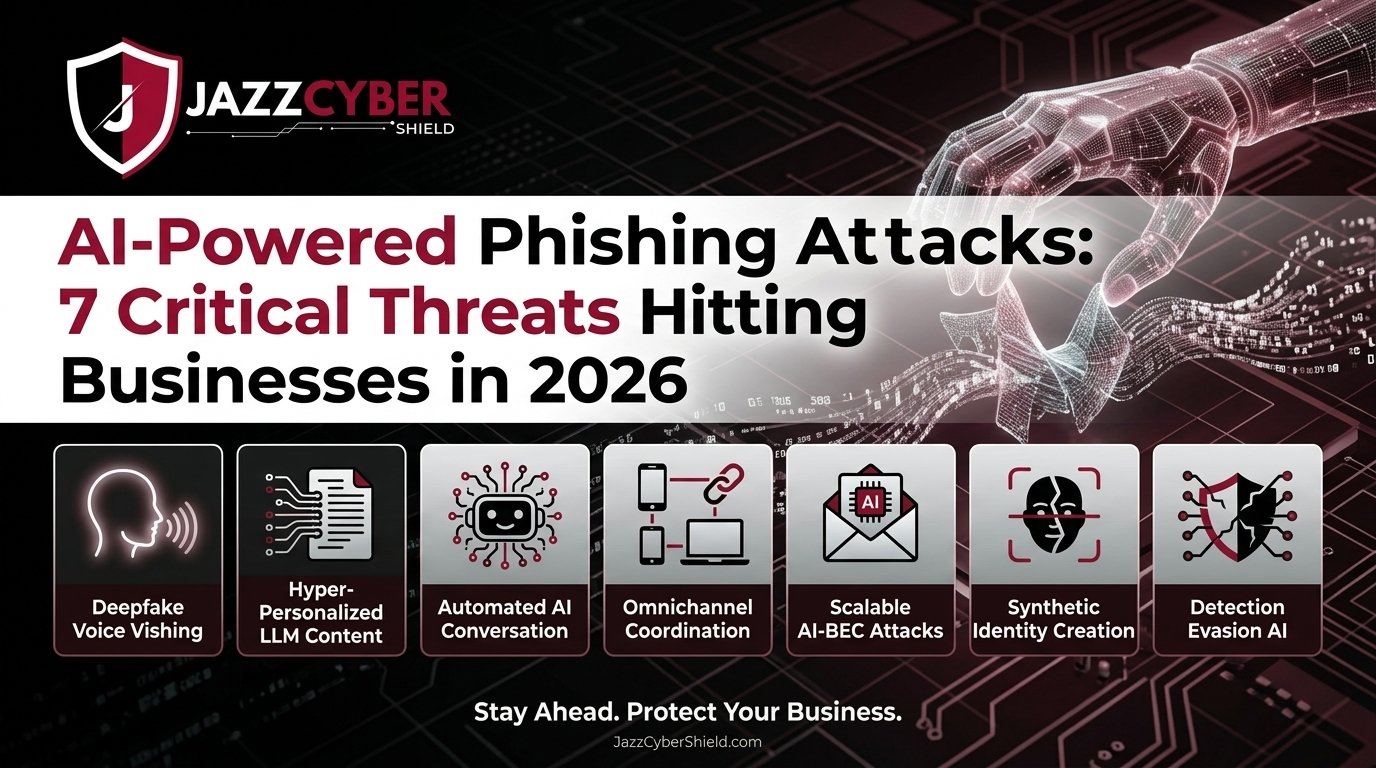
7 Critical AI-Powered Phishing Attack Types in 2026
Based on threat intelligence from CISA, The Hacker News, and our own analysis at Jazz Cyber Shield, these are the seven AI-powered phishing attack types every IT team must recognize this year.
1. AI Voice Cloning (Vishing) Attacks
Attackers clone the voice of a CEO or finance executive using just 30 seconds of audio scraped from a podcast or webinar. They then call a junior employee and authorize a fraudulent wire transfer. CrowdStrike recently linked the Cordial Spider and Snarky Spider threat groups to this exact tactic in rapid SaaS extortion attacks.
2. RMM Tool Hijacking
Already covered above with VENOMOUS#HELPER, this is now the dominant initial-access method for ransomware affiliates worldwide.
3. AI-Generated Spear Phishing With Internal Context
Large language models scrape your company website and craft emails that reference real projects, real coworkers, and even internal Slack channel names. The result feels like a message from someone you actually know.
4. Deepfake Video Conferencing Fraud
A finance employee joins what looks like a Zoom call with the entire executive team. Every face and voice is a deepfake. The “CEO” verbally approves a $25 million transfer. This is no longer hypothetical. It has caused multi-million-dollar losses across 2025 and 2026.
5. AppSheet and SaaS Relay Phishing
The recent AccountDumpling campaign hijacked over 30,000 Facebook accounts using Google AppSheet as a phishing relay, proving that attackers will weaponize legitimate cloud services to bypass URL reputation filters.
6. Single Sign-On Adversary-in-the-Middle Pages
Vishing-driven SSO phishing pages capture authentication tokens in real time, then pivot directly into Salesforce, Microsoft 365, and other connected SaaS apps. CrowdStrike’s report on Cordial Spider details this exact attack chain.
7. AI-Powered Tax and Invoice Phishing
The Silver Fox campaign in May 2026 used AI-generated tax-themed phishing emails impersonating India’s Income Tax Department and Russian tax authorities to deploy ABCDoor and ValleyRAT malware against industrial, retail, and transportation sectors.
How to Protect Your Business from AI-Powered Phishing Attacks
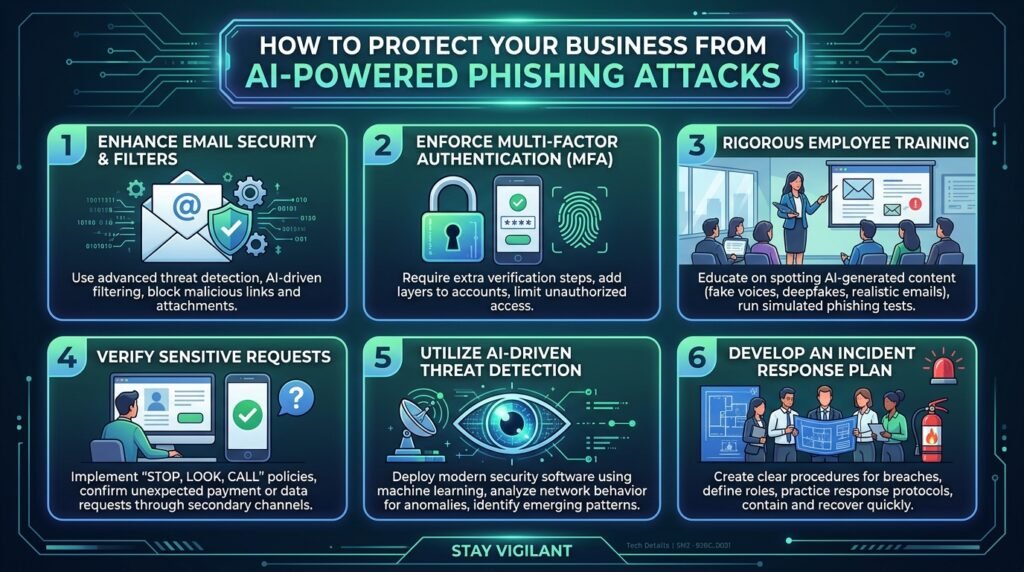
Defending against AI-powered phishing attacks requires a layered, defense-in-depth strategy. Here is the exact stack we recommend to every Jazz Cyber Shield client.
Layer 1: Next-Generation Firewall With AI Threat Prevention
Deploy a next-gen firewall like the Fortinet FortiGate or SonicWall TZ series with AI-driven sandboxing and SSL inspection enabled. These platforms decode encrypted traffic and use machine learning to detect zero-hour phishing payloads. Browse the full lineup of enterprise-grade firewalls at Jazz Cyber Shield to find the right model for your network size.
Layer 2: DNS Filtering and Web Gateway Security
Block phishing domains at the DNS level before any browser or email client can resolve them. Cloud-delivered web gateways add real-time URL reputation analysis on top.
Layer 3: Phishing-Resistant Multi-Factor Authentication
Disable SMS-based MFA. Use FIDO2 hardware keys or push-with-number-matching. AI-powered phishing attacks routinely defeat OTP-based MFA through real-time relay tactics.
Layer 4: Endpoint Detection and Response
Even if a malicious RMM tool installs successfully, a properly configured EDR will detect anomalous lateral movement, credential dumping, and command-and-control beacons.
Layer 5: Modern Security Awareness Training
Train employees on AI-cloned voices, deepfake video, and the red flags of pretext attacks. Run simulated phishing campaigns that include AI-generated lures, not just the obvious 2015-style emails.
Layer 6: Network Segmentation With VLANs
Even if attackers breach one device, proper VLAN segmentation contains the blast radius. Read our complete VLAN home and small office networking guide to learn how to implement this on your own network.
The Role of Next-Gen Firewalls in Stopping AI-Powered Phishing Attacks
Of all the defensive layers, the next-generation firewall remains the single most effective control point. Modern NGFWs from Fortinet, SonicWall, WatchGuard, and Cisco offer:
- Real-time URL filtering with cloud-updated blocklists
- Inline SSL/TLS decryption to inspect HTTPS-encrypted phishing payloads
- AI-powered sandboxing that detonates suspicious attachments in isolation
- DNS security built directly into the firewall
- Geo-IP blocking to stop traffic from high-risk regions
- Intrusion Prevention System signatures that catch RMM abuse patterns
For US small businesses, the Fortinet FortiGate 70F or SonicWall TZ370 with active subscriptions provide enterprise-grade protection at a price point that fits most budgets. Browse the full range of Fortinet firewalls and SonicWall security appliances available at Jazz Cyber Shield with US-wide same-week shipping.
AI-Powered Phishing Attacks: 2026 Statistics You Need to Know
Recent industry data paints a stark picture:
- 80+ confirmed organizations breached by VENOMOUS#HELPER alone (Securonix, May 2026)
- 30,000+ Facebook accounts hijacked in the AccountDumpling AppSheet phishing campaign (Guardio, May 2026)
- 1,600+ tax-themed phishing emails flagged in the Silver Fox campaign across India and Russia (Kaspersky, Q1 2026)
- $701 million in cryptocurrency seized from 9 international scam centers operating AI-driven investment fraud (US-UAE-China joint operation, May 2026)
- Cybercrime frequency and severity approximately doubled in 2025 due to LLM-powered automation (Hacker News analysis)
Final Thoughts: Stay Ahead of AI-Powered Phishing Attacks in 2026
AI-powered phishing attacks are not slowing down. They are accelerating, multiplying, and getting harder to detect by the week. The businesses that survive 2026 will be the ones that move from a single-layer email-filter mindset to a true zero-trust, defense-in-depth posture.
Start today by auditing your firewall, your MFA configuration, and your employee training program. If any layer is weak, attackers will find it within hours of their next AI-generated phishing campaign.
Need help building a complete cybersecurity stack for your business? Explore the curated range of Fortinet, SonicWall, and Cisco security solutions at Jazz Cyber Shield. Every product comes with US-wide shipping, authorized-reseller warranty, and expert deployment support.
For the latest threat intelligence, follow our cybersecurity news blog for daily updates on emerging AI-powered phishing attacks, ransomware campaigns, and zero-day vulnerabilities.

