



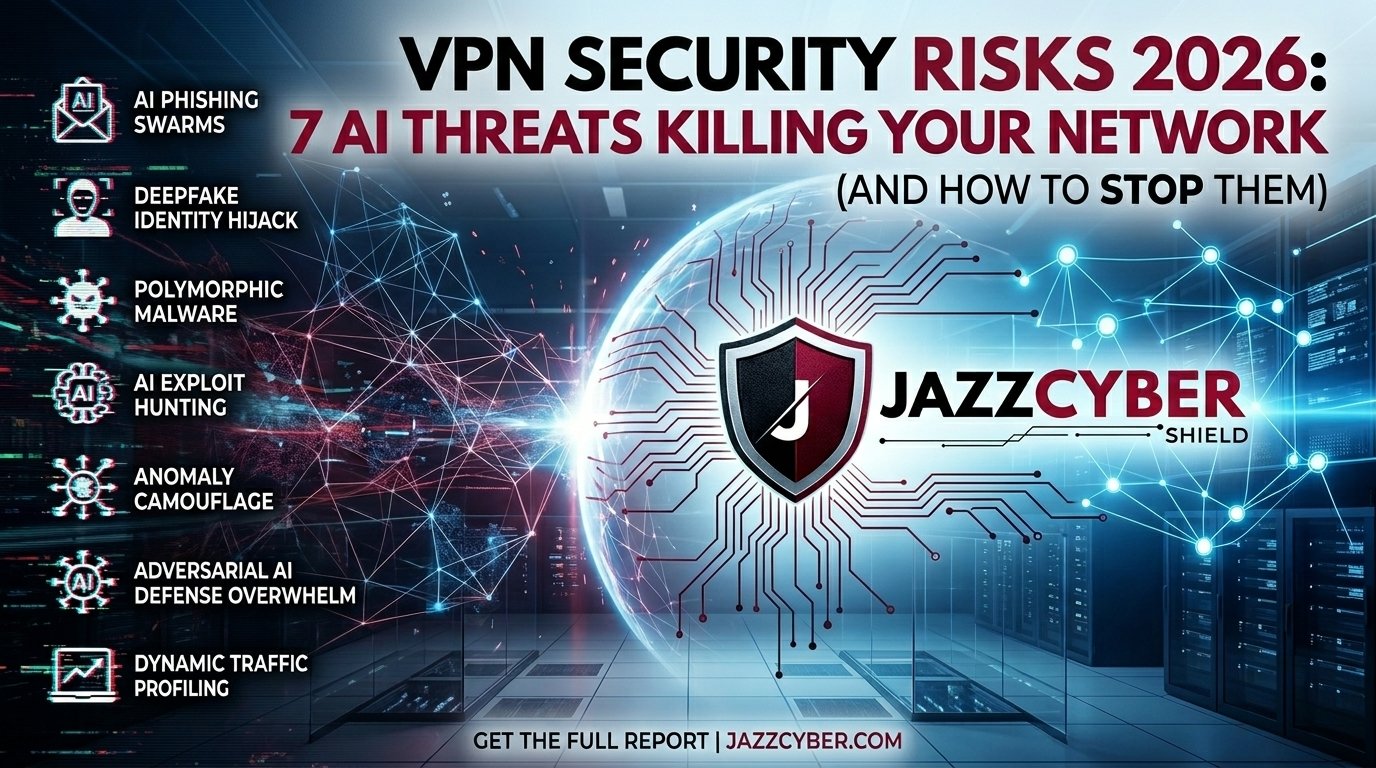
VPN security risks 2026 have officially become the #1 fastest path to a corporate breach, and the data is terrifying. According to the brand-new Zscaler ThreatLabz 2026 VPN Risk Report, AI has collapsed the human response window so dramatically that 79% of security leaders now fear attackers exploit vulnerabilities faster than patches can be deployed. If your business still relies on a legacy VPN for remote access, you are sitting on a ticking time bomb.
The harsh reality is simple. AI-powered attackers move at machine speed. Your VPN, your patch cycle, and your IT team move at human speed. That gap is exactly where every modern breach is happening in 2026.
In this guide, you will discover the 7 deadliest VPN security risks 2026 has unleashed, real attack examples from the last 90 days, and a practical defense plan you can deploy this week using enterprise-grade hardware.
Table of Contents
Why VPN Security Risks 2026 Are a Wake-Up Call for Every Business
The numbers from the Zscaler ThreatLabz report are not just statistics — they are evidence of a complete architectural failure. Here is what 600+ surveyed IT and security professionals just admitted:
- 79% fear AI lets attackers exploit flaws faster than patches deploy
- 70% have limited or zero visibility into AI threats moving over their VPN
- 61% of organizations encountered AI-enabled attacks in the last 12 months
- 54% require a full week or more to patch critical VPN vulnerabilities
- 1 in 3 organizations inspect 0% of encrypted VPN traffic
- 63% of users actively bypass VPN controls to reach apps faster
- 84% are planning or already transitioning to Zero Trust architecture
Furthermore, the report confirms what cybersecurity researchers have warned about for two years — VPNs were never designed for the AI threat era. They were built for trust, and trust is now the most exploitable asset on your network.
The bottom line: If you are running a small or medium business in 2026 with a legacy VPN setup, attackers can compromise your network faster than your IT team can finish their morning coffee.
The 7 Deadliest VPN Security Risks 2026 You Cannot Ignore
Let us break down each major VPN security risk 2026 has put on the threat map, ranked by real-world impact.
1. AI-Powered Exploitation at Machine Speed
Modern attackers no longer hunt for VPN vulnerabilities manually. Instead, AI-driven scanners probe thousands of VPN endpoints per minute, automatically test exploits, and deploy payloads — all without human intervention. Consequently, the window between vulnerability disclosure and active exploitation has shrunk from weeks to hours. This is the single biggest VPN security risk 2026 has introduced.
2. Encrypted Traffic Blind Spots
Here is the dirty secret nobody talks about — your VPN encrypts traffic, but it does not inspect it. As a result, malware, command-and-control beacons, and data exfiltration tunnel straight through your “secure” connection completely undetected. With 33% of businesses inspecting zero encrypted traffic, attackers are essentially handed a free pass.
3. The Deadly Patching Lag
When a critical VPN CVE drops, you have hours, not days, to patch. Yet 54% of organizations take a full week or more. During that gap, automated AI exploitation tools scan the entire internet for unpatched devices. The recent Akira ransomware SonicWall attacks prove this exact pattern — attackers weaponized known vulnerabilities before businesses could deploy fixes.
4. User Workarounds That Bypass VPN Entirely
Slow VPN performance creates desperate users. Specifically, 63% of employees admit to bypassing VPN controls completely — using personal devices, unsanctioned cloud apps, or direct internet connections to do their jobs faster. Each workaround is an unmonitored backdoor straight into your business data.
5. Lateral Movement Inside the Network
Once an attacker compromises a VPN session, traditional VPNs grant broad network access. Therefore, a single stolen credential becomes a master key to your entire infrastructure — file servers, finance systems, customer databases, the works. This is why ransomware gangs love legacy VPNs so much.
6. Credential Theft & AI-Powered Phishing
AI-generated phishing emails are now 4.5x more effective than traditional ones. Combined with VPN credential reuse and the absence of multi-factor authentication on legacy systems, attackers harvest VPN logins through fake portals, deepfake voice calls, and social engineering at industrial scale. Read our deep dive on agentic AI cybersecurity threats to understand how autonomous AI agents are weaponizing this attack vector.
7. Zero-Day Exploits in Legacy VPN Hardware
CISA has issued multiple emergency alerts in 2026 about VPN appliances harboring backdoors that survive reboots, firmware updates, and even factory resets. The recent Firestarter Cisco firewall malware campaign showed exactly how state-sponsored actors plant persistent implants in VPN-capable edge devices that organizations cannot detect with standard tools.
How AI Is Weaponizing VPN Security Risks 2026 in the Real World
Real attacks tell the story better than statistics ever could. In the past 90 days alone, security researchers have documented:
- April 2026 — BePrime breach: Attackers found unprotected VPN admin accounts lacking MFA, exfiltrated 12.6 GB of plaintext credentials, and seized control of 1,858 network devices serving Starbucks, Whirlpool, and Iberdrola subsidiaries.
- April 2026 — Vercel incident: A compromised third-party tool exposed access keys, source code, and internal deployment credentials through VPN-adjacent infrastructure.
- April 2026 — Drift Protocol: Attackers planned the breach for six months, ultimately draining over $280 million in user assets through compromised remote access channels.
Moreover, every one of these breaches shares the same DNA — legacy remote access architecture meeting AI-powered attackers. The defenders never stood a chance.
Zero Trust Network Access (ZTNA) — The Modern Replacement for VPN
The cybersecurity industry has reached consensus. Zero Trust Network Access is the only architectural answer to VPN security risks 2026 has exposed. Unlike VPNs, ZTNA never trusts. Instead, it verifies every user, device, and session continuously.
The core principles include:
- Application-level access instead of full network access
- Continuous identity verification based on context, device posture, and behavior
- Encrypted traffic inspection at the edge before granting access
- Microsegmentation to contain blast radius if a breach occurs
- Zero implicit trust for any user, even verified ones
In addition, modern next-generation firewalls now include built-in ZTNA capabilities. This means small businesses can adopt Zero Trust without ripping out their entire infrastructure. For a deeper technical breakdown, our complete guide on Next-Generation Firewall (NGFW) explains exactly how this works.
How to Mitigate VPN Security Risks 2026 (Practical Action Plan)
Here is a concrete 5-step defense plan you can start executing this week.
Step 1: Audit Your Current VPN Exposure
First, identify every VPN endpoint exposed to the internet. Next, map which users have access to what. Finally, log every authentication event from the past 90 days and flag anomalies. You cannot defend what you cannot see.
Step 2: Upgrade to a Next-Generation Firewall
Replace legacy VPN concentrators with a next-generation firewall that includes built-in SSL inspection, intrusion prevention, and ZTNA. Brands like Fortinet firewalls, SonicWall firewalls, and WatchGuard firewalls offer enterprise-grade NGFWs sized for small business budgets. Our guide on the best firewalls for small businesses in 2026 compares the top 7 options with real pricing.
Step 3: Implement Encrypted Traffic Inspection
Turn on SSL/TLS inspection on your firewall. Yes, it requires a more powerful appliance. However, without it, you are blind to 80% of modern threats riding inside encrypted tunnels.
Step 4: Slash Your Patch Cycle to Under 48 Hours
Establish an emergency patching SOP. Specifically, when a critical VPN or firewall CVE drops, your team should test and deploy within 48 hours maximum. Anything slower and you are gambling with your business.
Step 5: Migrate to Zero Trust Architecture
Finally, begin the migration to Zero Trust. Start small — one application, one user group, one segment at a time. Modern firewalls make this incremental adoption surprisingly straightforward.
Best Hardware to Defend Against VPN Security Risks 2026
To address VPN security risks 2026 has unleashed, your defense stack needs three core layers:
- A Next-Generation Firewall — Browse enterprise-ready NGFWs from Fortinet, SonicWall, WatchGuard, and Cisco — all available with US-based shipping in our authorized firewall collection.
- Managed Network Switches — Implement microsegmentation at the LAN level. Our managed network switches collection features Cisco and HPE Aruba models with VLAN and ACL support.
- Secure Access Points — For wireless ZTNA, deploy Wi-Fi 6/6E enterprise access points with WPA3 and 802.1X authentication.
This combined hardware stack closes every major attack vector identified in the Zscaler report.
Final Thoughts on VPN Security Risks 2026
VPN security risks 2026 are not theoretical — they are actively destroying small businesses every single day. The Zscaler ThreatLabz report is a wake-up call, not a marketing pitch. AI has fundamentally changed the math of cybersecurity, and legacy VPNs simply cannot keep up.
The good news? The defense playbook is clear, the hardware is available, and the migration path is well-trodden. You do not need to spend millions or hire a team of consultants. You need a modern firewall, a Zero Trust mindset, and 30 days of focused execution.
Do not wait for your business to become the next breach headline. The cost of upgrading your network security today is a fraction of what a single ransomware incident will cost you tomorrow.
Ready to upgrade? Browse our authorized firewall collection or contact our team for a free architecture review.
Frequently Asked Questions About VPN Security Risks 2026
Q1: Is my VPN safe in 2026? Most legacy VPNs are not safe in 2026. AI-powered attackers exploit known vulnerabilities within hours of disclosure. If you have not migrated to a next-generation firewall with built-in ZTNA, you are at serious risk.
Q2: What is the biggest VPN security risk in 2026? The biggest VPN security risk 2026 has revealed is the speed gap between AI attackers and human defenders. Specifically, 79% of organizations cannot patch critical vulnerabilities before automated exploitation tools find them.
Q3: Should I replace my VPN with Zero Trust? Yes, and 84% of surveyed organizations agree. Zero Trust Network Access provides application-level security without the broad blast radius that makes traditional VPNs so dangerous.
Q4: Which firewall brand best protects against VPN security risks 2026? Fortinet, SonicWall, WatchGuard, and Cisco all offer next-generation firewalls with built-in ZTNA, SSL inspection, and AI-driven threat detection. Choice depends on your network size, budget, and existing infrastructure.

