



Millions of people use a VPN every day. But most of them don’t know the real difference between free and paid VPNs — and it can cost them their privacy, money, or even their identity.
What is a VPN and why does it matter?
A VPN (Virtual Private Network) hides your IP address and encrypts your internet traffic. As a result, it protects you from hackers, ISPs, and data snoopers. Furthermore, it allows you to access geo-restricted content. In today’s world, online privacy is no longer optional — it is essential.
The real truth about free VPNs
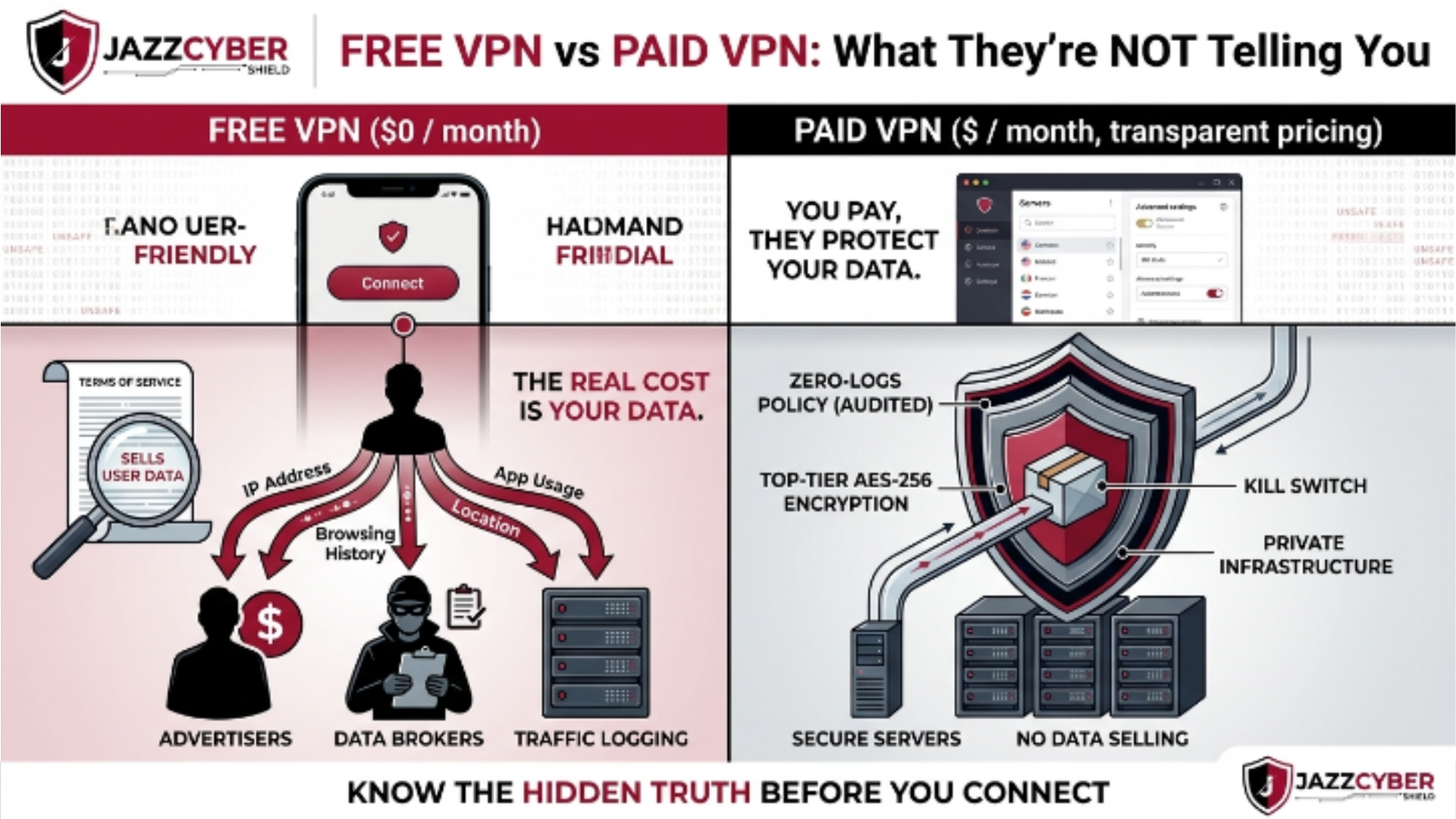
Free VPNs sound great. However, most of them come with serious hidden costs. In fact, many free VPN providers make money by collecting and selling your data to third parties. Additionally, they often inject ads into your browser, slow down your internet speed, and impose strict data limits.
A major 2023 study by Top10VPN found that over 38% of free VPN apps on Android requested access to sensitive phone data — including contacts and location. Moreover, several popular free VPNs were linked to malware. Therefore, what you save in money, you lose in privacy.
Furthermore, free VPNs typically use weak encryption protocols. As a result, your data is far easier for cybercriminals to intercept. In addition, many free services keep logs of your activity — defeating the entire purpose of using a VPN.
Free VPN
- Sells your browsing data
- Weak or outdated encryption
- Slow speeds & data caps
- Ad injection in browsers
- Keeps activity logs
- Limited server locations
- No customer support
Paid VPN
- Strict no-logs policy
- AES-256 encryption
- High-speed, unlimited data
- No ads or data selling
- Verified by audits
- 100+ global servers
- 24/7 customer support
What paid VPNs actually give you
Paid VPNs invest in proper infrastructure. Consequently, they offer faster servers, stronger encryption, and a genuine no-logs policy. Moreover, trusted services like NordVPN, ExpressVPN, and Surfshark submit to independent security audits. Therefore, you can verify their privacy claims with real evidence.
Additionally, paid VPNs support advanced protocols like WireGuard and OpenVPN. As a result, your connection is both faster and more secure. Furthermore, they offer features like a kill switch, DNS leak protection, and multi-hop routing — none of which are available in free VPNs.
In 2025, many paid VPN providers also introduced AI-powered threat detection. As a result, users get real-time protection against phishing sites and malicious scripts. Moreover, split tunneling allows you to choose which apps use the VPN — giving you full control over your traffic.
Free VPN data selling — the business model exposed
Here is what the industry rarely tells you: free VPNs are a business. Therefore, they need revenue. Since they charge you nothing, they monetize your data instead. Specifically, they track your browsing habits, location data, and app usage. Subsequently, they sell this data to advertisers and data brokers.
In 2021, the popular free VPN Hola was caught selling its users’ bandwidth to third parties. Similarly, SuperVPN — which had over 100 million downloads — was exposed for storing user logs and leaking personal data. As a result, users who thought they were protected were actually being monitored.
Performance: free VPN vs paid VPN speed test results
Speed is a major concern for VPN users. Generally, free VPNs throttle your connection to manage server load. Therefore, streaming, gaming, and video calls become frustrating. In contrast, paid VPNs consistently deliver 80–95% of your original internet speed, according to recent 2025 benchmarks by PCMag and TechRadar.
Furthermore, free VPN servers are overcrowded. As a result, connection drops and latency spikes are common. In comparison, paid VPNs offer thousands of servers across 60–90 countries. Therefore, finding a fast, nearby server is easy and reliable.
Is a free VPN ever safe to use?
In very limited cases, a free VPN can be acceptable. For instance, Proton VPN’s free plan is one of the few exceptions — it has a verified no-logs policy and does not sell data. However, even Proton’s free tier limits you to 3 server locations and slower speeds. Therefore, for daily use, it is still not the best option.
Moreover, if you are using a free VPN for banking, work, or personal communication, the risk is simply too high. Specifically, data breaches from insecure free VPNs have led to identity theft and financial fraud. As a result, the short-term savings are not worth the long-term damage.
What to look for in a paid VPN in 2025–2026
First, always choose a VPN with a verified no-logs policy. Additionally, look for AES-256 encryption and WireGuard protocol support. Furthermore, check for an independent audit report. Moreover, the VPN should have a kill switch, DNS leak protection, and multi-device support. Finally, choose a provider based outside 14-Eyes surveillance countries for maximum privacy.
Quick verdict
Free VPNs are not really free — you pay with your data. Consequently, they put your privacy at risk every time you connect. In contrast, a quality paid VPN costs around $2–5 per month and gives you genuine online security. Therefore, investing in a paid VPN is one of the smartest decisions you can make for your digital life.
Frequently asked questions
🚨 Can a free VPN actually steal your data?
Yes — and it happens more than you think. Many free VPNs log your browsing activity, sell it to data brokers, or share it with advertisers. Some even contain malware that steals sensitive information directly from your device. Always read the privacy policy before using any free VPN, and avoid apps with vague or missing data policies.
💸 Is paying for a VPN actually worth it in 2026?
Absolutely. A good paid VPN costs less than a Netflix subscription — around $2 to $5 per month. In return, you get strong encryption, a verified no-logs policy, fast speeds, and access to hundreds of servers worldwide. For anyone who values privacy, streams content, or works remotely, a paid VPN is absolutely worth the investment.
🔒 Which free VPN is actually safe to use?
Proton VPN’s free plan is currently the most trustworthy free option. It has a verified no-logs policy, uses strong encryption, and does not sell your data or inject ads. However, it limits you to 3 server locations and slower speeds. For casual, occasional browsing, it is acceptable — but it is not ideal for streaming, gaming, or daily security needs.
🌍 Does a free VPN work for Netflix and streaming?
Rarely. Netflix and other streaming platforms actively block most free VPN IP addresses. Even if a free VPN gets through, the slow speeds and data caps make streaming nearly unwatchable. Paid VPNs like NordVPN and ExpressVPN regularly update their servers to bypass streaming restrictions and offer smooth, buffer-free playback in HD and 4K.
⚠️ What are the biggest dangers of using a free VPN?
The biggest dangers include data logging and selling, malware infection, weak encryption that exposes your traffic, DNS leaks that reveal your real location, and bandwidth hijacking (your device being used as a relay for other users’ traffic). These risks make free VPNs especially dangerous when used for online banking, sensitive communications, or accessing private accounts.

