



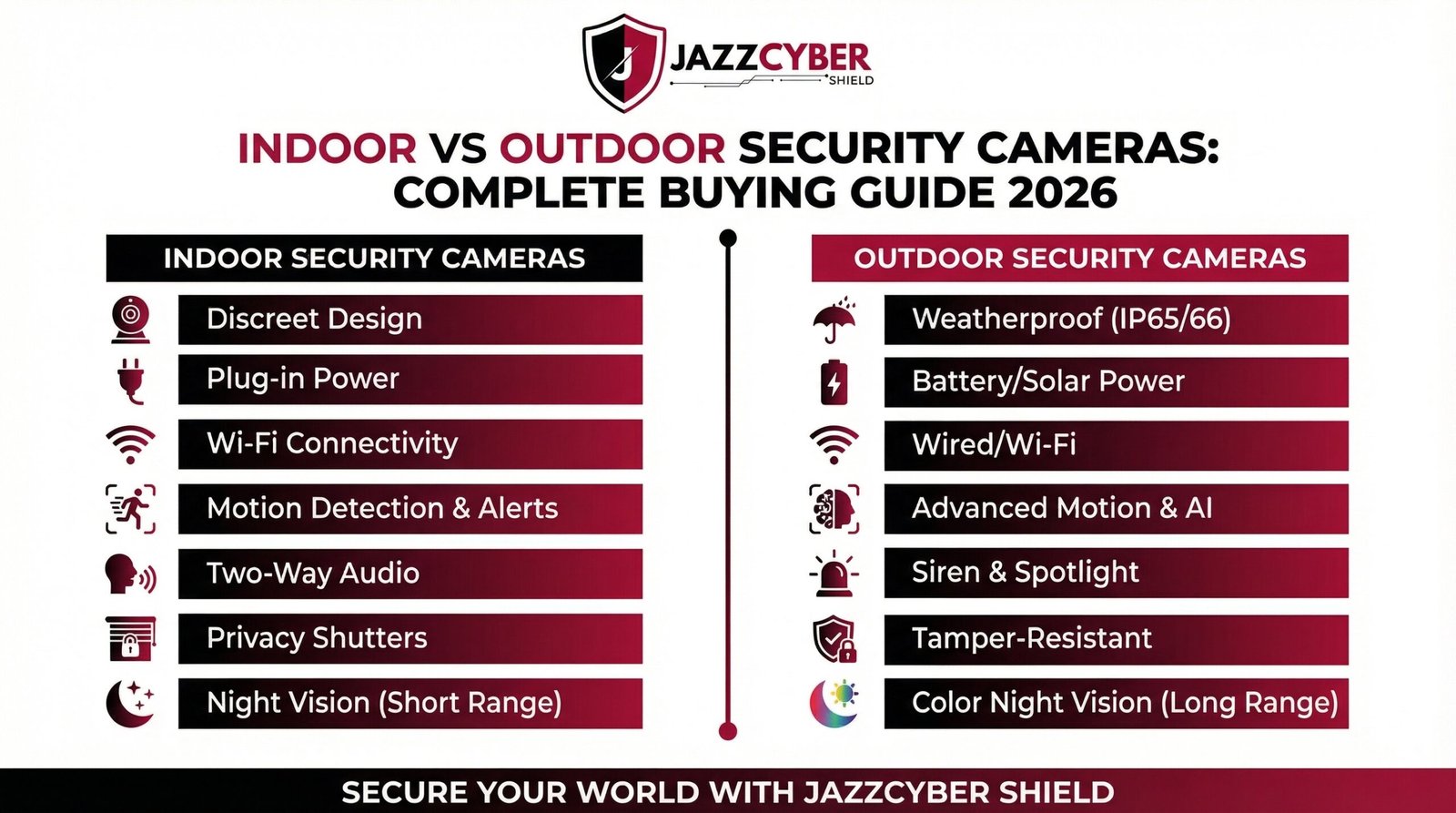
Choosing between indoor vs outdoor security cameras is one of the most critical decisions you will make for your home or business security in 2026. Buy the wrong type and you risk leaving dangerous blind spots, wasting money on cameras that fail in harsh weather, or investing in overkill hardware for a simple indoor space. This complete buying guide breaks down every key difference, use case, feature, and real-world consideration — so you make the right call the first time.
Whether you are securing a retail store, a warehouse, a home entrance, or a server room, the right security cameras can mean the difference between preventing a threat and just recording one.
1. What Are Indoor Security Cameras?
Indoor security cameras are designed specifically for controlled, covered environments. They monitor interior spaces such as living rooms, offices, server rooms, retail aisles, and hallways. These cameras are typically compact, aesthetically discreet, and optimized for stable lighting conditions.
Key characteristics of indoor cameras include:
- Lower IP rating (not weatherproof)
- Smaller, compact form factor — dome and fisheye styles dominate
- Lower operating temperature range
- No need for protective housing
- Often less expensive than outdoor equivalents
Because indoor spaces usually have controlled lighting and temperature, indoor cameras can focus their budget on resolution and wide-angle coverage rather than weatherproofing and vandal resistance.
2. What Are Outdoor Security Cameras?
Outdoor security cameras are purpose-built to withstand the elements. Rain, dust, UV exposure, extreme cold, and even deliberate vandalism are all threats an outdoor camera must survive. They are typically installed at entry points, parking lots, perimeters, driveways, loading docks, and building facades.
Key characteristics of outdoor cameras include:
- IP65 or IP67 rating (dust-tight and water-resistant/waterproof)
- IK10 vandal resistance rating for high-risk areas
- Infrared (IR) or full-color night vision for 24/7 surveillance
- Wider operating temperature range (typically -40°C to +60°C)
- Bullet, turret, or PTZ (Pan-Tilt-Zoom) form factors for directional monitoring
The extra durability comes at a higher price. However, for perimeter security, that investment is non-negotiable.
3. Indoor vs Outdoor Security Cameras: Core Differences
This is the heart of the indoor vs outdoor security cameras debate. The table below summarizes the critical differences every buyer must understand:
| Feature | Indoor Camera | Outdoor Camera |
|---|---|---|
| Weatherproofing (IP Rating) | IP20–IP44 | IP65–IP67+ |
| Vandal Resistance | Standard (IK07) | High (IK09–IK10) |
| Night Vision | Standard IR | Long-range IR / Color Night Vision |
| Operating Temperature | 0°C to +40°C | -40°C to +60°C |
| Form Factor | Dome, fisheye, cube | Bullet, turret, PTZ |
| Price Range | $50–$300 | $100–$1,000+ |
| Power Source | PoE, USB, AC | PoE, solar, AC |
| Typical Coverage | 10–30 ft | 30–150+ ft |
💡 Pro Tip: For businesses running PoE-based camera systems, pairing your cameras with a reliable PoE network switch ensures clean, centralized power delivery and reduces cable clutter dramatically.
4. Key Features to Compare Before Buying
4.1 IP Rating (Ingress Protection)
The IP rating is the single most important spec when deciding between indoor vs outdoor security cameras. It tells you how well a camera resists dust and water.
- IP44: Splash-resistant — fine for covered porches or dry indoor areas
- IP65: Dust-tight, protected against water jets — ideal for most outdoor use
- IP67: Dust-tight, survives temporary submersion — best for extreme environments
Always choose at least IP65 for any outdoor installation.
4.2 Resolution: 2MP vs 4MP vs 8MP (4K)
In 2026, 4MP (2.8K) has become the new baseline for serious surveillance. Here is what each resolution delivers:
- 2MP (1080p): Suitable for small indoor spaces, reception areas, offices
- 4MP (1440p): Excellent balance of detail and storage efficiency
- 8MP (4K): Required for wide outdoor areas, parking lots, or facial recognition
The Hikvision DS-2CD2143G0-I is a strong example of a 4MP outdoor dome camera that delivers crystal-clear footage while staying within a reasonable budget — currently available at Jazz Cyber Shield for $120.
4.3 Night Vision Technology
Outdoor environments are dark. Without effective night vision, your outdoor camera is essentially blind after sunset.
- Standard IR (Infrared): Produces black-and-white footage at night; most common
- Color Night Vision: Uses starlight sensors or supplemental white light to capture color footage at night
- IR Range: Look for at least 30 meters for driveways and at least 50+ meters for open lots
The AXIS P3374-V offers advanced low-light performance using Axis Lightfinder technology, making it a top-tier choice for environments with inconsistent lighting.
4.4 Field of View (FOV)
- Wide-angle (100°–180°): Best for indoor rooms and corridors
- Standard (60°–100°): Best for entrances and focused outdoor zones
- Narrow/Telephoto (<60°): Best for long-distance outdoor monitoring (parking lots, perimeters)
4.5 PoE vs Wireless
Power over Ethernet (PoE) cameras are far more reliable than Wi-Fi cameras for professional installations. They deliver both power and data over a single cable, eliminating latency, interference, and battery concerns. If you are planning a multi-camera PoE deployment, make sure your network infrastructure is properly designed — and consider reading our guide on how to set up a completely secure home network before installation.
5. Best Use Cases for Indoor Cameras
Indoor security cameras excel in the following environments:
- Home living rooms and bedrooms (baby monitors, nanny cams, senior care)
- Retail store interiors (POS zones, merchandise aisles, stockrooms)
- Server rooms and data centers (temperature, access, and activity monitoring)
- Office spaces (entrances, conference rooms, shared workspaces)
- School classrooms and hallways
A compact, wide-angle dome camera like the AXIS M3065-V 2MP Compact Dome Camera is ideal for discreet indoor deployment. Its wall/ceiling-mount versatility and day/night functionality make it well-suited for offices, retail, and educational facilities — available now at $229.
6. Best Use Cases for Outdoor Cameras
Outdoor security cameras are essential for:
- Building perimeters and fences
- Parking lots and garages
- Driveways, gates, and entrance barriers
- Loading docks and warehouse exteriors
- ATMs and utility meters
- Construction sites and open yards
For large outdoor coverage, PTZ cameras with pan, tilt, and optical zoom capabilities provide real-time situational awareness that fixed cameras simply cannot match.
7. Can You Use an Outdoor Camera Indoors (Or Vice Versa)?
Yes, you can use outdoor cameras indoors — and in many cases it is a smart move. An outdoor-rated camera installed indoors provides extra vandal resistance (ideal for prisons, schools, or public washrooms) and is simply overbuilt for most home environments.
However, you should NEVER use an indoor camera outdoors. Without proper IP and IK ratings, an indoor camera will suffer from:
- Condensation and water ingress destroying internal electronics
- UV damage to the lens and housing over time
- Failure in extreme cold or heat
- Tampering with no resistance
This is a mistake that leads to complete camera failure within weeks. Always match the camera to its environment.
8. Top Brands: Axis Communications vs Hikvision
Both brands are industry leaders stocked at Jazz Cyber Shield’s security camera store. Here is how they compare:
Axis Communications
Axis security cameras are the gold standard for enterprise and government-grade surveillance. Manufactured in Sweden with a focus on cybersecurity-first design, Axis cameras offer:
- End-to-end encryption and signed firmware
- Exceptional low-light performance (Lightfinder & Forensic WDR)
- Deep integration with VMS platforms like AXIS Camera Station
- GDPR compliance features built in
- Best for: Corporate offices, hospitals, government buildings, critical infrastructure
Hikvision
Hikvision security cameras deliver outstanding performance at highly competitive price points, making them one of the most widely deployed brands globally. Key strengths include:
- Wide product range from 2MP to 4K
- AcuSense AI-powered motion detection (filters humans from animals/vehicles)
- ColorVu technology for full-color night vision
- Deep Learning NVR compatibility
- Best for: Retail businesses, residential properties, small-to-medium businesses
⚠️ Important Note for US Buyers: As of 2024, Hikvision cameras face federal restrictions for government use in the United States. Always consult local compliance regulations for your specific deployment environment.
9. Storage: How Much Do You Need for Your Camera System?
Security cameras are only as useful as the footage they retain. Without reliable storage, your investment in cameras is partially wasted. For continuous 24/7 recording across multiple cameras, you will need:
- 4 cameras at 1080p: Approximately 500GB–1TB per month
- 8 cameras at 4MP: Approximately 2TB–4TB per month
- 16 cameras at 4K: Approximately 6TB–10TB per month
Jazz Cyber Shield carries a complete range of storage solutions including Seagate and Western Digital surveillance-grade HDDs specifically optimized for write-intensive, 24/7 camera recording workloads.
10. Recent Trends in Security Cameras in 2026
The security camera market in 2026 is being reshaped by several major developments:
10.1 AI-Powered Perimeter Detection
Cameras in 2026 are no longer passive recorders. Edge-AI processing enables real-time threat classification — distinguishing between a human intruder, a vehicle, a stray animal, or false alarms caused by moving shadows. This dramatically reduces alert fatigue for security teams.
10.2 Cybersecurity as a Camera Feature
With millions of IP cameras connected to the internet, camera hacking has become a serious threat. Learn more about this risk in our detailed guide: How Hackers Break Into Security Cameras (And How to Protect Yours). In 2026, buyers should prioritize cameras with:
- Signed firmware updates
- TLS 1.3 encrypted video streams
- IEEE 802.1X network authentication
- Automatic password enforcement on first use
10.3 Solar-Powered Outdoor Cameras
Wireless solar cameras have become viable for remote outdoor locations in 2026, eliminating the need for cable runs. Modern solar cameras now offer 4MP resolution, local SD card storage, and LTE connectivity — ideal for farms, construction sites, and remote properties.
10.4 Integration with Smart Home and Building Systems
Modern outdoor cameras integrate with access control systems, smart locks, alarm panels, and cloud platforms. This convergence between physical security and cybersecurity has been a defining trend across the industry. If you are managing a networked camera system and concerned about its exposure, also check our article on how hackers access security cameras and how to stop them.
11. Final Buying Checklist: Indoor vs Outdoor Security Cameras
Before purchasing, run through this checklist:
For Indoor Cameras:
- Do I need a discreet or visible deterrent?
- What is the room size and required FOV?
- Is PoE available, or do I need Wi-Fi/USB power?
- Do I need audio recording (two-way audio)?
- What is my VMS or NVR compatibility?
For Outdoor Cameras:
- Is the IP rating at least IP65?
- Does the camera have IK10 vandal resistance (high-risk areas)?
- What is the required night vision range?
- Do I need color night vision or standard IR?
- Is the operating temperature range suitable for my climate?
- Do I have adequate storage capacity (see Section 9)?
- Is my network infrastructure PoE-ready?
Browse the full selection of professional security cameras at Jazz Cyber Shield to find the right model for your exact environment.
FAQ: Indoor vs Outdoor Security Cameras
Q1: What is the main difference between indoor and outdoor security cameras?
The primary difference is weatherproofing. Outdoor cameras carry IP65 or higher ratings, making them dust-tight and water-resistant. They also feature wider operating temperature ranges, vandal-resistant housings (IK10), and long-range night vision. Indoor cameras skip these protections to focus on resolution, aesthetics, and cost efficiency.
Q2: Can I install an outdoor camera inside my house?
Yes, absolutely. An outdoor-rated camera installed indoors poses no problems and actually delivers extra durability. This is a common strategy in high-traffic, vandal-prone indoor environments such as school hallways, public restrooms, warehouses, and correctional facilities.
Q3: What IP rating do I need for outdoor security cameras?
For standard outdoor use — including rain exposure — you need a minimum of IP65. For cameras that may be hosed down during cleaning or installed near water features, IP67 is recommended. IP66 is also acceptable for heavy rain environments.
Q4: Do outdoor cameras work in extreme cold?
Quality outdoor cameras from brands like Axis and Hikvision are rated to operate in temperatures as low as -40°C (-40°F). Always verify the operating temperature specification before installing in regions with harsh winters.
Q5: What resolution should I choose for outdoor cameras in 2026?
For most outdoor applications in 2026, 4MP (1440p) is the recommended baseline. It provides enough detail to identify faces and license plates without generating the massive storage demands of 4K. For very wide outdoor areas or facial recognition requirements, 8MP (4K) is the better choice.
Q6: Are wireless outdoor cameras reliable?
Wi-Fi outdoor cameras are convenient but carry risks including signal interference, network dependency, and potential hacking. For professional and business-grade outdoor surveillance, wired PoE cameras are always preferable. They offer consistent bandwidth, zero wireless interference, and superior cybersecurity posture.
Q7: Which is better for business — Axis or Hikvision?
Both are excellent depending on your budget and security posture. Axis Communications is the preferred choice for high-security, compliance-sensitive, or government environments due to its cybersecurity-first design philosophy. Hikvision delivers exceptional value for retail, residential, and SMB deployments. Jazz Cyber Shield stocks both — browse Axis cameras and Hikvision cameras to compare models side by side.
Q8: How many cameras do I need for a typical home?
A standard home security setup typically requires:
2–4 outdoor cameras covering front door, back door, driveway, and side gates
1–2 indoor cameras for main living areas (optional, for interior monitoring)
For small businesses, 4–16 cameras depending on layout and risk profile is typical. Consult the Jazz Cyber Shield team for a customized camera recommendation based on your floorplan and security goals.
Q9: What storage format is best for security cameras?
For most systems, NVR (Network Video Recorder) with dedicated surveillance HDDs is the most reliable storage format. A surveillance-grade HDD from Seagate or Western Digital is specifically engineered for 24/7 write cycles and multi-stream recording — critical for camera system longevity. Browse storage solutions for security systems at Jazz Cyber Shield.
Q10: How do I prevent my security cameras from being hacked?
Key best practices in 2026 include: change default passwords immediately, enable firmware auto-updates, use encrypted video streams (HTTPS/TLS), isolate cameras on a dedicated VLAN, and purchase from reputable brands with active cybersecurity programs. For a deep dive into this topic, read our full guide: How Hackers Break Into Security Cameras (And How to Protect Yours).
Conclusion
The choice between indoor vs outdoor security cameras ultimately comes down to environment, purpose, and budget. Indoor cameras prioritize resolution and aesthetics in controlled spaces. Outdoor cameras prioritize durability, night vision, and long-range detection in unpredictable environments. In many complete security systems, you will need both — working together as a layered defense strategy.
For the best selection of enterprise-grade indoor and outdoor cameras from Axis Communications and Hikvision, visit the Jazz Cyber Shield Security Camera Store — with competitive pricing, expert support, and fast shipping across the United States.

