



OpenAI has just introduced ChatGPT Health, which is a big leap forward in the area of AI healthcare. The users of the feature can now directly associate medical records and wellness data with ChatGPT. Consequently, more personalized health insights are provided to users than ever before. In addition, millions of individuals rely on ChatGPT for health-related queries, thus making this update very relevant and timely. Consequently, we can expect that ChatGPT Health would really change the way health is understood and people take control of it.
In parallel with all that, the digital healthcare industry keeps on making progress at a rapid pace. As a direct consequence, AI medical assistants tools are becoming necessary. ChatGPT Health combines three aspects, artificial intelligence, medical data analysis, and user-friendly design, into one secure platform. So, it means the healthcare information will be able to be understood better, will be faster to access, and also will be more available.
What Is ChatGPT Health by OpenAI
ChatGPT Health is an exceptional healthcare experience inside ChatGPT dedicated only to healthcare matters. The chat in this particular area is markedly different from the regular one, as it covers only health-related subjects. Furthermore, it is also safe and secure as conversations and files are kept in a protected area. Consequently, people can have more private health issues discussions.
The patients are allowed to submit their medical records which consists of lab reports, test results, and clinical summaries. Besides, there is also an option for users to link their wellness applications that track fitness, sleep, diet, and activity. Connecting all the data together, ChatGPT Health gives a full picture of individual medical records. Hence, the AI can give more plausible interpretations and insights.
How Connecting Medical Records Works
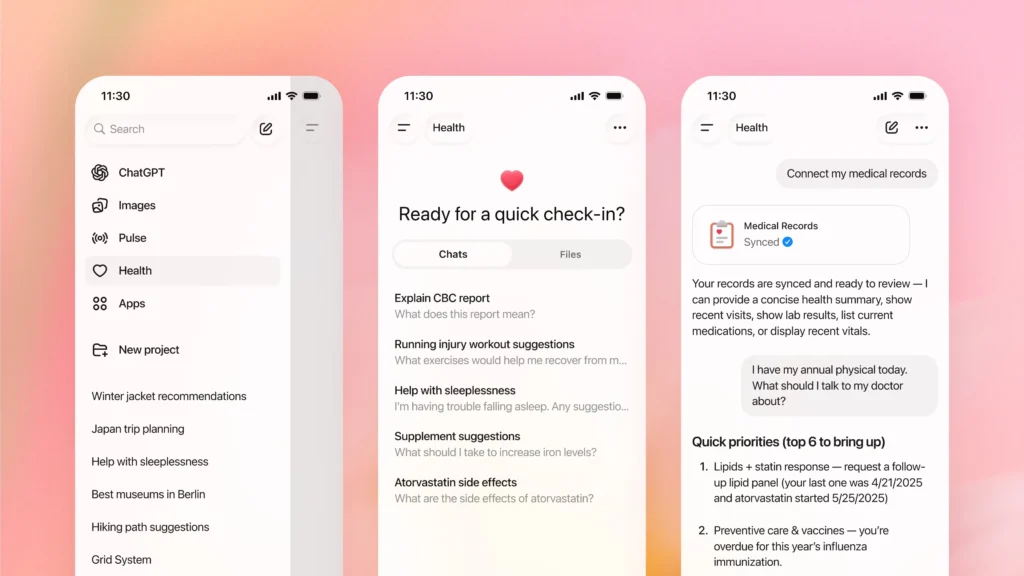
To connect medical records to ChatGPT Health it is both simple and secure. To begin with, the patients choose the information they want to either upload or sync. After this, the system organizes the information in a very reader-friendly manner. Then ChatGPT looks at the data and finds patterns and trends.
ChatGPT Health processes the data with AI technology that is very advanced, hence, it can translate medical jargon to layman’s terms. Besides, it can quickly give a summary of a long report, etc. Thus, time is saved by the users and the confusion is lessened. Most importantly, the AI is giving replies in a supportive and easy to understand tone.
Personalized Health Insights with AI
A main advantage of ChatGPT Health is the personalized healthcare insights. Rather than the generic replies, the AI is taking real medical data. So, the responses feel more relevant and significant. For instance, the users can inquire about lab values changes over the months. Then, ChatGPT gives the interpretation of such changes.
Additionally, ChatGPT Health keeps the users updated and aware of the health risks and trends. The AI does so by comparing the past with the present data and marking the patterns distinctly. Thus, the users feel more informed and sure of themselves. This degree of personalization is what differentiates AI-powered healthcare tools to a large extent.
Improved Doctor Visits and Health Planning
ChatGPT Health is of great assistance to users in their preparation for doctor visits. Users can virtually go through their medical history with the AI at the doctor appointment. On top of that, ChatGPT can recommend to the users some of the best questions to ask, depending on the last test results. Thus, the visits become more fruitful.
Moreover, the AI facilitates users’ decision-making and care planning. Users have the flexibility of discussing their treatment options, making lifestyle changes, and taking up follow-up steps. Consequently, patients become more participative in the health care process. This change reinforces the increasing trend of tech-savvy digital health centered around patients.
Integration of Wellness Data and Support for Lifestyle
Moreover, besides the medical records, AI ChatGPT Health liaises with wellness and fitness apps. These apps monitor the user’s exercise, sleep, nutrition, and daily activity. The AI’s insights become richer when it has medical data and wellness data combined. Thus, users are able to get a well-rounded kind of support that promotes their long-term wellness.
To illustrate, the AI can tell a user how not getting enough sleep affects his/her energy levels. Also, it can suggest a link between poor diet habits and lab results. This integration makes it possible for users to opt for lifestyle changes that are wiser. As a result, Artificial Intelligence (AI) becomes a daily health partner rather than just a doctor’s reference.
Privacy, Security, and User Control
Among various concerns in AI healthcare platforms, the most prominent issue is still Privacy. ChatGPT Health has been developed by OpenAI with a high level of security. The health data is stored separately and is still very safe. Moreover, the system provides high-level encryption for preventing any unauthorized access.
The users still have complete power over their information. Deleting history and unlinking apps are some of the actions that users can perform at their discretion. On top of that, OpenAI never includes health information in the training datasets for its universal AI models. These precautions create an environment where users can easily share their sensitive information with ChatGPT Health as the latter is considered trustworthy.
Limitations and Responsible AI Use
Although ChatGPT Health has so many advantages, it is still not a substitute for a doctor or a healthcare practitioner. It will neither give a diagnosis nor offer a treatment. Rather, it will be assisting via its support in the process of understanding and educating. Thus, users should always refer to certified healthcare professionals for health-related decisions.
AI tools may err or not comprehend the situation. Hence, the users should not take the AI insights as the final answer but the advice. However, ChatGPT Health is a huge help in the area of health literacy and awareness. Thus, the communication between patients and doctors is improved and the patients are able to make well-informed choices.
The Importance of ChatGPT Health for the Future
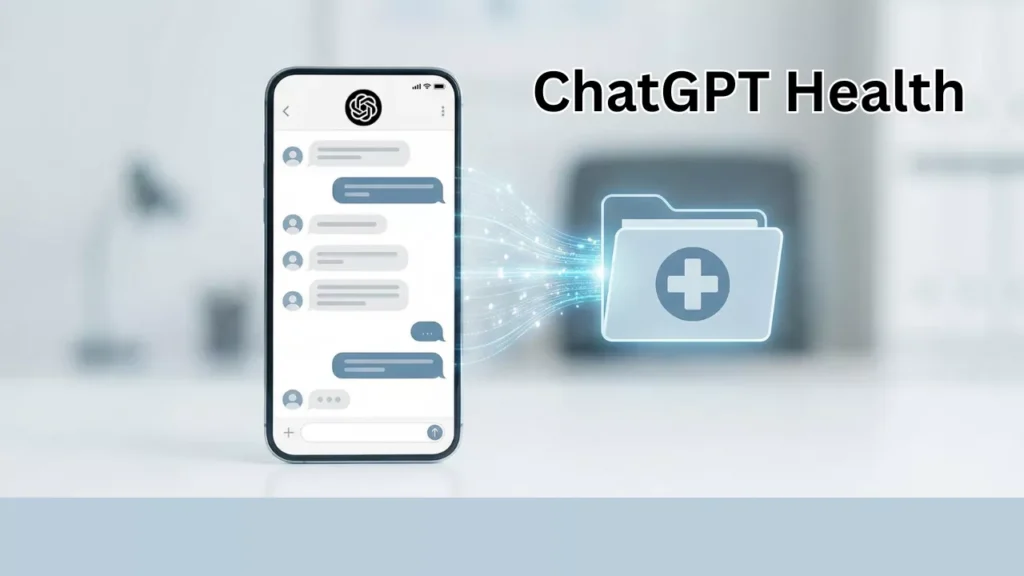
The development of ChatGPT Health is an example of the shift in the healthcare sector brought about by the AI-driven healthcare transformation. The use of artificial intelligence is no longer limited to hospitals but has now extended to patients directly. Thus, the general public now has access to health information that was previously restricted to medical professionals. People are now able to take charge of their health through this transition.
In addition, when medical records, wellness data, and AI are combined, it leads to the development of more intelligent health systems. These systems slash miscommunication and increase participation. Hence, ChatGPT Health has been a digital health platform and AI medical assistant that is quintessential to the future.
Conclusion: A Smarter Way to Understand Health
OpenAI’s ChatGPT Health has come up with a new model for interacting with one’s health data. Through the user’s linking of medical history, it provides individual, clear, and practical insights. Additionally, robust privacy measures are in place to keep confidential data safe.
By no means does it supplant doctors, yet ChatGPT Health fosters understanding and readiness. Thus, it enables users to be more assertive and educated. The advancements in AI healthcare have not only made it easier, yet ChatGPT Health has still emerged as a big leap toward smarter healthcare that is more interconnected.


With the rise of AI in healthcare, the potential for personalized insights is huge. But I’d love to hear more about how the system handles the complexities of medical history and varying diagnoses over time. Does it adjust to changes in health patterns?